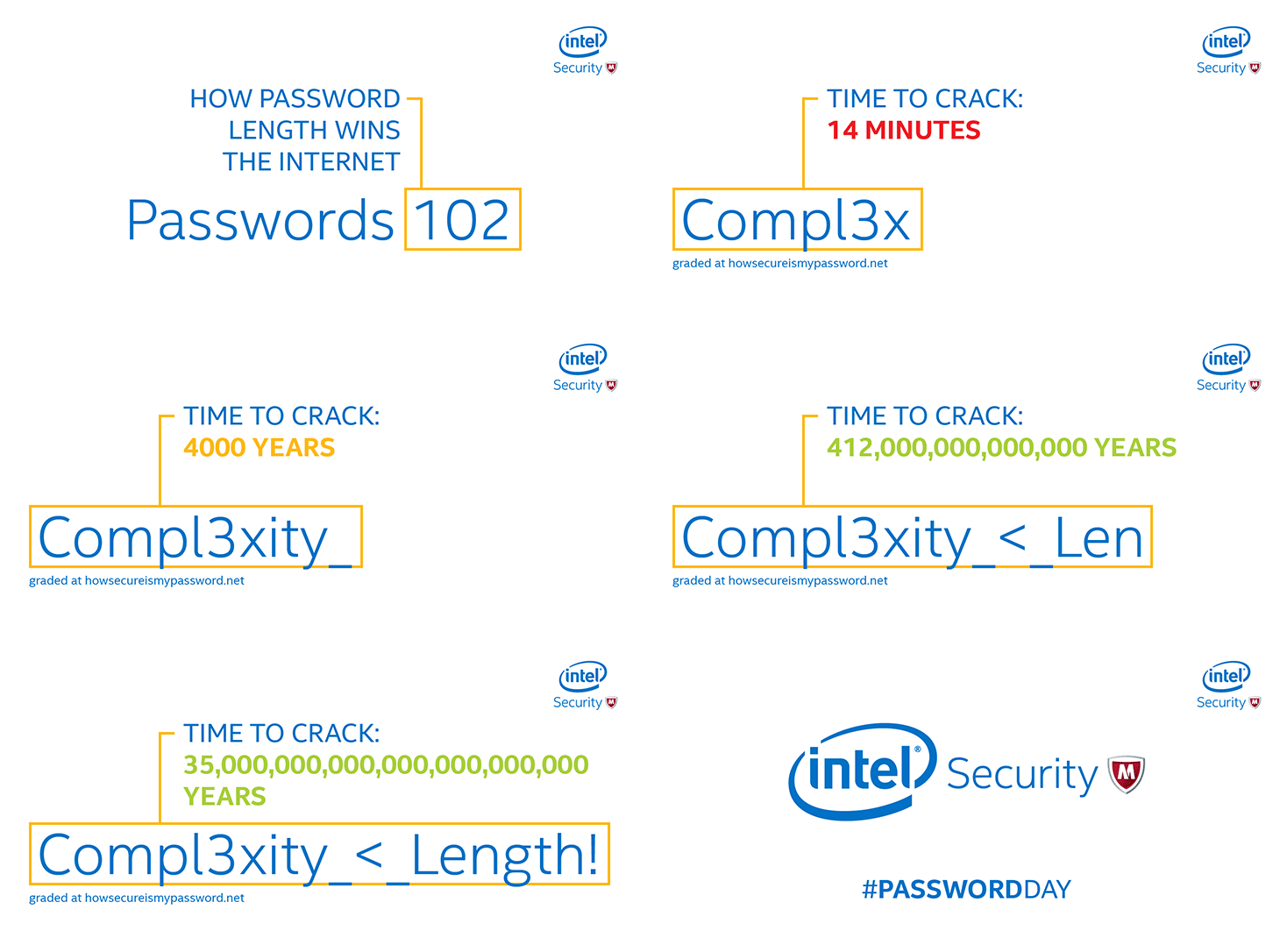
Only if an attacker is dumb enough to attempt to brute force a password.

Any decent cracking tool appends/prepends common words, like Password (and
combinations thereof), numbers, usernames etc.
https://www.schneier.com/blog/archives/2007/01/choosing_secure.html
http://arstechnica.com/security/2012/08/passwords-under-assault/
http://blog.erratasec.com/2012/06/linkedin-vs-password-cracking.html#.U-lV502KCUk
etc.
I'm sure there's been a few articles posted to this list that have shown how
same hackers attack an offline db. Pass phrases, by themselves, wouldn't be
much more secure than randomly generated passwords (charaters vs. words), and
by examining things like the RockWiz dump, and all subsequently cracked DBs (PS
network etc.), attackers don't need to try and guess what dictionary words to
use.

Cheers
Ken

From: [email protected] [mailto:[email protected]] On
Behalf Of James Button
Sent: Tuesday, 12 August 2014 12:34 AM
To: [email protected]
Subject: RE: [NTSysADM] Re: Something to share with your users, so they can see
how passwords matter

Agreed, it adds massively to the decoding workload just to add your name
before, or after what you consider the actual password
Or even just add the text prefix "Password" which takes a 4 digit pin to a 12
character entry with caps, lowercase, and numerics

JimB

From: [email protected]<mailto:[email protected]>
[mailto:[email protected]] On Behalf Of Melvin Backus
Sent: Monday, August 11, 2014 1:56 PM
To: '[email protected]'
Subject: RE: [NTSysADM] Re: Something to share with your users, so they can see
how passwords matter

And in any password strength calculator I've ever used, that would be a good
password.  I just don't understand why people are so resistant to longer
passwords.  If you can type more than 30 wpm it really doesn't make any
appreciable difference in the time it takes you to do anything.

--
There are 10 kinds of people in the world...
         those who understand binary and those who don't.

From: [email protected]<mailto:[email protected]>
[mailto:[email protected]] On Behalf Of Micheal Espinola Jr
Sent: Friday, August 08, 2014 11:10 PM
To: ntsysadm
Subject: Re: [NTSysADM] Re: Something to share with your users, so they can see
how passwords matter

Hmm.  Not bad...

Brute Force Search Space Analysis:
Search Space Depth (Alphabet):

26+26+33 = 85

Search Space Length (Characters):

31 characters

Exact Search Space Size (Count):
(count of all possible passwords
with this alphabet size and up
to this password's length)

656,336,
167,528,024,399,498,994,
877,218,488,129,122,193,
814,033,553,713,843,935

Search Space Size (as a power of 10):

6.56 x 1059

Time Required to Exhaustively Search this Password's Space:
Online Attack Scenario:
(Assuming one thousand guesses per second)

2.09 hundred billion trillion trillion trillion centuries

Offline Fast Attack Scenario:
(Assuming one hundred billion guesses per second)

2.09 thousand trillion trillion trillion centuries

Massive Cracking Array Scenario:
(Assuming one hundred trillion guesses per second)

2.09 trillion trillion trillion centuries

Note that typical attacks will be online password guessing
limited to, at most, a few hundred guesses per second.


... the password was "Steve Gibson can suck mah balls".

--
Espi


On Fri, Aug 8, 2014 at 5:21 PM, Angus Scott-Fleming
<[email protected]<mailto:[email protected]>> wrote:
I know some people here don't like GRC, but:

Password Haystacks: How Well Hidden is Your Needle?
https://www.grc.com/haystack.htm

On 7 Aug 2014 at 14:29, Micheal Espinola Jr wrote:

>
> http://i.imgur.com/XuMUU0b.gif
>
> I saw it on reddit - I dont have a source for it. Seems to be from Intel, but
> cant match the image
> to any websites.
> --
> Espi