Hi Dan,
In general, I would agree that the top navigation bar in the client
should remain fixed. I can't speak to other page elements that we might
also want to see fixed.
I think the patron editor work raised some concerns here about the need
to scroll back up to access the menu, but I hadn't raised it in the
previous thread because, as you noted in your email, it really is
something that will impact multiple areas of the client.
In fact, I was just talking to somebody about this topic this very
afternoon and was going to poke at the code at some time - if you don't
beat me to it :) - to see how it might look.
A +1 from me.

Kathy


On 07/10/2015 03:14 PM, Dan Wells wrote:
Hello all,
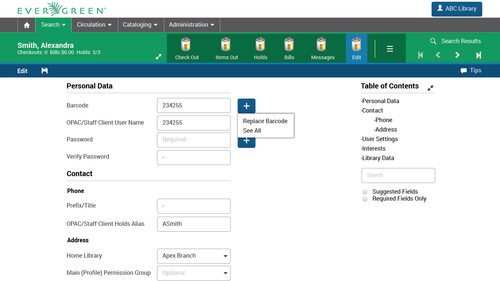
This came up in Kathy’s recent thread asking about the patron editor,
and rather than hijack that thread, I’d like to broaden the
conversation a little, because the same usability issues will affect
many areas of the staff client.
To cut straight to the point, I strongly believe that using fixed
position for large portions of the staff client interface will have a
major positive effect on usability. This has been applied and proven
in desktop applications for decades, and is now being rediscovered
within the browser environment as web “pages” become applications.
There is plenty of evidence out there to support this stance, but here
is a quick read which highlights the point well:
http://www.smashingmagazine.com/2012/09/11/sticky-menus-are-quicker-to-navigate/
If we consider the mockups from our design internship a few months
back, in the screenshot Kathy referenced, the entire top area (and, in
this case, the right sidebar) would ideally be fixed position. The
only scrolling area should be the actual form. For any who attended
my talk on design at the conference, this is exactly the concern of
rule of thumb #3: “Scroll the data, not the interface”, with “data”
broadly including all information and workspaces which are not “the
program”. (Here is Kathy’s screenshot link again for reference:
http://media.tumblr.com/69beec7802a938b889bdfa80c7e0d54b/tumblr_inline_nkn0okinXl1t572gy.png
)
The main complaint driven at fixed screen elements is that they take
up too much space. They do take up space, obviously, but with the
amount of use these elements get on a moment by moment basis, the
space is well worth taking. In cases where more workspace is truly of
benefit, we are better off using fixed position with a “hide” option
(auto or manual) than we would be with using scroll, as we can retain
the clear benefits of persistent availability and predictability.
(Expert users might also choose to do without some toolbars and rely
on keyboard shortcuts, but that sort of use will never be feasible for
many staff client users and scenarios.)
As the Smashing Magazine article points out, the easiest way to
understand the situation is to simply imagine other software working
with fully-scrolling interfaces. In this imaginary scenario, when you
are using a word processor, a spreadsheet application, or even a
browser itself, all of your menus, toolbars, tabs, etc., would simply
scroll off the screen as soon as you tried to scroll down to see
additional content. It’s likely that some ancient desktop software
did exactly that, but if they did, they are now extinct, and not
without good reason.
Another valid concern sometimes raised is the effect a rich, fixed
interface might have on a small screen appliance, like a phone. This
topic should be addressed, but I believe it is best kept separate from
the problems at hand, which are already large enough. My personal
stance would be that a full, first-class staff client interface on a
small screen device is not a realistic concern for a community of our
size, needs, and capabilities. Our bar for using the full client on
phones should be “not impossible”, and then we can re-dedicate a
portion of our energy to creating limited, purpose-built interfaces
for functions of known value on small devices (e.g. inventory
scanning), and which are also likely to best include some fixed top
and/or bottom elements.
I also want to emphasize that none if this is meant to disparage the
work which has been done so far. It is much harder to make something
out of nothing than to take something and make it better. I also
acknowledge that, while I have spent large amounts of time studying
the web client, I have found zero time to contribute to the actual web
client code. That said, if we can help establish consensus around
where we want to end up, I know I would feel more comfortable jumping
in, and I suspect others might as well.
Sincerely,

Dan

Daniel Wells

Library Programmer/Analyst

Hekman Library, Calvin College

616.526.7133
--
Kathy Lussier
Project Coordinator
Massachusetts Library Network Cooperative
(508) 343-0128
[email protected]
Twitter: http://www.twitter.com/kmlussier