-----BEGIN PGP SIGNED MESSAGE-----
Hash: SHA1

Somebody in the thread at some point said:
| Andy Green wrote:
|> How did you determine that it is "undriven"?  It's pulled up somewhere,
|> right?  What does the rise and fall times look like?
|
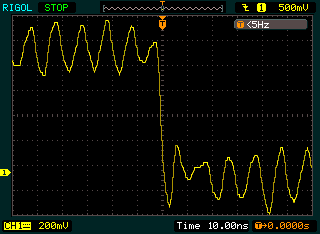
| Here's a transition from apparently undriven (~1V) to low:
| http://people.openmoko.org/werner/dat1-falling.png
1V sounds evil, I don't think we should ever see that static level on
3.3V SDIO interface.  We have 10K pullup on D1... R7906, so "undriven"
means it has pulldown of ~8K to 0V to reach 1V?  Truly undriven would
surely mean it was 3.3V via the pullup.  Maybe try to reduce the pullup.

| By the way, do you know what rise/fall time is actually allowed ?
| Whenever it comes to this kind of interesting detauls, the SDIO
| spec only cheerfully proclaims "This section is not included in
| the Simplified Specification." :-(

No, the reason I asked was because I wondered if too high a pullup
resistance was allowing the interrupt to look asserted at the start of
its slot depending on the data level when it stopped driving, it would
need to be > 1us to make trouble I guess.

- -Andy
-----BEGIN PGP SIGNATURE-----
Version: GnuPG v1.4.9 (GNU/Linux)
Comment: Using GnuPG with Fedora - http://enigmail.mozdev.org

iEYEARECAAYFAkkgeO4ACgkQOjLpvpq7dMrADwCfYLhfSmkEQbfkTJYteVG2zDUg
uoQAn188TfyNNBj73XXBMIQneBLJB8Bd
=9t6O
-----END PGP SIGNATURE-----