http://politicalmavens.com/index.php/author/phareswire/
Iran's Global Terrorist Reach
By  <http://politicalmavens.com/index.php/author/phareswire/> Walid Phares


Summary: Dr Walid Phares journal article "Iran's Global Terrorist Reach" was
published in the summer 2010 edition of InFocus Periodical. The article
shows the geopolitical expansion of the Iranian regime as well as its
terrorist and strategic reach around the world. Iran has developed weapons,
created terror networks and established a system of alliances, challenging
and threatening the region and the international community.

The United States became painfully aware of the threat posed by global
jihadism after the terror attacks of September 11, 2001. Until that day,
Iranian-backed terrorist networks, such as Hezbollah, were responsible for
killing more American citizens than al-Qaeda. In the years since, the
balance has been gradually tilting back towards Iran. In the words of former
U.S. Deputy Secretary of State Richard Armitage, al-Qaeda may be the 'B'
team of international terrorism, but Hezbollah is the 'A' team. Indeed,
Iran's Khomeinists began their war on the U.S. and other democracies years
before Osama bin Laden began his jihad.

The takeover of Iran's government in 1979 by radical Islamist forces
faithful to Ayatollah Ruhollah Khomeini was the breakthrough after which the
so-called Islamic Revolution spread throughout the Middle East and beyond.
The Khomeinist revolution is ideologically rooted in a radical Islamist
doctrine that stands in opposition to the more traditional "Quietist" school
of thought among Shia clerics. In a sense, the Khomeinists are the Shia
world's equivalent of the Salafists within the Sunni world. The Islamist
Shias are also jihadists, in the sense that they call for the establishment
of a future Imamate, a Shia form of Islamic Caliphate, by any means
necessarily, including what they coin as "Jihad," which practically means
war.

Because it cannot project much conventional military power, Iran threatens
the United States, Israel and other democracies by unconventional means.
Through the use of its terrorist surrogates-such as Hezbollah-Tehran's reach
extends around the world.

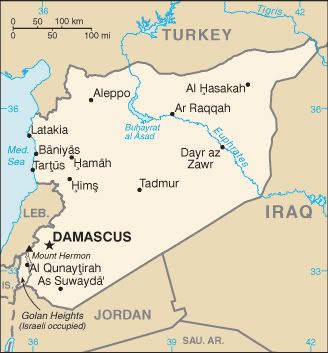
http://i141.photobucket.com/albums/r73/salem21_2006/syria_map.jpg
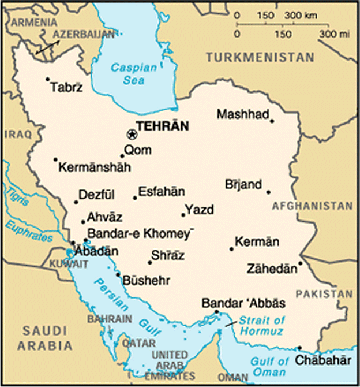
http://biglizards.net/Graphics/ForegroundPix/IranMapSized.gif

"Syrian-Iranian Axis"


Hezbollah


The formation of the Iranian-Syrian alliance in 1980 allowed Tehran to
penetrate Lebanon's Shi'ite communities and build a militia that enabled it
to extend its influence to the Mediterranean. Through Hezbollah, Iran
controls the resources of a large religious community in Lebanon and has
established itself as a dominant force inside the country. Iran is therefore
able to develop networks overseas more easily and engage Israel in direct
confrontation from across the border. Furthermore, the alliance has granted
greater access to U.S., European, and other interests on behalf of the
Khomeinist regime.

http://notesfromamedinah.files.wordpress.com/2010/01/hezbollah-salute.jpg
http://worlddefensereview.com/images/hezbollah.jpg

Hezbollah controls Lebanon

Hezbollah was an Iranian project designed to export its revolution globally
and it fast became the single most dangerous terrorist network. Since the
1979 revolution, the ayatollahs have invited radical Shia clerics from
Lebanon to Iran for theological training. They also recruited militants,
including Imad Mughniyeh, who became the central figure in the terror nexus
for decades. The Iranian Revolutionary Guard Corps (Pasdaran) established
its first bases in the northern Bekaa valley in 1980. From there, it
connected with "Islamic Amal," an offshoot of the Amal Movement, and with
radical religious scholars who studied at the holy cities of Qom in Iran and
Najaf in Iraq.

Hezbollah was born in a gradual process under the auspices of the Pasdaran
and launched from the Bekaa towards South Lebanon and Beirut's southern
suburbs. It took part in limited clashes against Lebanon's Christian enclave
in early 1982, and as the Israeli invasion destroyed the Palestinian
Liberation Organization (PLO) infrastructure in the South in June, Iran sent
Hezbollah into the fray. Its first strikes were directed at the U.S. embassy
and Marines, and French troops. Throughout the 1980s, Hezbollah took U.S.
and European hostages and engaged in operations against Israeli forces and
their local allies in the South Lebanon Army (SLA).

In 1990, Syria invaded East Beirut, seizing the central government and
conferring a mantle of state legitimacy on Hezbollah. Iran consequently
gained a third ally in the region, the Syrian-controlled Lebanese Republic.
After a decade of attacks, including suicide bombings, the Iranian-funded
organization won another victory when Israel withdrew from the security zone
in southern Lebanon and the SLA was disbanded.

In May 2000, Hezbollah was poised along the international border with the
"Zionist enemy." Through Lebanon's institutions, ports of entry, and
security apparatus, Iran has expanded its base inside the country, obtained
additional funding, and penetrated many countries around the world, from
Africa to Latin America. In 2005, the organization intimidated members of
Lebanon's Cedar Revolution, using terrorism to put down a democratic
uprising against Khomeinist-Baathist domination.


Connection with Hamas


In the early 1990s, Iran finally connected with Hamas through Hezbollah. The
hundreds of jihadists exiled by Israel into Lebanon were absorbed by the
Khomeinist organization in various training camps. The encounter between
Hezbollah (a Shia Islamist organization) and Hamas (an offshoot of the Sunni
Muslim Brotherhood) created the first hybrid of Sunni extremists acting in
alliance with Shia fundamentalists. Iranian funding further strengthened
Hamas.

http://scrapetv.com/News/News%20Pages/Everyone%20Else/images/hamas-soldiers.
jpg
http://news.bbc.co.uk/olmedia/1280000/images/_1283364_gaza_detail3_300map.gi
f

Hamas controls Gaza

The new strategic partnership gave Iran influence inside the Palestinian
communities, particularly in Gaza. As a jihadist organization, Hamas rejects
the peace process between Israel and the Palestinians, as it does not
recognize the existence of a Jewish state. Initially, its Muslim Brotherhood
training and Wahhabi funding directed its efforts against the PLO
negotiations with Israel, but when Hamas entered an alliance with Hezbollah
and Iran, it became part of a regional axis commanded from Tehran, and thus
became part of the ayatollahs' strategy to expand across the region and
topple moderate Arab governments. Hamas's 2007 coup d'etat against the
Palestinian Authority signaled that Hamas had become another Iranian
tentacle in the region.


Iran's stooges in Iraq and Afghanistan


The Iranian plan for Iraq is nothing new. Since the first days of the 1979
revolution, Iranian intelligence fomented trouble in the Shia areas of Iraq.
Its long-term goal would see the Shia majority in Iraq sympathetic to the
regime in Tehran and provide a land bridge to Syria and Lebanon in the west
- from Tehran to the Mediterranean Sea. With southern Iraq dominated by
Iran, it would change the nature of the confrontation with Israel and
threaten the oil-rich states of the Arabian Gulf.

The Shia Hizb al-Dawa of Iraq had struggled to establish an Islamist state
in Mesopotamia since the 1960s. During the Iraq-Iran War, Khomeini planned
to seize Basra and Iraq's southern provinces and declare an Islamic Republic
there. After Saddam Hussein invaded Kuwait and was routed, thousands of
Shi'ites fled to Iran, where they were trained by the Pasdaran. The Badr
Brigade, Supreme Council for Islamic Revolution in Iraq, and other Iraqi
factions were born in exile in Iran.

http://andybowden.files.wordpress.com/2008/10/mahdi20army20in20basra20copyri
ght20nabil20al-jurani1.jpg       http://www.stratfor.com/mmf/118791

Mahdi Army and Khoneinists expand in Iraq

With the collapse of Iraq's ruling Baath party at the hands of the U.S.-led
coalition in 2003, Iran began another secret invasion of Iraq, dispatching
operatives, special forces and Hezbollah trainers throughout the Shia areas
of the country. Iran penetrated most political parties with Islamist (Shia)
inclination, and organized a bold pro-Khomeinist force: the Mahdi Army.
Iran, Syria, and Hezbollah worked in unison to establish a "pro-axis" force
inside Iraq.

In Afghanistan, Iran's strategists were undeterred by the presence of NATO
troops after 2001. Despite the collapse of the Taliban regime that year,
Tehran infiltrated Afghanistan's Shi'ite Hazara community in the center of
the country and provided logistical support to the Taliban insurgency.
Evidently the Iranian regime is interested in driving out the U.S.-led
effort, weakening the Karzai government in Kabul, and carving out its own
influence in the Central Asian country. And Tehran's reach in Afghanistan
will only increase as Pakistan becomes increasingly unstable.


Infiltrating Arabia: Yemen, Saudi Arabia and the Gulf


Over the past few years, Tehran has widened its subversive activities in the
Arabian Peninsula, quarreling with the Gulf Arab states of Bahrain and the
United Arab Emirates. Although the UAE claims the island of Abu Musa as part
of its sovereign territory, Iranian forces have occupied it, and reject
calls to withdraw. Recent statements by Khomeinist clerics assert that
Bahrain, too, is an Iranian possession under the name of Mishmahig Island,
and it has triggered a severe diplomatic crisis with the small kingdom.

Behind these historical disputes lay greater geopolitical ambitions. Iran
has been investing large amounts of oil money in the UAE with the aim of
expanding its political and military influence in the Gulf. Iranian
intelligence has also been expanding its cells and cadres in the large Shia
community of Bahrain.

http://image3.examiner.com/images/blog/EXID4454/images/Yemen_Saudi_v4_800233
33.JPG http://images.alarabiya.net/large_53742_37847.jpg

Houthis operate between Yemen and Saudi Arabia

In the majority-Sunni Yemen, the Pasdaran's networks have hooked up with the
Houthis, who are waging an armed insurrection in the northern tip of the
country. Yemeni President Ali Abdallah Saleh has accused Iran and Hezbollah
of training the insurgents, who have battled government forces and attacked
Saudi positions across the border. By 2009, the Khomeinists had practically
established a military enclave in the southern corner of the Arabian
Peninsula, threatening Saudi Arabia and its most sensitive province, the
Hejaz, home to Islam's holiest shrines Mecca and Medina.


Targeting North Africa


Although North Africa has been home almost exclusively to Salafi jihadists,
it has witnessed increased activity by Tehran's Shi'ite operatives.
According to Moroccan authorities, Iran has funded religious institutions
whose first mission is to convert Sunnis to Shia, in what is coined as
"Tashyeeh." In 2009 and 2010, the Rabat government shut down a number of
these entities and arrested people involved in them.

Moreover, Moroccan and Algerian opposition sources believe Iran is
attempting to convince Algiers to proceed with cooperation agreements
similar to the Iranian-Syrian treaties or the latest Syrian-Turkish accords.
If this thrust were to bear fruit, the benefits for Tehran would be
incalculable. Not only would the Khomeinists have a solid base south of the
Mediterranean, but they would also gain a wide gate into the weak states of
Central Africa and beyond.

http://newsimg.bbc.co.uk/media/images/46253000/jpg/_46253248_007836542-1.jpg
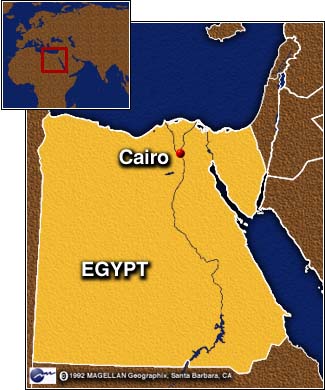
http://www.topnews.in/files/egypt.cairo.map.lg.jpg

Hezbollah infiltrates Egypt

Meanwhile, last year in Egypt, Hosni Mubarak's government accused Hezbollah
of creating cells inside the country and planning attacks against Egyptian
and Western targets. Egypt, the most populous and powerful Arab country with
a Sunni majority, has been targeted significantly by Sunni Salafi terror
networks. The new addition of Hezbollah cells acting on the inside
dramatically raises the threat Egypt faces from jihadists.

Egyptian courts have sentenced a number of Lebanese Hezbollah members as
well as Egyptian citizens working with them. From Beirut, Hezbollah's
secretary general sent veiled threats to President Mubarak's government,
claiming that Hezbollah and the "Islamic resistance" have the right to
operate from any Arab and Islamic land against their enemies, principally
Israel. Hassan Nasrallah had previously threatened Cairo when he exhorted
the Egyptian military to rebel against its government.

But the Iranian strategy to build terror networks along the Nile Valley by
way of Hezbollah has not been limited to Egypt. Sudan, whose regime has been
both Islamist and jihadist since 1989, has undergone a rapprochement with
Tehran. This convergence of interests between the elites of the two rogue
states has only increased since the International Criminal Court indicted
Sudanese dictator Omar al Bashir for the genocide in Darfur. In the weeks
and months following the indictments, Hezbollah delegations followed by
Iranian delegates supported Bashir against the West, and thus against the
African uprisings in the south, west and east of the troubled country.

http://www.sudantribune.com/IMG/jpg/al-Bashir_greets_Ahmadinejad.jpgAhmedini
jad and Bashir allies

Iran's access to Sudan also brought strategic advantages to the Pasdaran:
Hezbollah and Iranian intelligence benefit from the immense land mass by
building military bases and training regime militias for potential
confrontations to come. By linking up with Sudan, Hezbollah and its Iranian
sponsors now have a host south of Egypt, where they can access the Red Sea
via Port Sudan and use paths to Eritrea and Chad.


Facilities in East and West Africa


Towards the end of 2008 and 2009, intense contacts between Iranian president
Mahmoud Ahmadinejad's representatives and Eritrean officials culminated in
the signing of an agreement granting Iran's navy facilities along the coasts
of the Eritrea. This strategically significant development provided the
Khomeinists with hundreds of miles of access in the Red Sea. While U.S. and
allied naval forces deter Iran in the Persian Gulf, Iranian assets-though
not as sophisticated as the Western forces in the region-can now operate in
the Red Sea. Indeed, where the Iranian regime goes, Hezbollah follows.
Israel is thus surrounded by Iranian proxies and the Horn of Africa is under
the increasing risk posed by the axis of resistance.

http://www.tehrantimes.com/News/10322/02_ERIT.jpg
http://images-partners-tbn.google.com/images?q=tbn:bk4xoKv9WKOtsM::imgfox.co
m/images/ouubk82jlnmy9kxpqnq9.jpg

Ahmedinijad  in Eritrea                               Hezbollah in West
Africa

Iran has also worked to penetrate West Africa since the 1980s. Taking
advantage of the substantial size of the Lebanese communities in Senegal,
Liberia, Sierra Leone, the Ivory Coast, Benin, and Nigeria, Hezbollah has
developed financial and intelligence networks that span the entire region.
This increase of Iranian-backed activities in West Africa could have
negative effects on security coordination between these countries and the
West, including the U.S. and Europe.


Iran in Europe


Since the so-called "Islamic revolution," Iran has undertaken sinister
intelligence activities throughout Europe, intimidating and occasionally
assassinating opposition figures and dissidents. But Tehran's most dangerous
presence in Europe comes in the form of active Hezbollah cells. Since 9/11,
a number of European governments have detected Hezbollah activities on their
soil. Indeed, Germany has arrested and tried members of the organization who
were planning illegal activities.

Iran has extended its strategic reach into European countries, penetrating
them with intelligence and terrorist networks, and weakening their resolve
to join forces with the U.S. in sanctions or other punitive measures against
Tehran.


Stretching into the Americas


Iran's longest arm stretches into Latin America. As of the early 1990s,
Hezbollah had established a presence in the tri-border area between Brazil,
Argentinaand Paraguay. This lawless zone enables the Khomeinist network to
develop illegal financial activities and train and plan for terrorist
attacks in the region. The 1992 bombing of the Israeli embassy in Buenos
Aires and the 1994 bombing of a Jewish center there are prime examples of
Tehran's terrorist activities and global reach.

http://oglobo.globo.com/fotos/2009/09/06/06_PHG_Ali_Khamenei_Ch%C3%A1vez.JPG
http://i80.photobucket.com/albums/j200/swampgift/chavezAhmadinejad.jpg
http://newsimg.bbc.co.uk/media/images/42038000/jpg/_42038494_chavez_assad_ap
203.jpg

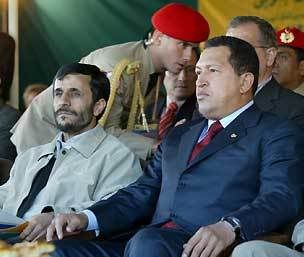
Khamanei-Chavez                          Ahmedinijad-Chavez
Chavez-Assad

With the rise of the Hugo Chavez regime, Iran's Latin American presence
expanded even further. The Venezuelan strongman has signed several
agreements with Ahmadinejad's regime, including an April 2009 defense treaty
that provides for military and intelligence cooperation. Venezuela has
granted Hezbollah operatives permission to organize their presence under the
protection of Iran's Pasdaran and local intelligence, and according to U.S.
Department of Defense reports, the Venezuelans are providing Iranian units
with Spanish language instruction with the aim of inserting them in a Latin
American context. One of the most dangerous aspects of Iran's presence in
Venezuela is the increasing ability to install Iranian missiles aimed at the
United States and other countries in the region.

As of now, Iran's reach within the United States is principally-but not
entirely-in the hands of Hezbollah's networks, which have been trying to
recruit new agents since they established their own foundations in Lebanon
in the 1980s. Working naturally through Lebanese communities, beginning with
its bases in the home country, Hezbollah established groups and cells inside
the U.S. in states such as Michigan, New York and North Carolina.

The main activities detected by U.S. law enforcement organizations have
centered on smuggling, fundraising, and providing material support to the
mother organization in Lebanon. But Hezbollah has gained valuable experience
in penetrating Lebanon, Egypt, Iraq, Yemen and the countries of northern
Africa, which enables Iran to do considerable damage to the U.S. in case of
open conflict. American authorities have also been monitoring Iran's
financial presence in the U.S., with recent discoveries showing Iranian
front companies even holding assets in Manhattan.


Facilitators: Turkey's AKP and Qatar


Over the past few years, two additional Middle Eastern
governments-supposedly close U.S. allies-have been aiding Iran in its
attempts to emerge from international isolation. Since 2002, Turkey, led by
the Islamic Justice and Development Party (AKP), has slowly become more
supportive of Iran's policies, including Tehran's nuclear program. Turkish
Prime Minister Recep Tayyip Erdogan recently endorsed Ahmadinejad's
controversial reelection despite the massive democratic opposition inside
Iran. Ankara's Islamists also rejected UN sanctions over Iran's nuclear
program.

http://i254.photobucket.com/albums/hh112/salaami/AhmadinejadAssadSayyedNasra
llah.jpg http://www.andrewbostom.org/blog/wp-content/uploads/Erogan.Ajad.jpg
http://www.payvand.com/news/08/aug/Iran-President-Qatar-Emir1.jpg

Nasrallah, Assad, Ahmadinijad, Erdogan, Hamad bin Khalifa

According to several Arab governments, Qatar, which has been funding the
Al-Jazeera network since the late 1990s, has also made life easier for the
Iranian regime in the region. Qatar's emir made diplomatic maneuvers to
prevent the UN from implementing Security Council Resolution 1559, which
provides for the disarming of Hezbollah in Lebanon. Instead, Qatar held a
counter-conference in Doha in 2008 to help bring Hezbollah into the fold of
the Lebanese government, at the expense of the democratic Cedar Revolution.


The Iranian Threat


The threat from Iran goes far beyond its pursuit of nuclear weapons. Its use
of terrorist proxies and its creation of global terror networks has been one
the longest-standing bones of contention with the West. Despite the current
focus on the Taliban and al-Qaeda, no group has had more practice in global
terrorism than Hezbollah, and no state has proved a better and more
consistent patron than Iran.

http://www.payvand.com/news/06/nov/Iranian-missiles2.jpg
http://www.iran-resist.org/local/cache-vignettes/L400xH618/10263_133-29d7c.j
pg

Pasdaran's missiles: world threat

>From a U.S. counterterrorism perspective, the threats posed by Iran,
Hezbollah, and its global terrorist network are considerable. But the
addition of nuclear weapons into this global network of Khomeinists may well
prove as dangerous if not more so than nuclear weapons in the hands of
al-Qaeda.

Dr. Walid Phares is director of the Future of Terrorism Project at the
Foundation for Defense of Democracies. He teaches global strategies at the
National Defense University and is author of The Confrontation: Winning the
War Against Future Jihad


[Non-text portions of this message have been removed]


------------------------------------

--------------------------
Want to discuss this topic?  Head on over to our discussion list,
[email protected].
--------------------------
Brooks Isoldi, editor
[email protected]

http://www.intellnet.org

  Post message: [email protected]
  Subscribe:    [email protected]
  Unsubscribe:  [email protected]


*** FAIR USE NOTICE. This message contains copyrighted material whose use has
not been specifically authorized by the copyright owner. OSINT, as a part of
The Intelligence Network, is making it available without profit to OSINT
YahooGroups members who have expressed a prior interest in receiving the
included information in their efforts to advance the understanding of
intelligence and law enforcement organizations, their activities, methods,
techniques, human rights, civil liberties, social justice and other
intelligence related issues, for non-profit research and educational purposes
only. We believe that this constitutes a 'fair use' of the copyrighted material
as provided for in section 107 of the U.S. Copyright Law. If you wish to use
this copyrighted material for purposes of your own that go beyond 'fair use,'
you must obtain permission from the copyright owner.
For more information go to:
http://www.law.cornell.edu/uscode/17/107.shtmlYahoo! Groups Links

<*> To visit your group on the web, go to:
    http://groups.yahoo.com/group/osint/

<*> Your email settings:
    Individual Email | Traditional

<*> To change settings online go to:
    http://groups.yahoo.com/group/osint/join
    (Yahoo! ID required)

<*> To change settings via email:
    [email protected]
    [email protected]

<*> To unsubscribe from this group, send an email to:
    [email protected]

<*> Your use of Yahoo! Groups is subject to:
    http://docs.yahoo.com/info/terms/