<http://www.meforum.org/2743/suicide-bomber-sunni-shii-hybrid>
http://www.meforum.org/2743/suicide-bomber-sunni-shii-hybrid
 <http://www.meforum.org/meq/issues> Middle East Quarterly


SUMMER 2010 . VOLUME XVII: NUMBER 3


The Suicide Bomber as Sunni-Shi'i Hybrid


by Benjamin T. Acosta
Middle East Quarterly
Summer 2010, pp. 13-20


Beginning with the 1979 Shi'i Iranian revolution and the subsequent success
of the Sunni mujahideen's resistance to the Soviets in the 1980s, acts of
violence committed in the name of Islam have risen sharply. Increasingly,
the role of martyrdom has taken a central position in violent campaigns
conducted by Islamic groups. The suicide bomber has become the ideal of
Islamic martyrdom, simultaneously appalling Western audiences and
captivating Islamic ones. What seems to have gone unnoticed, however, is how
the concept of Islamic martyrdom has undergone a transformation that blends
and synthesizes notions that were once limited to one or the other of the
main Muslim sects. In order to better address the challenge of Islamic
violence, it is necessary to examine both the Islamic world's attachment to
such behavior and to understand better how the role of the martyr has
changed with the times.


Evolving Islamic Martyrdom


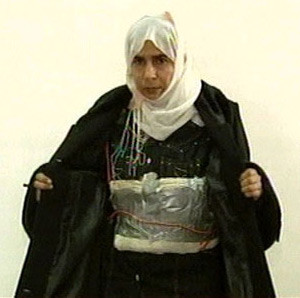
  <http://www.meforum.org/pics/large/97.jpg>

A Palestinian woman wears a suicide belt. Islamic law allows women to engage
in jihad when the Muslim state comes under attack. In recent years, women
have volunteered for membership in a range of terrorist groups including
Hamas and Islamic Jihad. In April 2005, the Iranian regime created a unit of
female suicide bombers nicknamed the Olive Daughters. An Iranian website
announced that these women were following in the footsteps of the "holy
female Palestinian warriors."

Martyrdom in Islamic history has taken on a variety of shapes and relied on
numerous contexts for justification and implementation. Over the last
century, new strains of martyrdom have moved across the umma (the global
Islamic community) from Mandatory Palestine, French Algeria, and
revolutionary Iran to everywhere between Morocco and Indonesia. Evolutions
in martyrdom's place within Islamic thought expose shifts within Muslims'
own sense of self as well as changes in culture.

In Arabic-Islam's sacred language-several words refer to variations on the
concept of the martyr. Shahada, often translated as "martyrdom," literally
stands for the act of "witnessing," and depending on context, it can mean
the "confession of one's submission to God" or "death for God's sake."
Istishhad literally refers to the act of martyrdom. Shahada then refers to
incidental death during jihad (i.e., a soldier falling in battle) whereas
istishhad indicates deliberate death during jihad. The former connotes a
"willingness to die," the latter an explicit "eagerness to die."[1]
<http://www.meforum.org/2743/suicide-bomber-sunni-shii-hybrid#_ftn1>

Today, shahid best describes one who dies during jihad rather than one who
simply dies for Islam. In popular usage, the shahid refers primarily to the
perpetrators of suicide attacks but has expanded to include those deemed
martyrs by Muslim society at large, i.e., participants in jihad who have
died one way or another. Palestinian society views both the shahid and the
istishhadi as martyrs who deserve the rewards of paradise.[2]
<http://www.meforum.org/2743/suicide-bomber-sunni-shii-hybrid#_ftn2>
Indeed, Palestinians often speak about both the istishhadi (one who puts
himself forward knowingly to die during jihad) and the shahid (one who
incidentally attains martyrdom during jihad) as shuhada' (martyrs).

These terms are embedded within a surrounding "culture of martyrdom," a
phrase often applied to some contemporary Muslim societies, whether a
relatively small one like that of the Palestinian Arabs or a larger,
transnational one, like Al-Qaeda and its so-called affiliates, that promote
self-sacrificial terrorism, including suicide bombings and other "martyrdom
operations.[3]
<http://www.meforum.org/2743/suicide-bomber-sunni-shii-hybrid#_ftn3> " The
culture of martyrdom also refers to those elements such as music videos,
popular poems, textbooks, rallies, memorabilia, etc., that support ideas of
jihad, shahada, and istishhad, or commemorate a past shahid. Less tangible
elements such as popular acceptance and praise of shahids as well as other
forms of popular consent, (e.g., limited or no condemnation by authority
figures) are aspects of the culture. Such a culture has roots deep in
Islam's historical narrative.


Different Paths to Martyrdom


One major trajectory for martyrdom's importance within the Muslim tradition
derives from the Shi'i narrative that developed following the death of
Muhammad's grandson Hussein in 680 CE. Hussein and his followers did not
choose martyrdom at the Battle of Karbala in the manner of most other
Islamic martyrs in successive generations. Nevertheless, Shi'i tradition
embellishes his death with prophetic foreknowledge of the outcome. It also
embodies the model of a woefully small force of true believers arrayed
against an overwhelming army of "evil-doers." As a result of his death, the
role of martyrdom would forever serve as a basis for the distinction of
Shi'ism from Sunni orthodoxy. Hussein's death has since demonstrated the
extent to which martyrdom proves one's commitment to an Islamic cause. This
gives it a capability like none other in political Islam: the power to
affect ideological change from within.

Furthermore, by couching their opposition to the ruling Umayyad caliphate as
a protest against a false understanding of the faith, the nascent Shi'i
community cast their martyrs as the "opposition" par excellence. As Farhad
Khosrokhavar states in his study of suicide bombers,

The martyrdom of [Hussein] provided an opportunity to denounce the usurpers
so as to reestablish the true religion of [Muhammad]. In this case, the
relationship between martyrdom and jihad is ambiguous, as self-sacrifice was
not made when victory was in sight. On the contrary, it resulted in
temporary defeat.[4]
<http://www.meforum.org/2743/suicide-bomber-sunni-shii-hybrid#_ftn4>

The Ismaili Assassins, a Shi'i offshoot of the eleventh and twelfth
centuries, represent a further step in that trajectory as an example of
Muslims who identify themselves so differently from the ruling sect that
violence and death became the most desirable option for pursuing their
collective goals. In pursuit of political change, the Assassins combined
Shi'i martyrdom with the Islamic concept of taqiyya or deception, taking the
conventions of resistance in new directions. Responding to their oppression
at the hands of Sunni caliphs, the Assassins refocused their allegiance on
their sect rather than their more encompassing Islamic faith. Most
significantly though, by later targeting Crusader officials, the Assassins
introduced Islam's brand of martyrdom to the West as an inter-civilizational
tool of warfare and political messaging.

A second, significant trajectory is that of the dominant, Sunni perspective
on jihad and the Sunni understanding of martyrdom. While always present,
Sunni martyrdom within the framework of jihad remained mostly stagnant for
hundreds of years as Sunnis largely enjoyed the power of the majority. This
began to change in the eighteenth and nineteenth centuries with Western
dominance over territory formally under Islamic control (Dar al-Islam) and
most significantly with the influx of mainly European Jews into Palestine.
Their arrival was often perceived as a challenge to Muslim hegemony by local
Sunni leaders.


The Palestinian Incarnation


Although suicide terrorism has become a major feature of modern jihad, it
has its roots in earlier concepts of the shahid who goes into battle
determined to kill as many of the enemy as possible in the knowledge that he
will die. The martyr's death is constantly presented as the perfect way for
a Muslim to die, and this conviction has, in the modern period, given rise
to the phenomenon of a self-detonating shahid, especially among Palestinian
fighters.[5]
<http://www.meforum.org/2743/suicide-bomber-sunni-shii-hybrid#_ftn5>

With the Zionist settlement of Ottoman-ruled southern Syria, later
British-controlled Mandatory Palestine, and the eventual establishment of
the state of Israel in 1948, the political geography of the Islamic world
was dramatically reformatted, giving rise in turn to new notions of how to
wage a "defensive jihad." A key catalyst to nascent Arab nationalism proved
to be the "us-versus-them" scenarios that played out in confrontations
between Jewish immigrants and the local Arab population. In direct response
to the growth of the yishuv (the pre-state Jewish community and its
leadership), the Arab population-also made up of many newcomers from various
places in the Arab world[6]
<http://www.meforum.org/2743/suicide-bomber-sunni-shii-hybrid#_ftn6> -began
constructing its own national identity. But the leaders of this Arab
community were simultaneously religious leaders (e.g., the Grand Mufti of
Jerusalem Hajj Amin al-Husseini, Sheikh 'Izz al-Din al-Qassam[7]
<http://www.meforum.org/2743/suicide-bomber-sunni-shii-hybrid#_ftn7> ), and
the conflict over Mandatory Palestine was soon framed in terms of Muslims
versus Jews. At the center of this identity stood its hero-the shahid.[8]
<http://www.meforum.org/2743/suicide-bomber-sunni-shii-hybrid#_ftn8>
Muslims who died opposing the Zionists were "martyred" and ascended to
national hero status within the population.

In the decades after Israel's establishment, Palestinian Arabs placed ethnic
or national identity ahead of their Islamic identity because Muslim leaders
had failed them and Arabism seemed to offer a more promising future. Yasser
Arafat's Fatah guerrilla group began employing the traditional Sunni notion
of a feda'i (self-sacrificer) to define their fearless revolutionaries, who
opposed the imperial powers through guerrilla warfare and terrorism,
replacing the religious shahid in the national consciousness. A feda'i or
mujahid (one who wages jihad) displays a willingness to sacrifice his life
for Islam but usually seeks to fight for as long as possible and does not
court death as an end-goal.

The use of feda'i served another purpose as well. Fatah and others within
the umbrella of the Palestine Liberation Organization (PLO) shaped their
political message with the vernacular of the international environment in
mind. The Cold War, the rise of Arabism, and the strategic and ideological
compatibility of Palestinian revolutionaries with the Soviets influenced the
PLO's manner of framing its struggle. While the PLO took on an identity that
allowed it smoother access within the international system, it did so
without compromising its positions regarding martyrdom. The PLO never became
any less Islamic or Arab internally. The Sunni tradition of martyrdom may
have temporarily moved to the background, but it still remained an animating
force, mobilizing the PLO's resistance to Zionism by having its fighters
engage in risky, nearly suicidal operations.

Throughout the 1950s and 1960s, Palestinian groups sat at the forefront of
modern terrorism,[9]
<http://www.meforum.org/2743/suicide-bomber-sunni-shii-hybrid#_ftn9>  and
their fedayeen martyrs remained central to their strategy of political
extortion. The term jihad, however, seemed to disappear from the framework.
This was not a particularly Palestinian phenomenon. Historian David Cook
notes that "the muted use of jihad held throughout the Muslim world until
the rise of political Islam after the Six-Day War with Israel in 1967."[10]
<http://www.meforum.org/2743/suicide-bomber-sunni-shii-hybrid#_ftn10>

However, in the 1970s, the Muslim world woke up to a new era. Secularist
alternatives to tradition, such as pan-Arabism, had either been found
wanting or were associated, like Baathism, with repressive regimes. Israel
had roundly defeated Arab states in war, particularly in 1967 and in 1973.
Most significantly, a revolution in Iran in 1979 resulted in the rise of a
religiously-oriented regime that showed itself able to confront the "Great
Satan," the United States. This did not go unnoticed in the larger, Sunni
world: By the mid-1980s, a coalition of Sunni warriors from several
countries was fighting and eventually defeating Soviet forces in
Afghanistan.


The Iranian Shahada


Meanwhile, Khomeini's use of shahada within the Iranian revolution and the
Iran-Iraq war demonstrated the ability of martyrdom to advance an Islamic
cause. Without the thousands of volunteers who blew themselves up clearing
Iraqi minefields, one can never know with certainty if Iran could have
staved off Iraq's mechanized encroachments. Using the power of identity
politics, Khomeini cast the shah, and subsequently Saddam Hussein, in the
role of Yazid, the slayer of Hussein at Karbala and thus the explicit enemy
of all Shi'a. The needs of revolution and war led Khomeini to call for acts
of martyrdom. Inadvertently perhaps, the exigencies that led Khomeini and
the Iranian Revolutionary Guards Corps to mobilize waves of self-sacrificers
served to expand the parameters of the culture of martyrdom.

Soon thereafter, Iran's agent in Lebanon, Hezbollah, advanced notions of
Shi'i martyrdom in its own right, perhaps more significantly than
revolutionary Iran did. Hezbollah's superimposition of the shahid onto the
figure of a suicide-bomber completely altered the contemporary direction in
the uses of Islamic martyrdom. The act of an individual directly killing him
or herself while killing others, whether U.S. troops in Beirut or Israeli
troops in southern Lebanon, reinvigorated Islamic martyrdom. Moreover, this
evolution was to have an immeasurable effect on political Islam within both
Shi'i and Sunni spheres. The structure of the conflict pitted Hezbollah
against much more advanced forces, highlighting the advantages of using the
shahid to attack soft targets. Culture and identity also played a part in
Hezbollah's successful importation of Iranian ideas and tactics: the Shi'a
were the traditional low men on the totem pole of Lebanon's confessional
politics and met Khomeini's concept of martyrdom with unexpected levels of
enthusiasm.


The Rise of the Suicide Bomber


Although a purely Shi'i entity, Hezbollah refocused Muslims engaged in armed
violence away from the concept of the feda'i and back to that of the shahid.
Middle East scholar Rafael Israeli explains the subtle but important
sociopolitical difference between the two notions:

both shahid and fida'i are motivated by a profound and numbing religious
fanaticism, which pushes them to commit acts of self-sacrifice, which we
usually refer to as "suicide attacks"... However, while the shahid is a
martyr in the sense that he is serving a cause, the fida'i connotes more of
a devotion to a leader.[11]
<http://www.meforum.org/2743/suicide-bomber-sunni-shii-hybrid#_ftn11>

Thus the focus of Islamic martyrdom shifted from the specific to the
universal, moving away from the established organization member to any
individual who aspired ad hoc to answer the call of jihad.[12]
<http://www.meforum.org/2743/suicide-bomber-sunni-shii-hybrid#_ftn12>

In late 1992, as a response to the seemingly endless first intifada, Yitzhak
Rabin's Israeli government made the mistake of deporting some of the
uprising's leaders and other Islamic Palestinian activists, including both
Hamas and Palestinian Islamic Jihad (PIJ) members, to southern Lebanon.[13]
<http://www.meforum.org/2743/suicide-bomber-sunni-shii-hybrid#_ftn13>  Under
the auspices of Hezbollah and the Iranian Revolutionary Guards, these Hamas
and PIJ members learned the functional elements of suicide attacks and
matured their understanding of martyrdom operations.[14]
<http://www.meforum.org/2743/suicide-bomber-sunni-shii-hybrid#_ftn14>
Compounding its mistakes, the Rabin government allowed many of the 418
deportees to return to the disputed territories by the end of 1993.[15]
<http://www.meforum.org/2743/suicide-bomber-sunni-shii-hybrid#_ftn15>  By no
coincidence, Hamas and PIJ attacked Israel with suicide bombers a combined
eight times during 1993 alone.

The transmission of the Shi'i shahid/suicide bomber to the Sunni world marks
the full convergence of the two historical trajectories. The mid-1990s
ushered in a period when Hamas and PIJ transitioned potential martyrs from
rock throwers and gunmen to suicide bombers as well as shifted Palestinians'
support from shahada (incidental death) to istishhad (deliberate death). Not
to be outdone, Arafat's nominally secular Fatah adopted the istishhad
approach. By the time of the Aqsa intifada in 2000, Palestinian
organizations had injected esoteric Shi'i concepts into the Sunni world of
martyrdom, including pre-attack rituals initially developed in Iran and
Lebanon.[16]
<http://www.meforum.org/2743/suicide-bomber-sunni-shii-hybrid#_ftn16>

The Sunni adoption of a Shi'i form of martyrdom has led to a hybrid version
that takes the most virulent components of each. Superimposing the jihadi
martyrdom of Sunni tradition onto the self-annihilating Shi'i version has
contributed to the brutality and audaciousness of acts of martyrdom
committed by Palestinians and the international jihadi movement.
Interestingly, in the late 1980s, Hezbollah came to recognize the negative
social potential of mass istishhad, and its spiritual advisor, Mohammed
Hussein Fadlallah, accordingly issued a fatwa (Islamic religious ruling)
authorizing its practice "only on special occasions" in order to prevent
"exaggerated use [by] overzealous youth."[17]
<http://www.meforum.org/2743/suicide-bomber-sunni-shii-hybrid#_ftn17>

With the growing importance of the Palestinian cause to the Sunni world, at
least on a popular level, Palestinian promotion of Hezbollah's virulent
shahid/suicide-bomber modus operandi received support and inspired others.
The structure of the Israeli-Palestinian conflict, framed as one between
Jews and Muslims, helped foster international support for the new type of
martyr. In turn, widespread support for this type of attack, against
civilians and on a mass scale, led to the construction of a new Sunni
culture of martyrdom across the global Islamic community.

Inevitably, as respected Sunni leaders such as Sheikh Yusuf al-Qaradawi and
entire Arab societies sanctioned Palestinian suicide terrorism against
Israeli civilians, it opened the door of legitimacy for other Sunnis to
engage in similar acts. Though neither the Afghan mujahideen nor their Arab
partners used any form of suicide attack during the jihad against the
Soviets, Palestinians did inspire Al-Qaeda and others within the
international jihadi movement to adopt not only the suicide-terror tactic
but also the complementary istishhad strategy.[18]
<http://www.meforum.org/2743/suicide-bomber-sunni-shii-hybrid#_ftn18>

Al-Qaeda and others have mobilized Sunni shuhada'-suicide bombers for their
own cause. Framed on a global level, Al-Qaeda has unleashed its weapon
against all who do not fit its own identity grouping, including fellow
Muslims and particularly the Shi'a. In Iraq, a role reversal of titanic
portions has occurred. While Palestinian martyrdom operations, the attacks
of 9/11, and subsequent Al-Qaeda-inspired violence targeted Western foes,
the Shi'a represented the target of choice in Iraq.[19]
<http://www.meforum.org/2743/suicide-bomber-sunni-shii-hybrid#_ftn19>  In
Iraq, Sunni organizations have effectively advanced Shi'i concepts of
martyrdom and now use them predominantly against Shi'i targets.


Implications


Al-Qaeda's capability to export the Palestinian form of martyrdom on a
worldwide level is sure to leave a greater path of destruction and despair
than it already has. At some point, martyrdom seems to have become the
primary goal within the Palestinian arena, reducing to secondary importance
the stated objectives that initially encouraged the act.[20]
<http://www.meforum.org/2743/suicide-bomber-sunni-shii-hybrid#_ftn20>  As
with the international jihadi movement, political objectives may be
maintained at the organizational level, but on the operational level,
fixating potential martyrs on the act itself remains the fundamental goal.

The spread of an international Islamic culture of martyrdom with roots in
the Shi'i narrative has further empowered disaffected Muslims. Khosrokhavar
contends,

The vogue for martyrdom can also be analysed in terms of fashion: The wish
to imitate the other in death was a constant feature of young people in the
[Iranian] revolutionary movement because it allowed them to take on a
collective identity, to look different to others, and to establish a new
hierarchy of the heart rather than a social hierarchy.[21]
<http://www.meforum.org/2743/suicide-bomber-sunni-shii-hybrid#_ftn21>

The international jihadi movement has to a degree restructured the
relationship between the Islamic community and its spiritual and temporal
leaders, incorporating Muslims into a bottom-up political movement of
martyrdom operations, in which they can decide to actively participate at
any time. Perhaps not since the death of Hussein have notions of martyrdom
caused as drastic an evolution in political Islam as has the suicide-bomber.
Martyrdom has become a central concept within contemporary political Muslim
discourse and has assumed the role of the dominant cause rather than the
consequential effect in its relationship with political Islam. Its most
notable adherents are now the members of the international jihadi movement,
increasingly bolstering their claim that they are the true representatives
of the global Islamic community. Al-Qaeda's sustained targeting of the Shi'a
could lead to the use of Islamic martyrdom as an internal Islamic tool used
to eliminate inter-sectarian rivals in addition to a weapon for use against
non-Muslims.

Concepts of martyrdom have played important roles throughout Islamic
history, and today's "martyrdom operations" display the continuing
importance of the phenomenon as an expression of Islamic grievance and as a
form of religiously-motivated armed combat. For many political Islamic
groups today, the martyr stands at the pinnacle of resolving intergroup
conflict. Heroes represent a group's ideal member, and the idea of ordinary
individuals achieving extraordinary feats captures the attention and
inspires many to answer the call of their group-especially in the face of
conflict with a perceived encroaching enemy, whether a U.S. soldier or a
Shi'i politician. Now, the acts of suicide-homicide martyrs epitomize
heroism for many jihadi organizations. Accordingly, one should expect
support for and participation in violent acts of martyrdom to continue to
increase in the Sunni world over the foreseeable future.

Benjamin T. Acosta is currently working on a Ph.D. in political science and
cultural studies at Claremont Graduate University.

[1] <http://www.meforum.org/2743/suicide-bomber-sunni-shii-hybrid#_ftnref1>
Jon Elster, "Motivations and Beliefs in Suicide Missions," in Diego
Gambetta, ed., Making Sense of Suicide Missions (New York: Oxford University
Press, 2006), pp. 237-8.
[2] <http://www.meforum.org/2743/suicide-bomber-sunni-shii-hybrid#_ftnref2>
Yasser Mahmoud Ali Abu Bakar, cited in "Suicide Bombing Terrorism during the
Current Israeli-Palestinian Conflict: September 2000-December 2005,"
Intelligence and Terrorism Information Center, Ramat HaSharon, Jan. 1, 2006,
pp. 7-8.
[3] <http://www.meforum.org/2743/suicide-bomber-sunni-shii-hybrid#_ftnref3>
Benjamin T. Acosta, "Palestinian Precedents: The Origins of Al-Qaeda's Use
of Suicide Terrorism and Istishhad," in Joseph M. Skelly, ed., Political
Islam from Muhammad to Ahmadinejad: Defenders, Detractors, and Definitions
(Santa Barbara: Praeger Security International, 2009), pp. 198-9.
[4] <http://www.meforum.org/2743/suicide-bomber-sunni-shii-hybrid#_ftnref4>
Farhad Khosrokhavar, Suicide Bombers: Allah's New Martyrs, David Macey,
trans. (Ann Arbor: Pluto Press, 2005), p. 21.
[5] <http://www.meforum.org/2743/suicide-bomber-sunni-shii-hybrid#_ftnref5>
Denis MacEoin, "Dimensions of Jihad: Suicide Bombing as Worship
<http://www.meforum.org/2478/suicide-bombing-as-worship> ," Middle East
Quarterly, Fall 2009, pp. 15-24.
[6] <http://www.meforum.org/2743/suicide-bomber-sunni-shii-hybrid#_ftnref6>
Fred M. Gottheil, "The Smoking Gun: Arab
<http://www.meforum.org/522/the-smoking-gun-arab-immigration-into-palestine>
Immigration into Palestine, 1922-1931," Middle East Quarterly, Winter 2003,
pp. 53-64.
[7] <http://www.meforum.org/2743/suicide-bomber-sunni-shii-hybrid#_ftnref7>
Benny Morris, Righteous Victims: A History of the Zionist-Arab Conflict,
1881-2001 (New York: First Vintage Books, 2001), pp. 113-4; idem, The Birth
of the Palestinian Refugee Problem Revisited (Cambridge: Cambridge
University Press, 2004), p. 10.
[8] <http://www.meforum.org/2743/suicide-bomber-sunni-shii-hybrid#_ftnref8>
Benny Morris, 1948: The First Arab-Israeli War (New Haven: Yale University
Press, 2008), pp. 34, 67, 209, 395; idem, One State, Two States: Resolving
the Israel/Palestine Conflict (New Haven: Yale University Press, 2009), pp.
52-4, 103.
[9] <http://www.meforum.org/2743/suicide-bomber-sunni-shii-hybrid#_ftnref9>
Bruce Hoffman, Inside Terrorism (New York: Columbia University Press, 2006),
pp. 64, 71-9.
[10]
<http://www.meforum.org/2743/suicide-bomber-sunni-shii-hybrid#_ftnref10>
David Cook, Martyrdom in Islam (New York: Cambridge University Press, 2007),
p. 136.
[11]
<http://www.meforum.org/2743/suicide-bomber-sunni-shii-hybrid#_ftnref11>
Raphael Israeli, Islamikaze: Manifestations of Islamic Martyrology (London:
Frank Cass, 2003), p. 75.
[12]
<http://www.meforum.org/2743/suicide-bomber-sunni-shii-hybrid#_ftnref12>
Ami Pedahzur and Arie Perliger, "The Changing Nature of Suicide Attacks: A
Social Network Perspective," Social Forces, June 2006, pp. 1987-2008.
[13]
<http://www.meforum.org/2743/suicide-bomber-sunni-shii-hybrid#_ftnref13>
Scott Atran, "Genesis of Suicide Terrorism," Science, Mar. 7, 2003.
[14]
<http://www.meforum.org/2743/suicide-bomber-sunni-shii-hybrid#_ftnref14>
Hoffman, Inside Terrorism, p. 148.
[15]
<http://www.meforum.org/2743/suicide-bomber-sunni-shii-hybrid#_ftnref15>
Jessica Stern, Terror in the Name of God: Why Religious Militants Kill (New
York: Harper Collins, 2003), p. 47.
[16]
<http://www.meforum.org/2743/suicide-bomber-sunni-shii-hybrid#_ftnref16>
Mohammed M. Hafez, Manufacturing Human Bombs: The Making of Palestinian
Suicide Bombers (Washington, D.C.: U.S. Institute for Peace Press, 2006), p.
41-2.
[17]
<http://www.meforum.org/2743/suicide-bomber-sunni-shii-hybrid#_ftnref17>
Rafael Israeli, "A Manual of Islamic Fundamentalist Terrorism," Terrorism
and Political Violence, Jan. 24, 2002, p. 30.
[18]
<http://www.meforum.org/2743/suicide-bomber-sunni-shii-hybrid#_ftnref18>
Acosta, "Palestinian Precedents," pp. 193-204.
[19]
<http://www.meforum.org/2743/suicide-bomber-sunni-shii-hybrid#_ftnref19>
Mohammed M. Hafez, Suicide Bombers in Iraq: The Strategy and Ideology of
Martyrdom (Washington, D.C.: U.S. Institute for Peace Press, 2007), pp. 5,
75-8.
[20]
<http://www.meforum.org/2743/suicide-bomber-sunni-shii-hybrid#_ftnref20>
David Brooks, "The Culture of Martyrdom: How Suicide Bombing Became Not Just
a Means but an End," The Atlantic Monthly, June 2002.
[21]
<http://www.meforum.org/2743/suicide-bomber-sunni-shii-hybrid#_ftnref21>
Khosrokhavar, Suicide Bombers, p. 101.

Related Topics:  Radical Islam
<http://www.meforum.org/topics/27/radical-islam> , Suicide terrorism
<http://www.meforum.org/topics/39/suicide-terrorism>   |  Summer 2010
<http://www.meforum.org/meq/issues/201006/> MEQ receive the latest by email:
subscribe to the free mef mailing list
<http://www.meforum.org/list_subscribe.php>  To receive the full, printed
version of the Middle East Quarterly, please see details about an affordable
subscription <https://www.meforum.org/participation/subscribe.php> . This
text may be reposted or forwarded so long as it is presented as an integral
whole with complete information provided about its author, date, place of
publication, and original URL.

C1994-2011 The Middle East Forum . 1500 Walnut St. . Suite 1050 .
Philadelphia, PA 19102 . Tel: 215-546-5406 . Fax: 215-546-5409 . E-mail:
[email protected]


[Non-text portions of this message have been removed]


------------------------------------

--------------------------
Want to discuss this topic?  Head on over to our discussion list,
[email protected].
--------------------------
Brooks Isoldi, editor
[email protected]

http://www.intellnet.org

  Post message: [email protected]
  Subscribe:    [email protected]
  Unsubscribe:  [email protected]


*** FAIR USE NOTICE. This message contains copyrighted material whose use has
not been specifically authorized by the copyright owner. OSINT, as a part of
The Intelligence Network, is making it available without profit to OSINT
YahooGroups members who have expressed a prior interest in receiving the
included information in their efforts to advance the understanding of
intelligence and law enforcement organizations, their activities, methods,
techniques, human rights, civil liberties, social justice and other
intelligence related issues, for non-profit research and educational purposes
only. We believe that this constitutes a 'fair use' of the copyrighted material
as provided for in section 107 of the U.S. Copyright Law. If you wish to use
this copyrighted material for purposes of your own that go beyond 'fair use,'
you must obtain permission from the copyright owner.
For more information go to:
http://www.law.cornell.edu/uscode/17/107.shtmlYahoo! Groups Links

<*> To visit your group on the web, go to:
    http://groups.yahoo.com/group/osint/

<*> Your email settings:
    Individual Email | Traditional

<*> To change settings online go to:
    http://groups.yahoo.com/group/osint/join
    (Yahoo! ID required)

<*> To change settings via email:
    [email protected]
    [email protected]

<*> To unsubscribe from this group, send an email to:
    [email protected]

<*> Your use of Yahoo! Groups is subject to:
    http://docs.yahoo.com/info/terms/