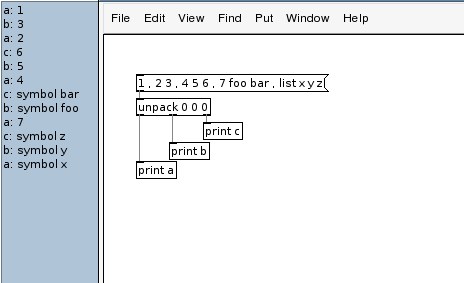
In what case do you rely on using [unpack 0 0 0] except for throwing an
error when it receives a symbol? As it was previously suggested on this
list, why use anything else than [t a] or [t b]? I think Mathieu's end of
type restrictions is a great idea. For example, if you use Max/Msp every so
often, you regularly curse at the useless int/float type restriction.
Mathieu, you would only need to create a new object that would determine the
type of the data (unless your new [route] still does this). For example, I
sometimes use [route bang list symbol] to parse data by its type when an
abstraction has many different "functions" attached to the same inlet.

--
thomas ouellet fredericks, [EMAIL PROTECTED], montreal, canada

On 7/21/07, Frank Barknecht <[EMAIL PROTECTED]> wrote:
Hallo,
Mathieu Bouchard hat gesagt: // Mathieu Bouchard wrote:

>   http://artengine.ca/desiredata/gallery/unpack-mixed.png

Oh, that last one is tricky IMO. Even when you obviously don't care
about patch compatibility to other Pds anymore, making [unpack 0 0 0]
behave as you suggest may break even old patches and abstractions,
that rely on nothing else than a float getting through a 0 in
"unpack". Why don't you use [unpack a a a] like in trigger?

Ciao
--
Frank Barknecht                 _ ______footils.org_ __goto10.org__

_______________________________________________
[email protected] mailing list
UNSUBSCRIBE and account-management ->
http://lists.puredata.info/listinfo/pd-list
_______________________________________________
[email protected] mailing list
UNSUBSCRIBE and account-management ->
http://lists.puredata.info/listinfo/pd-list