Too reiterate, try translating the values you put into your patch
between dB and RMS. dB is logarithmic while RMS is linear, so your
absolute gain increase of 4 times the original signal translates to 112
dB. 100 dB is the "clipping point", or a Pd signal level of "1", thus 4x
the original signal is 12 dB over clipping. And your limiting threshold
of 90 dB translates to a scaling factor of 0.316 times the original signal.
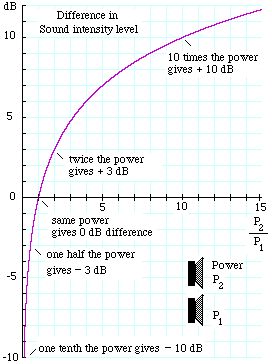
Confused? Want a picture?
http://www.phys.unsw.edu.au/jw/graphics/LI.GIF

(Source: http://www.phys.unsw.edu.au/jw/dB.html)
Where the author has written "power", think RMS. So twice the RMS value
is an increase of +3 dB. Likewise, half the RMS values is -3 dB. Because
you were calculating your limiter entirely in dB, the RMS values needed
for correct limiting were all wrong (far too little) so it didn't appear
that your limiter was limiting at all!
Best!
Derek


Derek Holzer wrote:
But this one does. Working in RMS values appears to be the solution to
your problem.
D.

Mirko Maier wrote:
Thank you, but it definitely doesn't limit the signal!

-------- Original-Nachricht --------
Datum: Wed, 26 Aug 2009 12:16:17 +0200
Von: Derek Holzer <[email protected]>
An: Mirko Maier <[email protected]>
CC: [email protected]
Betreff: Re: [PD] limiter questions
You may want to investigate the relationship between dB and RMS
further. Attached is a working patch, however very crudely. Have a
look at the numbers given by the [dbtorms] and [rmstodb] objects.
Note use of [line~] as well.
--
::: derek holzer ::: http://blog.myspace.com/macumbista :::
http://www.vimeo.com/macumbista :::
---Oblique Strategy # 26:
"Change ambiguities to specifics"

_______________________________________________
[email protected] mailing list
UNSUBSCRIBE and account-management ->
http://lists.puredata.info/listinfo/pd-list