I meant to include a link to making your own solar filter for photography.
I've seen tutorials that call for using CDs or floppy disk material,
but I will not recommend those (without some further research).
What you want to use is Baader AstroSolar material.
Here are some links:
http://www.baader-planetarium.de/com/pdf/construct_binocular.pdf
https://www.youtube.com/watch?v=EiDheBRZrg0
http://astrosolar.com/en/information/how-to/how-to-make-your-own-objective-solar-filter-for-your-camera-or-telescope/
Darren Addy
Kearney, Nebraska

On Thu, Apr 6, 2017 at 10:59 PM, Ken Waller <[email protected]> wrote:
>> That's important because lens choice determines the diameter of the
>> filters I'm going to have to buy. I don't want to be fumbling around
>> changing lenses when the time comes and I only have three really good,
>> sturdy tripods.
>
>
> You could buy the largest filter for the lenses you have and buy stepdown
> rings to fit that filter to your other lenses.
>
> Kenneth Waller
> http://www.pentaxphotogallery.com/kennethwaller
>
> ----- Original Message ----- From: "John Sessoms" <[email protected]>
> Subject: Re: August Solar Eclipse
>
>
>> I've been thinking about this for a couple of years now. I already had
>> the NASA sites bookmarked.
>>
>> I looked at the Nikon & MrEclipse sites Igor suggested, but neither of
>> them answer my question about what *focal length* will give me the best
>> results, which in turn determines which lens I'm going to want to use.
>>
>> That's important because lens choice determines the diameter of the
>> filters I'm going to have to buy. I don't want to be fumbling around
>> changing lenses when the time comes and I only have three really good,
>> sturdy tripods.
>>
>> Right now I'm thinking the K1 + 300 f/2.8 on the sturdiest; K20D +
>> 80-200 f/2.8 on the second sturdiest; K10D + ??? on the third and the K3
>> + ??? handheld for the moon's shadow sweeping towards me. But I don't
>> KNOW if those are the best choices ... and that's the point of starting
>> a discussion now.
>>
>> Darren's point about terrain is a good one.
>>
>> My first choice for a viewing point is Beech Gap on the Cherohala Skyway
>> at the North Carolina/Tennessee state line between Robbinsville &
>> Tellico Plains. That's close to the crest (couple hundred feet either
>> way) and it's dead center in the Path of the Totality.
>>
>> 35.343889, -84.032817 (put those numbers in to Google Maps search)
>>
>> But I'm still looking at long range weather predictions, because I don't
>> want to get there only to find overcast skies.
>>
>> That happened the last time a good eclipse came that was within my range
>> of travel ... 30 May 1984 0.9980 Annular eclipse that the path crossed
>> U.S. 17 within 20 miles or so of where I was at Camp A.P. Hill, Virginia.
>>
>> It was pouring down rain in Virginia that day.
>>
>> I understand Greensboro, NC got a good look; clouds broke open for a few
>> minutes right as the eclipse reached its maximum.
>>
>> This time I have a much greater range & no real constraint on how far I
>> can drive if I have to in order to reach clear skies.
>>
>>
>> On 4/6/2017 12:53, Darren Addy wrote:
>>>
>>> I don't have any previous experience photographing a solar ECLIPSE,
>>> but I'm about to get into serious planning mode for the upcoming one
>>> in August. The center line (maximum time in totality) literally
>>> crosses 1 mile north of my workplace. I plan on taking the day off and
>>> being somewhere with more interesting terrain, however, even if it
>>> means giving up some time in totality.
>>>
>>> The reason why I am interested in the terrain is that I am not just
>>> interested in photographing the sun itself, but also the moon's shadow
>>> as it races over the earth and then envelops my location. If I can
>>> pull it off, I'd like to photograph this with several different
>>> cameras.I will have my longest focal length on my Vixen Polarie,
>>> probably taking time-lapse shots of the sun through a solar filter.
>>>
>>> I'd suggest making a solar filter and trying to take some solar photos
>>> now, prior to the eclipse (there are some good sunspots to try to nail
>>> your focus on, right now).
>>>
>>> Darren Addy
>>> Kearney, Nebraska
>>>
>>> On Thu, Apr 6, 2017 at 7:44 AM, Igor PDML-StR <[email protected]> wrote:
>>>>
>>>>
>>>>
>>>> John,
>>>>
>>>> First of all, thank you for bringing attention to this event.
>>>> Even though we will get only a partial one, it is a great experience for
>>>> the
>>>> kids. I just marked the calendar.
>>>>
>>>> I would assume you want to use a long telephoto lens (for the moon).
>>>>
>>>> But if you google for e.g. "photographing solar eclipse", you will find
>>>> plenty of pages discussing this in great detail.
>>>> Nikon-USA did a good job, I think:
>>>>
>>>> http://www.nikonusa.com/en/learn-and-explore/a/tips-and-techniques/how-to-photograph-a-solar-eclipse.html
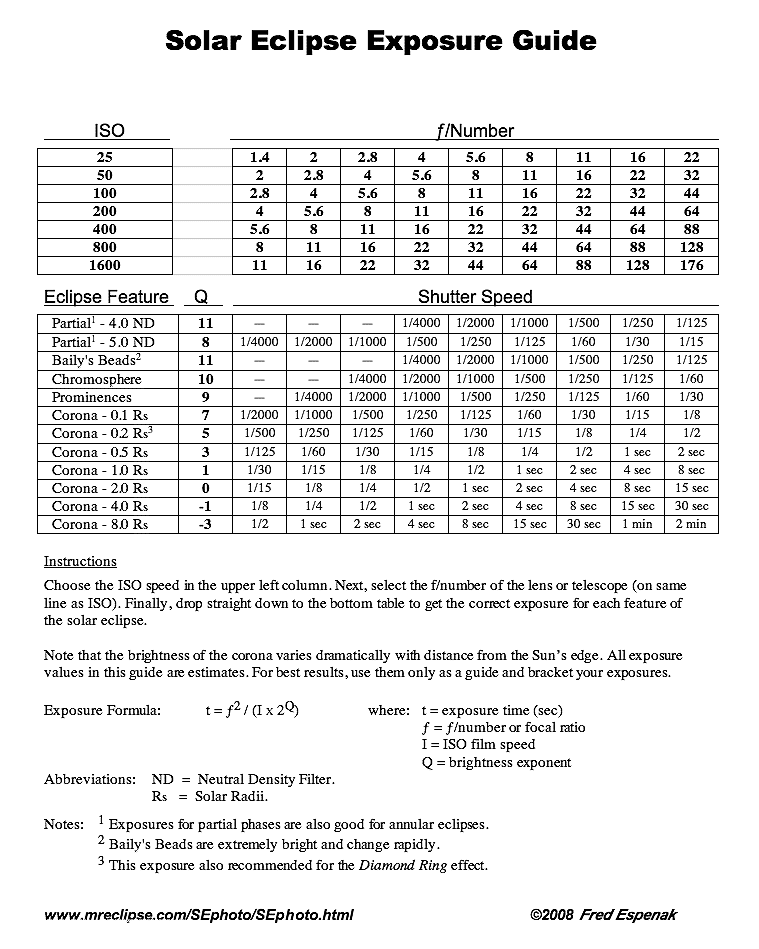
>>>> including the link to the exposure guide at the end:
>>>> http://www.mreclipse.com/SEphoto/image/SE-Exposure1w.GIF
>>>>
>>>> There are other pages with various degree of hype and large red letters
>>>> in
>>>> your face for emphasis.
>>>>
>>>> I would point out one very useful resource for figuring out the time of
>>>> the
>>>> different stages of the event:
>>>>
>>>> https://eclipse.gsfc.nasa.gov/SEgoogle/SEgoogle2001/SE2017Aug21Tgoogle.html
>>>> If you click on the map and make a marker for where you live, - it will
>>>> show
>>>> you information for the eclipse for your place. Don't get it mixed up:
>>>> the
>>>> time is in UTC, so you'd have to subtract the difference according to
>>>> your
>>>> time zone.
>>>>
>>>>
>>>> Cheers,
>>>>
>>>> Igor
>>>>
>>>>
>>>>
>>>>
>>>> On Apr 5, 2017, at 11:04 PM, John Sessoms wrote:
>>>>
>>>>> The Great Solar Eclipse is coming to the U.S. in August. Does anyone on
>>>>> the list have prior experience photographing eclipses?
>>>>>
>>>>> I'm planning to use my K-1 & K-3, but I'm wondering which lenses would
>>>>> be my best choices?
>>>>>
>>>>> The pool of lenses I can choose from (full frame):
>>>>> D FA 15-30 f/2.8
>>>>> Sigma 24-70 f/2.8
>>>>> FA 77 f/1.8 Ltd
>>>>> SMCP-A 100 f/2.8 Macro
>>>>> Tokina ATX Pro 80-200 f/2.8
>>>>> Sigma 300 f/2.8
>>>>>
>>>>> Additionally, I have the SMC Pentax-DA L 18-55mm F3.5-5.6 AL &
>>>>> SMC Pentax-DA L 18-55mm F3.5-5.6 AL WR APS-C kit lenses.
>>>>>
>>>>> I need to figure it out now so I can go ahead and order the appropriate
>>>>> solar filters for whatever lenses I'm going to use.
>>>>>
>>>>> I have a viewing spot south of Great Smokey Mountains National Park
>>>>> picked out, but I'll be looking for other options as the date draws
>>>>> nearer based on weather forecasts. If anyone knows long term weather
>>>>> trends & where I will find the highest probability of clear skies,
>>>>> chime
>>>>> in as well.
>
>
>
> --
> PDML Pentax-Discuss Mail List
> [email protected]
> http://pdml.net/mailman/listinfo/pdml_pdml.net
> to UNSUBSCRIBE from the PDML, please visit the link directly above and
> follow the directions.


--
“The Earth is Art, The Photographer is only a Witness ”
― Yann Arthus-Bertrand, Earth from Above

--
PDML Pentax-Discuss Mail List
[email protected]
http://pdml.net/mailman/listinfo/pdml_pdml.net
to UNSUBSCRIBE from the PDML, please visit the link directly above and follow
the directions.