2010/4/12 Kingsley Idehen <[email protected]
<mailto:[email protected]>>

   All,

   Edited, as I just realized some critical typo+errors that affect
   context.

   Hopefully, you understand what Nathan is articulating (ditto
   Giovanni). If not, simply step back and as yourself a basic
   question: What is Linked Data About?

   Is it about markup? Is it about Data Access? Is it about a never
   ending cycle of subjective commentary and cognitive dissonance
   that serves to alienate and fragment a community that desperately
   needs clarity and cohesion.

   Experience and history reveal the following to me:

   1. Standards based data access is about to be inflected in a major way
   2. The EAV (Entity-Attribute-Value) graph model is the new focal
   point of Data Access (covering CRUD operations).

   Microsoft, Google, and Apple grok the reality above in a myriad of
   ways via somewhat proprietary offerings (this community should
   really learn to look closer via objective context lenses). Note,
   "proprietary" is going to mean less and less since their
   initiatives are HTTP based i.e., it's all about hypermedia
   resources bearing EAV model data representations -- with varying
   degrees of fidelity.

   **
   Players and EAV approaches:

   1. Microsoft -- OData (EAV with Atom+Feed extension based data
   representation)

   2. Google -- GData (EAV with Atom+Feed based data representation)

   3. RDF based Linked Data -- (RDF variant of EAV plus a plethora of
   data representation formats that are pegged to RDF moniker)

   4. Apple -- Core Data (the oldest of the lot from a very
   proprietary company, this is basically an EAV store that serves
   all Mac OS X apps, built using SQLite; until recently you couldn't
   extend its backend storage engine aspect) .
   **

   Reality re. Business of Linked Data:

   "Data as a Service" (DaaS) is the first step i.e., entity oriented
   structured data substrate based on the EAV model. In a nutshell,
   when you have structured data place, data meshing replaces data
   mashing.  Monikers aside, entrepreneurs, CTOs, and CIOs already
   grok this reality in their own realm specific ways.

   Microsoft in particular, already groks data access (they developed
   their chops eons ago via ODBC). In recent times, they've groked
   EAV model as mechanism for concrete Conceptual Model Level data
   access, and they are going unleash an avalanche of polished EAV
   based applications courtesy of their vast developer network. Of
   course, Google and Apple will follow suit, naturally.

   The LOD Community and broader Semantic Web Problem (IMHO):

   History is a very good and kind teacher, make it an integral part
   of what you do and the path forward becomes less error prone; a
   message that hasn't penetrated deep enough within this community,
   in my personal experience.

   **
   Today, I see a community rife with cognitive dissonance and
   desires to define a non existent "absolute truth" with regards to
   what constitutes an "Application" or "Killer Application".
   Ironically, has there EVER been a point in history where the
   phrase: Killer Application, wasn't retrospective? Are we going to
   miraculously change this, now?

   **

   Has there ever been a segment in the market place (post emergence
   of Client-Server partitioning) where if you didn't make both the
   Client and the Server, the conclusion was: we have nothing?

   We can continue postulating about what constitutes an application,
   but be rest assured, Microsoft, Google, Apple (in that order), are
   priming up for precise execution with regards to opportunities in
   the emerging EAV based Linked Data realm. They have:

   1. Polished Clients
   2. Vast User Networks
   3. Vast Integrator Networks
   4. Vast Developer Networks
   5. Bottom-less cash troves
   6. Very smart people.

   In my experience, combining the above has never resulted in
   failure, even if the deliverable contains little bits of impurity.

   Invest a little more time in understanding the history of our
   industry instead of trying to reinvent it wholesale. As Colin
   Powell articulated re. the IRAQ war: If You Break The Pot, You Own It!

   Folks, we are just part of an innovation continuum, nothing is new
   under the sun bar, context !!


+1

Just to add maybe that CRUD is just one part of the equation, after that
can come aggregation, curation, self healing etc.

Now I'm trying to work out whether what you've presented is good news or
bad.

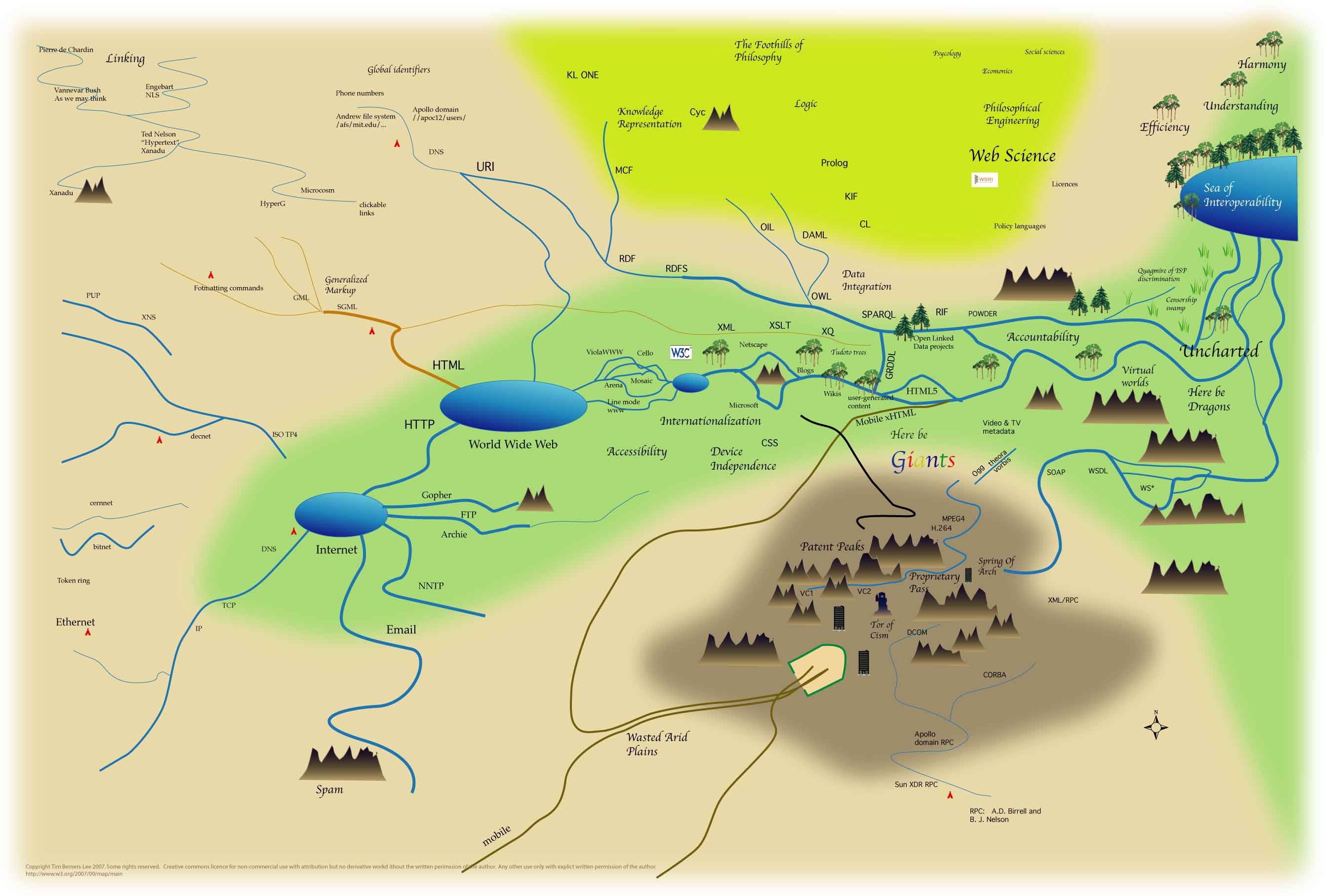
http://www.w3.org/2007/09/map/main.jpg

Looking at the WWW Roadmap, are we all headed for the Sea of
Interoperability or to be sucked in to a Growing Desert Wasteland?


   --
   Regards,

   Kingsley Idehen       President & CEO OpenLink Software     Web:
   http://www.openlinksw.com
   Weblog: http://www.openlinksw.com/blog/~kidehen
   <http://www.openlinksw.com/blog/%7Ekidehen>
   Twitter/Identi.ca: kidehen