On 6/11/13 3:31 PM, Phil Archer wrote:
I don't dislike Linked Stuff personally. I often say that URIs are technology-neutral. Use URIs to identify things and it doesn't matter tuppence whether you use RDF or something else since dereferencing a URI can (and frequently does) return a choice of HTML, RDF/XML, Turtle, JSON, XML or whatever people will be using in 20 years' time. David's "linked stuff" definition matches that.
Are you suggesting that "linked stuff" is how we should refer to Linked Data that isn't inextricably bound to RDF, when speaking to folks outside this and other RDF related communities?
I suspect (and hope) that isn't what you mean.Anyway, if we want to rename Linked Data, then there's a nice name from the past in the form or "Hyperdata" that jibes nicely. That moniker is even much more accurate since it conveys the fact that hypermedia/webby resources can be constructed from hypertext or hyperdata based content :-)
Links:1. http://bit.ly/11xnQ36 -- note that includes HTML (which doesn't necessarily include RDFa)
2. http://bit.ly/15tk1Au -- ditto down the hash URI path.


Kingsley
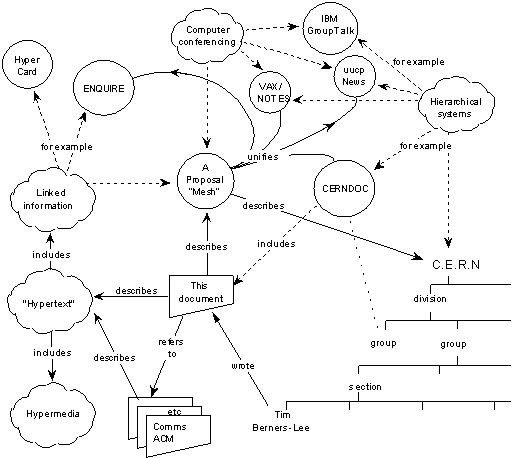
And, to return to the beginning of the conversation, Rufus has nodded agreement at the idea of URIs being technology-neutral identifiers which is encouraging.On 11/06/2013 19:15, Kingsley Idehen wrote:On 6/11/13 1:59 PM, David Booth wrote:On 06/11/2013 12:18 PM, Kingsley Idehen wrote:On 6/11/13 11:56 AM, David Booth wrote:On 06/11/2013 10:59 AM, Kingsley Idehen wrote:[ . . . ] many RDF advocates want to conflate Linked Data and RDF. This is technically wrong, and marketing wise -- an utter disaster.I have not heard RDF advocates conflating Linked Data and RDF, but maybe you talk to different RDF advocates than me. AFAICT, the vast majority of RDF advocates know that Linked Data is RDF in which URIs are deferenceable to more RDF, but RDF is not necessarily Linked Data, because RDF itself does not require URIs to be dereferenceable. DavidRDF isn't the defining characteristic when speaking about Linked Data outside the RDF community.But RDF *is* one of Linked Data's defining characteristics, regardless of whether people outside the RDF community understand that. (And it seems to me that if they don't understand that, then we should help them to understand that, rather than perpetuating their misunderstanding.)Of course its one of the defining characteristics. My point is that it isn't the most important characteristic when speaking to folks outside the RDF community when the subject matter is Linked Data. This is the crux of the matter re. our disagreement. I don't see a need to inject RDF into my conversations about Linked Data when my target audience isn't interested in RDF or overtly suffers from R-D-F reflux.It is much more palatable outside of the RDF community to loosely couple Linked Data (the concept) and RDF (aframework) which enables the construction of powerful Linked Data that'sendowed with *explicit* human and machine-comprehensible entity relationships semantics.We could define a new concept that decouples RDF from Linked Data.We don't need to define a new concept. A concept exists, and it is loosely coupled with RDF. Linked Data (the concept) existed before RDF. Even in TimBL's mind it clearly existed before RDF [1]. The original design of the Web includes a variety of relations, the most important one being the "describes" relation. All of the relations were denoted using links which became URI (a powerful abstraction mechanism for a variety of data related endeavors). -10000 for your "Linked Stuff" . Sorry! Links: 1. http://www.nic.funet.fi/index/FUNET/history/internet/w3c/Image1.gif -- that's a Linked Data way before any notion of R-D-F.
--

Regards,

Kingsley Idehen
Founder & CEO
OpenLink Software
Company Web: http://www.openlinksw.com
Personal Weblog: http://www.openlinksw.com/blog/~kidehen
Twitter/Identi.ca handle: @kidehen
Google+ Profile: https://plus.google.com/112399767740508618350/about
LinkedIn Profile: http://www.linkedin.com/in/kidehen
 smime.p7s
Description: S/MIME Cryptographic Signature