National Radio Astronomy Observatory


For Release: 2 p.m., EDT, Thursday, 18 July 2013
Contacts:
Charles Blue, NRAO Public Information  Officer
Charlottesville, Virginia
(434)  296-0314
[email protected]
David Aguilar, CfA Public Affairs  Director
(617) 495-7462
[email protected]

Snow Falling around Infant Solar System: Icy region gives planet and comet
formation a boost
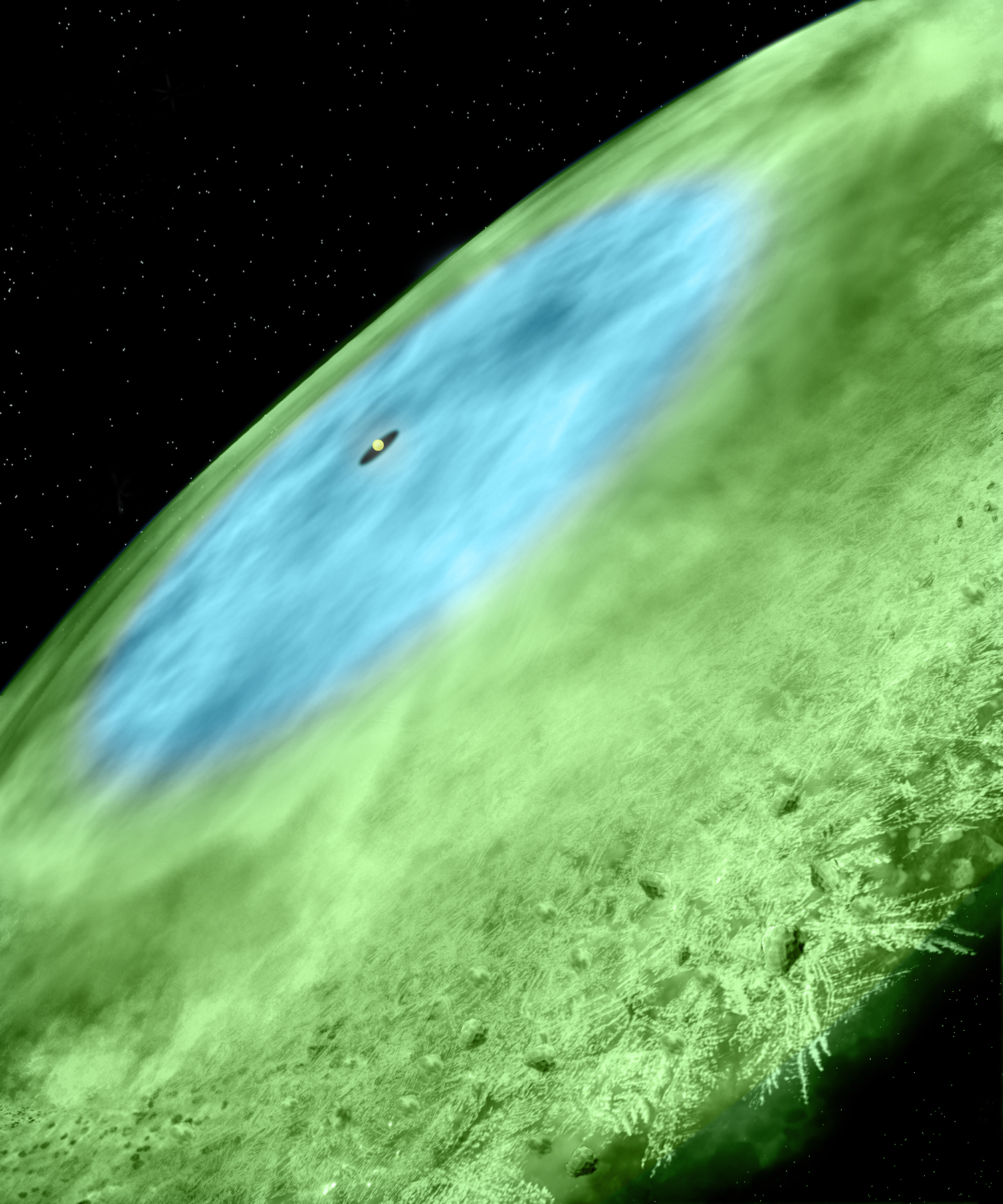
The sight of a snowfall can thrill children, but the first-ever snow line
seen around a distant star gives astronomers an even greater thrill because
of  what it reveals about the formation of planets and our Solar System's
history.       (http://www.nrao.edu/pr/2013/snowline/snowline.jpg)
Artist concept of snow line in TW  Hydrae
CREDIT: Bill Saxton/Alexandra Angelich, NRAO/AUI/NSF
_Full  Caption 1_ (http://www.nrao.edu/pr/2013/snowline/#caption_1)
Astronomers using the new Atacama Large Millimeter/submillimeter Array
(ALMA)  telescope have taken the first-ever image of a snow line in an infant
solar  system. This frosty landmark is thought to play an essential role in
the  formation and chemical make-up of planets around a young star.
On Earth, snow lines typically form at high elevations where falling
temperatures turn atmospheric moisture to snow. In much the same way, snow
lines
are thought to form around young stars in the distant, colder reaches of
the  disks from which solar systems form. Depending on the distance from the
star,  however, other more exotic molecules can freeze and turn to snow.
Familiar water ice freezes out first, then moving outward in concentric
circles other abundant gases like carbon dioxide (CO2), methane (CH4), and
carbon monoxide (CO) freeze, forming a frost on dust grains, which are the
building blocks of planets and comets.
ALMA spotted a never-before-seen CO snow line around TW Hydrae, a young
star  175 light-years away from Earth. Astronomers believe this nascent solar
system  has many of the same characteristics that our own Solar System had
when it was  just a few million years old. The results were published in
Science  Express.
"ALMA has given us the first real picture of a snow line around a young
star,  which is extremely exciting because of what it tells us about the very
early  period in the history of our own Solar System," said Chunhua "Charlie"
Qi, a  researcher with the Harvard-Smithsonian Center for Astrophysics in
Cambridge,  Mass., who led the international research team with Karin Oberg,
a researcher  with Harvard University and the University of Virginia in
Charlottesville.
"We can now see previously hidden details about the frozen outer reaches of
 another solar system, one that has much in common with our own when it was
less  than 10 million years old," said Qi.
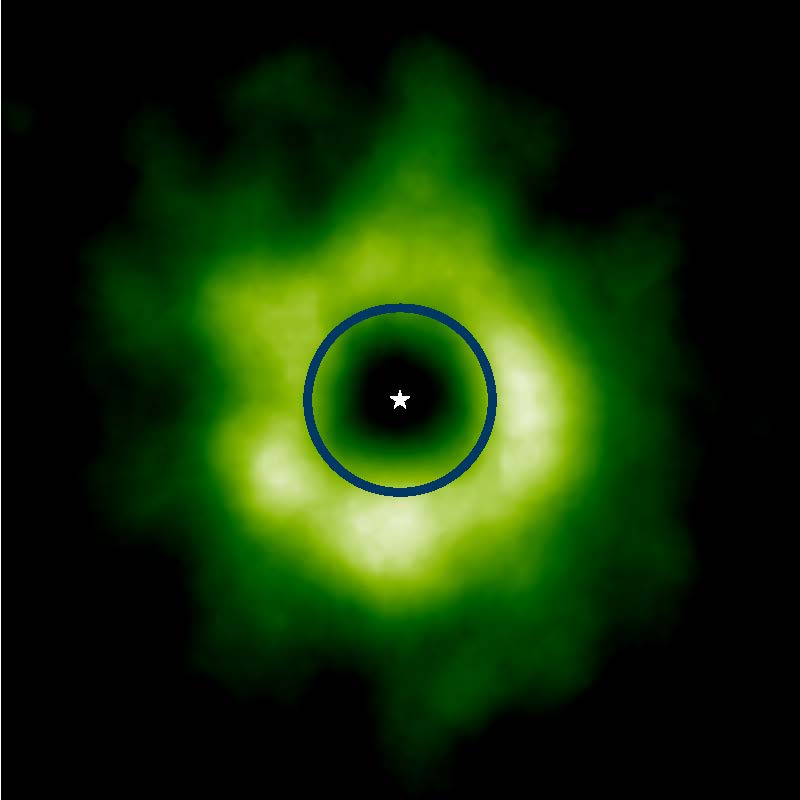
(http://www.nrao.edu/pr/2013/snowline/neptune-comp.jpg)
CO snow line compared to orbit of  Neptune
CREDIT: Karin Oberg, Harvard/University of Virginia
_Full  Caption 2_ (http://www.nrao.edu/pr/2013/snowline/#caption_2)
Snow lines have, until now, only been detected by their spectral
signatures;  they have never been imaged directly, so their precise location
and
extent could  not be determined.
This is because snow lines form exclusively in the relatively narrow
central  plane of a protoplanetary disk. Above and below this region, stellar
radiation  keeps the gases warm, preventing them from forming ice. Only with
the
insulating  effect of the concentrated dust and gas in the central plane of
the disk can  temperatures drop sufficiently for CO and other gases to cool
and freeze.
Normally, this outer cocoon of hot gas would prevent astronomers from
peering  inside the disk where the gas had frozen out. "It would be like trying
to find a  small, sunny patch hidden within a dense fogbank," said Oberg.
The astronomers were able to pierce the intervening CO fog by instead
hunting  for a different molecule known as diazenylium (N2H+). This fragile
molecule is  easily destroyed in the presence of CO gas, so would only appear
in
detectable  amounts in regions where CO had frozen out, and is hence a proxy
for CO ice.
Diazenylium shines brightly in the millimeter portion of the spectrum,
which  can be detected by radio telescope like ALMA here on Earth.
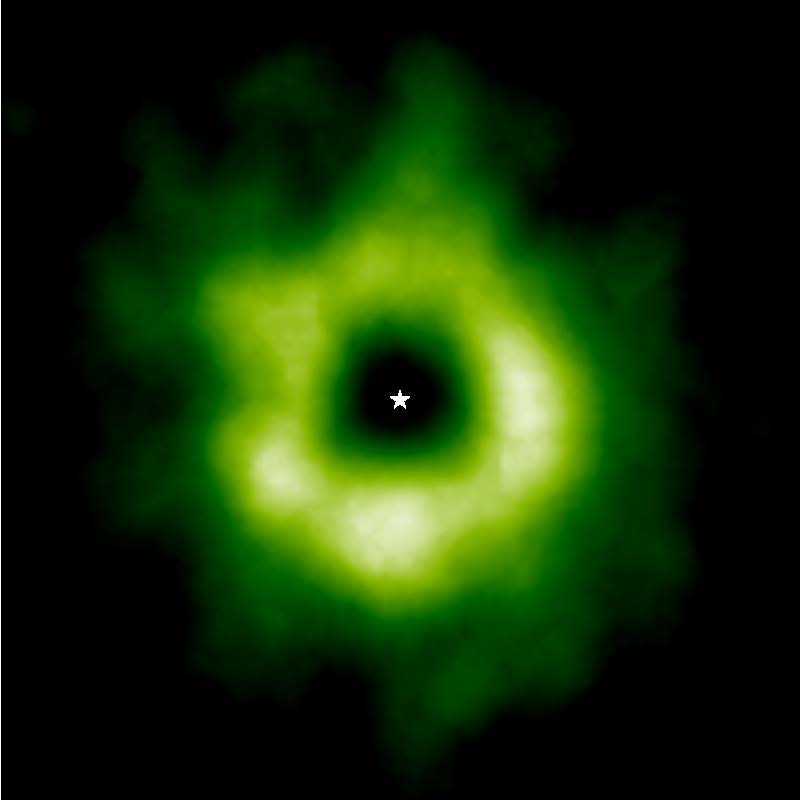
ALMA's unique sensitivity and resolution allowed the astronomers to trace
the  presence and distribution of diazenylium, finding a clearly defined
boundary  approximately 30 astronomical units (AU) from TW Hydrae (one AU is
the
Sun-Earth  distance).
(http://www.nrao.edu/pr/2013/snowline/twh-snowline.jpg)
ALMA image of CO snow line
CREDIT: Karin  Oberg, Harvard/University of  Virginia
"Using this technique, we were able to create, in effect, a photonegative
of  the CO snow in the disk surrounding TW Hydrae," said Oberg. "With this we
could  see the CO snow line precisely where theory predicts it should be --
the inner  rim of the diazenylium ring."
Snow lines, astronomers believe, serve a vital role in the formation of a
solar system. They help dust grains overcome their normal tendency to
collide  and self-destruct by giving the grains a stickier outer coating. They
also  increase the amount of solids available and may dramatically speed up the
planet  formation process. Since there are multiple snow lines, each may be
linked to  the formation of specific kinds of planets.
Around a Sun-like star, the water snow line would correspond approximately
to  the orbit of Jupiter and the CO snow line would roughly correspond to
the orbit  of Neptune. The transition to CO ice could also mark the starting
point where  smaller icy bodies like comets and dwarf planets like Pluto
would form.
Oberg also points out that the CO snow line is particularly interesting
since  CO ice is needed to form methanol, which is a building block of more
complex  organic molecules that are essential for life. Comets and asteroids
could then  ferry these molecules to newly forming Earth-like planets, seeding
them with the  ingredients for life.
These observations were made with only a portion of ALMA's eventual full
complement of 66 antennas. The researchers hope future observations with the
full array will reveal other snow lines and provide additional insights
into the  formation and evolution of planets.
_ALMA_ (http://www.nrao.edu/index.php/about/facilities/alma) , an
international astronomy facility, is a partnership of Europe, North America and

East Asia in cooperation with the Republic of Chile. ALMA construction and
operations are led on behalf of Europe by ESO, on behalf of North America by
the  National Radio Astronomy Observatory (NRAO), and on behalf of East Asia
by the  National Astronomical Observatory of Japan (NAOJ). The Joint ALMA
Observatory  (JAO) provides the unified leadership and management of the
construction,  commissioning and operation of ALMA.
The National Radio Astronomy Observatory is a facility of the National
Science Foundation, operated under cooperative agreement by Associated
Universities, Inc.

--
--
Centroids: The Center of the Radical Centrist Community
<[email protected]>
Google Group: http://groups.google.com/group/RadicalCentrism
Radical Centrism website and blog: http://RadicalCentrism.org

---
You received this message because you are subscribed to the Google Groups
"Centroids: The Center of the Radical Centrist Community" group.
To unsubscribe from this group and stop receiving emails from it, send an email
to [email protected].
For more options, visit https://groups.google.com/groups/opt_out.