Fantastic points; I would urge caution in overestimating the ability of any
single entity to 'come to power' as is suggested and suddenly be given free
reign over the country. This is the main reason I am intrigued more than
most by our current predicament: we have Trump in office and the system of
checks and balances, be them in the condition that they are in, are
churning away to keep him as dead center as could be expected. It is not
enough, of course, and many of us in the extreme center argue for a redo of
the Constitution altogether - but it is pretty cool that at least some of
the Centrist mechanisms put in place still hold up to some degree. While
acknowledging Trump as somewhat Authoritarian I also submit that the system
he is playing in is more Center than many previously imagined.
On Wednesday, February 22, 2017 at 4:44:13 PM UTC-8, Dr. Ernie Prabhakar
wrote:
>
> Don't get me wrong - Facebook has enormous power to impose its values on
> the world. That is precisely why an open ecosystem for building trust is so
> essential as a counterweight.
>
> https://stratechery.com/2017/manifestos-and-monopolies/
>
> Manifestos and Monopolies
> Tuesday, February 21, 2017
>
> It is certainly possible that, as per recent speculation
> <https://www.theatlantic.com/technology/archive/2017/01/zuckerberg-2020/513689/>,
>
> Facebook CEO Mark Zuckerberg is preparing to run for President. It is also
> possible that Facebook is on the verge of failing “just like MySpace”. And
> while I’m here, it’s possible that UFOs exist. I doubt it, though.
>
> The reality is that Facebook is one of the most powerful companies the
> tech industry — and arguably, the world — has ever seen. True, everything
> posted on Facebook is put there for free, either by individuals or
> professional content creators;
>
> and true, Facebook isn’t really irreplaceable when it comes to the
> generation of economic value;
>
> and it is also true that there are all kinds of alternatives when it comes
> to communication. However, to take these truths as evidence that Facebook
> is fragile requires a view of the world that is increasingly archaic.
>
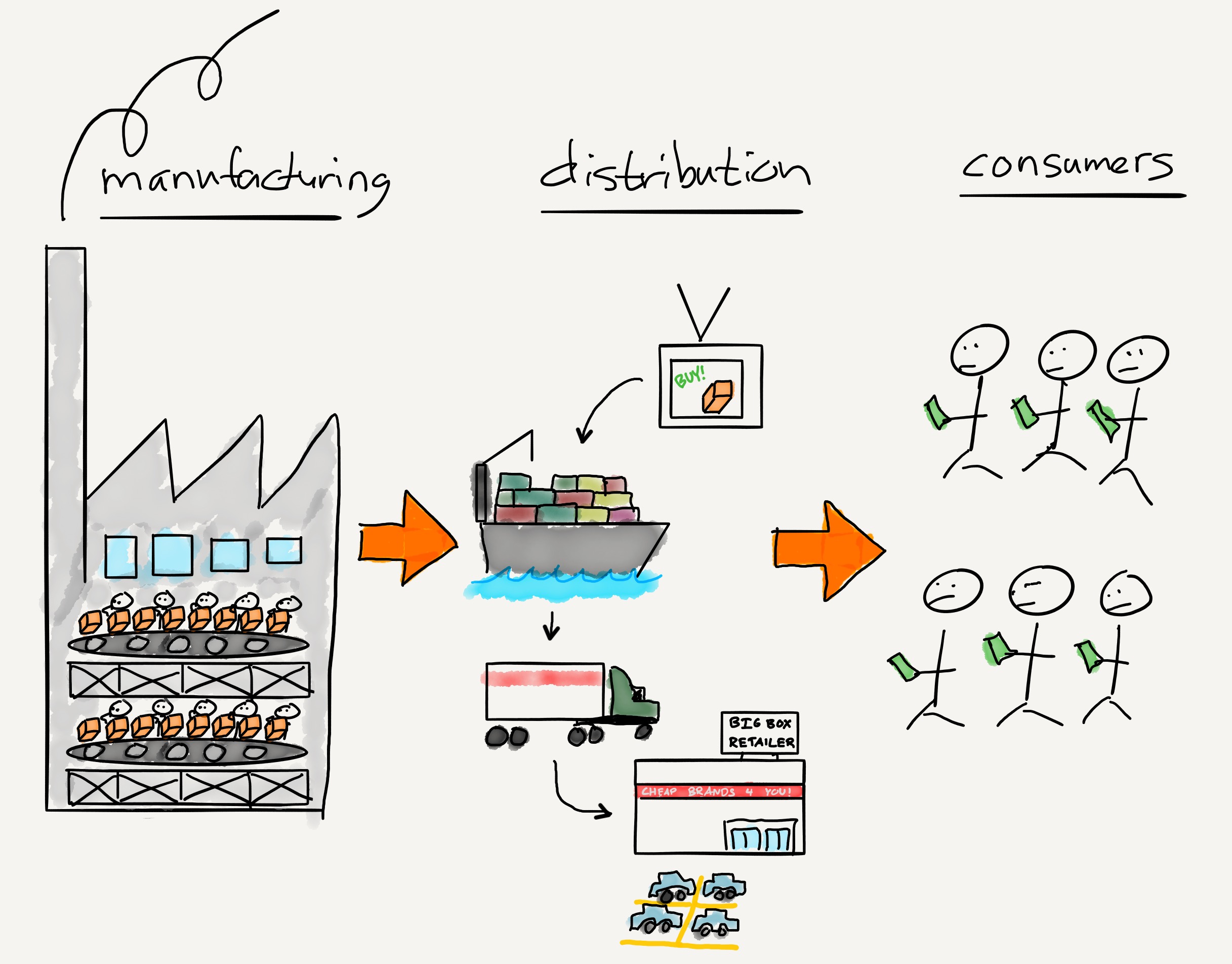
> Start with production: there certainly was a point in human history when
> economic power was derived through the control of resources and the
> production of scarce goods:
>
> [image: fullsizerender]
> <https://stratechery.com/wp-content/uploads/2017/02/FullSizeRender.jpg>
>
> However, for most products this has not been the case for well over a
> century; first the industrial revolution and then the advent of the
> assembly-line method of manufacturing resulted in an abundance of products.
> The new source of economic power became distribution: the ability to get
> those mass-produced products in front of customers who were inclined to buy
> them:
>
> [image: fullsizerender-2]
> <https://stratechery.com/wp-content/uploads/2017/02/FullSizeRender-2.jpg>
>
> Today the fundamental impact of the Internet
> <https://stratechery.com/2016/the-state-of-technology-at-the-end-of-2016/>
> is to make distribution itself a cheap commodity — or in the case of
> digital content, completely free. And that, by extension, is why I have long
> argued <https://stratechery.com/2013/friction/> that the Internet
> Revolution is as momentous as the Industrial Revolution: it is transforming
> how and where economic value is generated, and thus where power resides:
>
> [image: img_0138]
> <https://stratechery.com/wp-content/uploads/2017/02/IMG_0138.png>
>
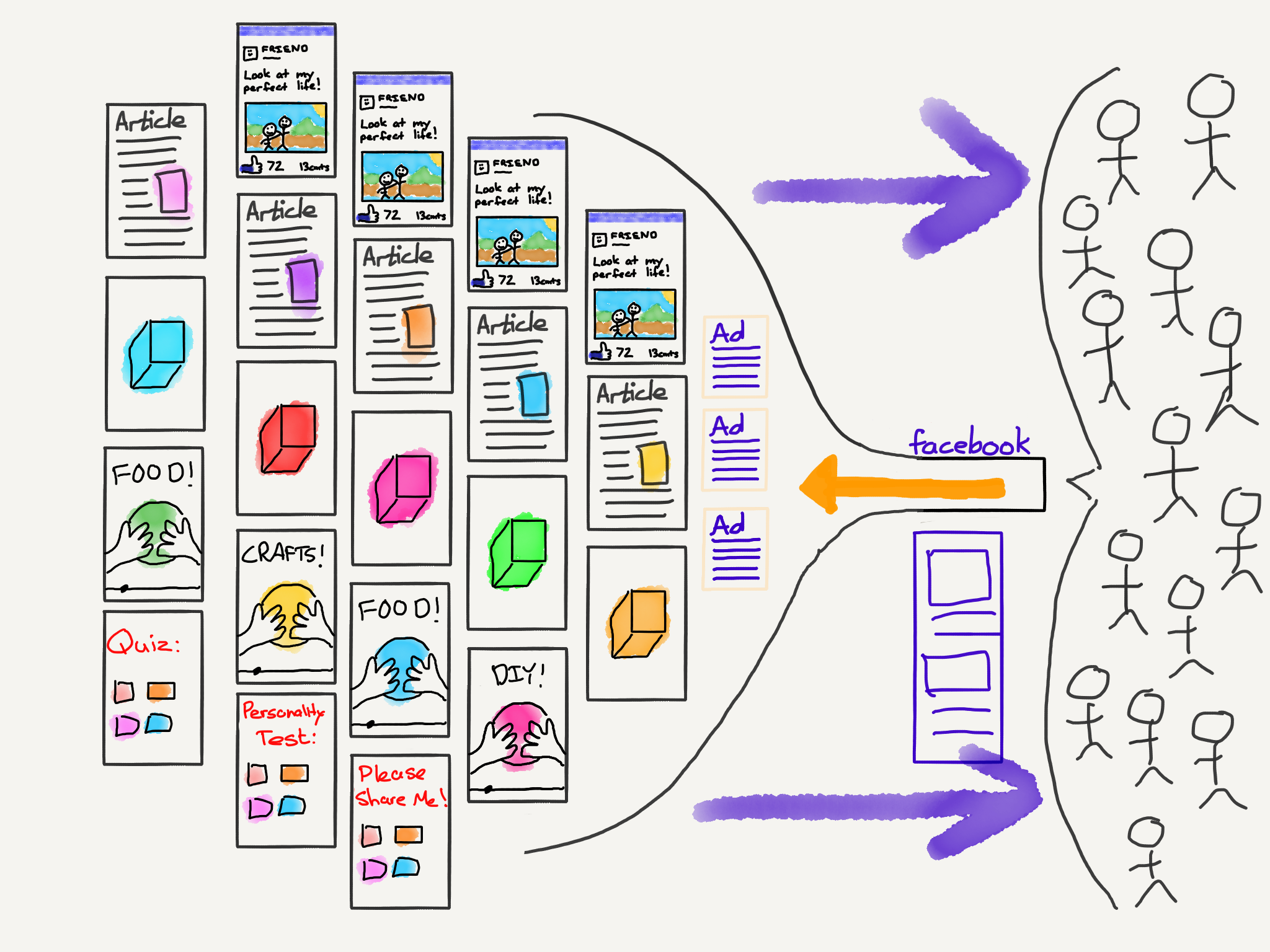
> In this brave new world, power comes not from production, not from
> distribution, but from controlling consumption: all markets will be
> demand-driven <https://stratechery.com/2015/aggregation-theory/>; the
> extent to which they already are is a function of how digitized they have
> become <https://stratechery.com/2015/airbnb-and-the-internet-revolution/>.
>
> This is why most Facebook-fail-fundamentalists so badly miss the point:
> that the company pays nothing for its content is not a weakness, it is a
> reflection of the fundamental reality that the supply of content (and
> increasingly goods) is infinite, and thus worthless; that the company is
> not essential to the distribution of products is not a measure of its
> economic importance, or lack thereof, but a reflection that distribution is
> no longer a differentiator. And last of all, the fact that communication is
> possible on other platforms is to ignore the fact that communication will
> always be easiest on Facebook, because they own the social graph. Combine
> that with the fact that controlling consumption is about controlling
> billions of individual consumers, all of whom will, all things being equal,
> choose the easy option, and you start to appreciate just how dominant
> Facebook is.
>
> Given this reality, why would Zuckerberg want to be President? He is not
> only the CEO of Facebook, he is the dominant shareholder as well,
> answerable to no one. His power and ability to influence is greater than
> any President subject to political reality and check-and-balances, and
> besides, as Zuckerberg made clear last week
> <https://www.facebook.com/notes/mark-zuckerberg/building-global-community/10103508221158471/?pnref=story>,
>
> his concern is not a mere country but rather the entire world.
> Facebook Unease
>
> The argument that Facebook is more powerful than most realize is not a new
> one on Stratechery; in 2015 I wrote The Facebook Epoch
> <https://stratechery.com/2015/the-facebook-epoch/> that made similar
> points about just how underrated Facebook was, particularly in Silicon
> Valley. In my role as an analyst I can’t help but be impressed: I have
> probably written more positive pieces about Facebook than just about any
> other company, and frankly, still will.
>
> And yet, if you were to take a military-type approach to analysis —
> evaluating Facebook based on capabilities, not intent — the company is, for
> the exact same reasons, rather terrifying. Last year in The Voters Decide
> <https://stratechery.com/2016/the-voters-decide/> I wrote:
>
> Given their power over what users see Facebook could, if it chose, be the
> most potent political force in the world. Until, of course, said meddling
> was uncovered, at which point the service, having so significantly betrayed
> trust, would lose a substantial number of users and thus its lucrative and
> privileged place in advertising, leading to a plunge in market value. In
> short, there are no incentives for Facebook to explicitly favor any type of
> content beyond that which drives deeper engagement; all evidence suggests
> that is exactly what the service does.
>
> The furor last May over Facebook’s alleged tampering with the Trending
> Topics box — and Facebook’s overwrought reaction
> <https://stratechery.com/2016/defending-facebook-amazon-video-direct/> to
> even the suggestion of explicit bias — seemed to confirm that Facebook’s
> incentives were such that the company would never become overtly political.
> To be sure, algorithms are written by humans, which means they will always
> have implicit bias, and the focus on engagement has its own harms,
> particularly the creation of filter bubbles
> <https://stratechery.com/2016/the-real-problem-with-facebook-and-the-news/>
> and fake news <https://stratechery.com/2016/fake-news/>, but I have
> longed viewed Facebook’s use for explicit political ends to be the greatest
> danger of all.
>
> This is why I read Zuckerberg’s manifesto, Building a Global Community
> <https://www.facebook.com/notes/mark-zuckerberg/building-global-community/10103508221158471/?pnref=story>,
>
> with such alarm. Zuckerberg not only gives his perspective on how the world
> is changing — and, at least in passing, some small admission that
> Facebook’s focus on engagement may have driven things like filter bubbles
> and fake news — but for the first time explicitly commits Facebook to
> playing a central role in effecting that change in a manner that aligns
> with Zuckerberg’s personal views on the world. Zuckerberg writes:
>
> This is a time when many of us around the world are reflecting on how we
> can have the most positive impact. I am reminded of my favorite saying
> about technology: “We always overestimate what we can do in two years, and
> we underestimate what we can do in ten years.” We may not have the power to
> create the world we want immediately, but we can all start working on the
> long term today. In times like these, the most important thing we at
> Facebook can do is develop the social infrastructure to give people the
> power to build a global community that works for all of us.
>
> For the past decade, Facebook has focused on connecting friends and
> families. With that foundation, our next focus will be developing the
> social infrastructure for community — for supporting us, for keeping us
> safe, for informing us, for civic engagement, and for inclusion of all.
>
> It all sounds so benign, and given Zuckerberg’s framing of the
> disintegration of institutions that held society together, helpful, even.
> And one can even argue that just as the industrial revolution shifted
> political power from localized fiefdoms and cities to centralized
> nation-states, the Internet revolution will, perhaps, require a shift in
> political power to global entities. That seems to be Zuckerberg’s position:
>
> Our greatest opportunities are now global — like spreading prosperity and
> freedom, promoting peace and understanding, lifting people out of poverty,
> and accelerating science. Our greatest challenges also need global
> responses — like ending terrorism, fighting climate change, and preventing
> pandemics. Progress now requires humanity coming together not just as
> cities or nations, but also as a global community.
>
> There’s just one problem: first, Zuckerberg may be wrong; it’s just as
> plausible to argue that the ultimate end-state of the Internet Revolution
> is a devolution of power to smaller more responsive self-selected entities
> <http://slatestarcodex.com/2014/06/07/archipelago-and-atomic-communitarianism/>.
>
> And, even if Zuckerberg is right, is there anyone who believes that a
> private company run by an unaccountable all-powerful person that tracks
> your every move for the purpose of selling advertising is the best possible
> form said global governance should take?
> The Cost of Monopoly
>
> My deep-rooted suspicion of Zuckerberg’s manifesto has nothing to do with
> Facebook or Zuckerberg; I suspect that we agree on more political goals
> than not. Rather, my discomfort arises from my strong belief that
> centralized power is both inefficient and dangerous: no one person, or
> company, can figure out optimal solutions for everyone on their own, and
> history is riddled with examples of central planners ostensibly acting with
> the best of intentions — at least in their own minds — resulting in the
> most horrific of consequences; those consequences sometimes take the form
> of overt costs, both economic and humanitarian, and sometimes those costs
> are foregone opportunities and innovations. Usually it’s both.
>
> Facebook is already problematic for society when it comes to opportunity
> costs. While the Internet — specifically, the removal of distribution as
> a bottleneck <https://stratechery.com/2016/facebook-versus-the-media/> —
> is the cause of journalism’s woes, it is Facebook that has gobbled up all
> of the profits in publishing
> <https://stratechery.com/2014/newspapers-are-dead-long-live-journalism/>.
> Twitter, a service I believe is both unique and essential
> <https://stratechery.com/2016/why-twitter-must-be-saved/>, was squashed
> by Facebook <https://stratechery.com/2016/how-facebook-squashed-twitter/>;
> I suspect the company’s struggles for viability are at the root of the
> service’s inability to evolve or deal with abuse. Even Snapchat, led by the
> most
> visionary product person <https://stratechery.com/2016/snapchats-ladder/>
> tech has seen in years, has serious questions about its long-term
> viability <https://stratechery.com/2017/snaps-apple-strategy/>. Facebook
> is too dominant: its network effects are too strong, and its data on every
> user on the Internet too compelling to the advertisers other
> consumer-serving businesses need to be viable entities.
>
> I don’t necessarily begrudge Facebook this dominance; as I alluded to
> above I myself have benefited from chronicling it. Zuckerberg identified a
> market opportunity, ruthlessly exploited it with superior execution, had
> the humility to buy when necessary
> <https://stratechery.com/2014/social-conglomerate/> and the audacity to
> copy well <https://stratechery.com/2016/the-audacity-of-copying-well/>,
> and has deservedly profited in the face of continual skepticism. And
> further, as I noted, as long as Facebook was governed by the
> profit-maximization incentive, I was willing to tolerate the company’s
> unintended consequences: whatever steps would be necessary to undo the
> company’s dominance, particularly if initiated by governments, would have
> their own unintended consequences. And besides, as we saw with IBM and
> Windows, markets are far more effective than governments at tearing down
> the ecosystem-based monopolies they enable — in part because the pursuit of
> profit-maximizing strategies is a key ingredient of disruption
> <https://hbr.org/1995/01/disruptive-technologies-catching-the-wave>.
>
> That, though, is why for me this manifesto crosses the line: contra
> Spiderman, Facebook’s great power does not entail great responsibility;
> said power ought to entail the refusal to apply it, no matter how
> altruistic the aims, and barring that, it is on the rest of us to act in
> opposition.
> Limiting Facebook
>
> Of course it is one thing to point out the problems with Facebook’s
> dominance, but it’s quite another to come up with a strategy for dealing
> with it; too many of the solutions — including demands that Zuckerberg use
> Facebook for political ends — are less concerned with the abuse of power
> and more with securing said power for the “right” causes. And, from the
> opposite side, it’s not clear that a traditional antitrust is even possible
> for companies governed by Aggregation Theory
> <https://stratechery.com/2015/aggregation-theory/>, as I explained last
> year in Antitrust and Aggregation
> <https://stratechery.com/2016/antitrust-and-aggregation/>:
>
> To briefly recap, Aggregation Theory is about how business works in a
> world with zero distribution costs and zero transaction costs; consumers
> are attracted to an aggregator through the delivery of a superior
> experience, which attracts modular suppliers, which improves the experience
> and thus attracts more consumers, and thus more suppliers in the
> aforementioned virtuous cycle…
>
> The first key antitrust implication of Aggregation Theory is that, thanks
> to these virtuous cycles, the big get bigger; indeed, all things being
> equal the equilibrium state in a market covered by Aggregation Theory is
> monopoly: one aggregator that has captured all of the consumers and all of
> the suppliers.
>
> This monopoly, though, is a lot different than the monopolies of
> yesteryear: aggregators aren’t limiting consumer choice by controlling
> supply (like oil) or distribution (like railroads) or infrastructure (like
> telephone wires); rather, consumers are self-selecting onto the
> Aggregator’s platform because it’s a better experience.
>
> Facebook is a particularly thorny case, because the company has multiple
> lock-ins: on one hand, as per Aggregation Theory, Facebook has completely
> modularized and commoditized content suppliers desperate to reach
> Facebook’s massive user base; it’s a two-sided market in which suppliers
> are completely powerless. But so are users, thanks to Facebook’s network
> effects: the number one feature of any social network is whether or not
> your friends or family are using it, and everyone uses Facebook (even if
> they also use another social network
> <https://stratechery.com/2016/what-facebook-is-and-isnt/> as well).
>
> To that end, Facebook should not be allowed to buy another network-based
> app; I would go further and make it *prima facie* anticompetitive for one
> social network to buy another. Network effects are just too powerful to
> allow them to be combined. For example, the current environment would look
> a lot different if Facebook didn’t own Instagram or WhatsApp (and, should
> Facebook ever lose an antitrust lawsuit, the remedy would almost certainly
> be spinning off Instagram and WhatsApp).
>
> Secondly, all social networks should be required to enable social graph
> portability — the ability to export your lists of friends from one network
> to another. Again Instagram is the perfect example: the one-time
> photo-filtering app launched its network off the back of Twitter by
> enabling the wholesale import of your Twitter social graph. And, after it
> was acquired by Facebook, Instagram has only accelerated its growth by
> continually importing your Facebook network. Today all social networks have
> long since made this impossible, making it that much more difficult for
> competitors to arise.
>
> Third, serious attention should be given to Facebook’s data collection on
> individuals. As a rule I don’t have any problem with advertising, or even
> data collection, but Facebook is so pervasive that it is all but impossible
> for individuals to opt-out in any meaningful way, which further solidifies
> Facebook’s growing dominance of digital advertising.
> ------------------------------
>
> Anyone who has read Stratechery for any length of time knows I have great
> reservations about regulation; the benefits are easy to measure, but the
> opportunity costs are both invisible and often far greater. That, though,
> is why I am also concerned about Facebook’s dominance: there are
> significant opportunity costs to the social network’s dominance. Even then,
> my trepidation about any sort of intervention is vast, and that leads me
> back to Zuckerberg’s manifesto: it’s bad enough for Facebook to have so
> much power, but the very suggestion that Zuckerberg might utilize it for
> political ends raises the costs of inaction from not just opportunity costs
> to overt ones.
>
> Moreover, my proposals are in line with Zuckerberg’s proclaimed goals: if
> the Facebook CEO truly wants to foster new kinds of communities, then he
> ought to unleash the force that can best build the tools those disparate
> communities might need. That, of course, is the market, and Facebook’s
> social graph is the key. That Zuckerberg believes Facebook can do it alone
> is evidence enough that for Zuckerberg, saving the world is at best a close
> second to saving Facebook; the last thing we need are unaccountable leaders
> who put their personal interests above those they purport to govern.
>
>
> Sent from my iPhone
>

--
--
Centroids: The Center of the Radical Centrist Community
<[email protected]>
Google Group: http://groups.google.com/group/RadicalCentrism
Radical Centrism website and blog: http://RadicalCentrism.org

---
You received this message because you are subscribed to the Google Groups
"Centroids: The Center of the Radical Centrist Community" group.
To unsubscribe from this group and stop receiving emails from it, send an email
to [email protected].
For more options, visit https://groups.google.com/d/optout.