Following is an article that pretty well  captures my thinking about
economics
the past few weeks. De Dora's essay refers  to an article by Massimo
Pigliucci.
That essay is included verbatim, below,  word-for-word. This is because
it makes it easy for readers to find it and  read it without
hop-skip-and-jump
links and the need to reformat if you  actually want to save or re-use
something. Here it is, ready to  go.

This is part of my war against reflexive  use of links and about formatting
generally
-a subject that seems to sail over the  heads of tech whizzes obsessed with
the functions of computers and not  ease-of-use.


But everybody does it that way? Maybe they  do, but it has been my
experience that what "everybody does" is  usually wrong, at least to
consider the kinds of issues now under  review.

De Dora's article has been edited to cut  out such things as his aside
about writer's block, etc, which isn't  really germane to the topic.


A larger point is that it has stuck me that just about ANY discussion  of
economics needs to also be a discussion of morality. Not in some  clumsy
ham-fisted way, preaching church doctrine, but on behavioral merits.
Just what does this policy (your pick, infrastructure like the Dakota
access pipeline or anything else, or protectionism, or free trade)
actually do to human behavior or the health of American communities?

Economists call such considerations "externals." It is handy to know  about
this word usage, but what is really external about it?  It  goes directly to
the nature of the kind of society we want to live in and to the
quality of life we want for ourselves.

This is parallel to another insight that recently flew into my head
from work on the issue of the effects of Popular Culture.

What is religion?  Here is what most (overwhelmingly most) religious  people
simply do not "get."  For them there is true religion, their own,  which
they
may not call "religion" at all but something like "faith" or "spiritual
path"
or the like. Some other religions may be sort of junior partners,
the way that Judaism is regarded by most Christians, but outside
of that, most "other" religions are side shows of no real interest.

This is even largely true among Evangelicals in Hawaii, where
you would think it would make really good sense for them
to look into Buddhism, since Buddhists are 1/4th of the population.
While there actually is some heightened interest in Buddhism among
Hawaiian Evangelicals it is only marginally greater than on the  mainland.

There is no sense that there are such things as religious phenomena
that cut across just about all faiths and that it is legitimate to  see
something of Christian morality in other religions, for instance,
or something of psychology familiar to Buddhists existing
in some schools of Hinduism, for example.

That is, with the glaring exception of  Islam and some off-the-charts  cults
(Scientology, Satanism, etc), nearly all religions have common  foundations
-not in everything, obviously, but in a lot of basics. You know, how  do
people treat each other?  What should marriage consist of? What  behaviors
simply do not fly if we want a functional community?

The point of all this is that if we want a moral society we would be
well advised to look into the moral effects of religious faith  regardless
of which specific religion we are most familiar with. If religion
is subtracted, if the secular / libertarian / economistic war against
religion continues what would the consequences be?

And what substitutes for religion would arise? What new "religions"
that don't look like religions but have religious functions?

Economics and morality are similar. Just what are we getting  morally
when we adopt one economic policy and not another?  What is  important
to remember is that "morality" has a much broader definition then
conventional church-designated morality

Social issues are "nothing but" wedge issues and are not really  important?
That is just as much a load of crap as economic determinism, indeed,
it is a re-statement of economic determinism. Which even the Left
does not really believe because, you see, calling something a
wedge issue trivializes it so that the favorite social issues  of
the Left can prevail.

We need to wake up to the effects  -nearly all of them negative-
of libertarian thinking and values on our lives.


Billy


====================================


Economics should not be divorced  from morality

By: Michael De Dora

2011

---------------------------------


Last week, our friend Massimo Pigliucci _published an  essay_
(http://rationallyspeaking.blogspot.com/2011/07/why-i-dont-like-larry-summers.html)
  here
in which he argued  for
an idea I have long thought to be  true: that economic considerations
cannot be  divorced    from moral ones. Here is the appropriate passage from
Massimo’s  article:
“I simply do not buy the fundamentalist (yes, I’m  using the term on
purpose) libertarian       idea that economics is all there is or that should
count in pretty  much  all                            human    transactions and
social problems. The hallmark of a  just society  is
precisely that it does     consider issues of intrinsic  rights — not just
to life and property,    as the  libertarians              would   have it —
but also to health, education, housing  and      jobs. Thewhole point of
living in a structured society, as  opposed to Hobbes’ war of all   against
all, is so that our lives are  not going to be ‘solitary, poor, nasty, brutish
and short.’ Which means that  what [Larry] Summers dismisses as ‘social
concerns’ really ought to be central  to the way we structure our societies.
Economic systems ought to  be                      the servants of human
flourishing, not  itsmasters.”


The idea I  would like to propose in this brief essay is this: economics
cannot be divorced  from morality because one’s values determine which
economic structure he or she  prefers. There are no such things as purely
economic
ends divorced from all  other ends because economic decisions are made based
on moral values. They also  have a moral impact on other people

Morality is the sphere of one’s  foundational beliefs and attitudes about
right and wrong. Economics is the  matter of how to set up and manage the
financial situation of a given society or  community. I think it is clear that
morality, by its very definition, will play  a major role in shaping the
economic structure of a given society. Morality  simply shapes how we approach
most things in life, including economics. I also  submit that economics is
inextricably tied to the welfare of the citizens for  which it functions.

But  people in several political camps, namely libertarianism and
neoliberalism,  disagree that economics is so closely linked with morality.
They
believe economics is a discussion about  business and bottom-lines, not ethics.
This divide is also present in political  news coverage. Take _this quote_
(http://dispatchpolitics.com/live/content/insight/stories/2011/05/08/can-faith
-have-a-prayer-in-politics.html?sid=101)  from Mark Caleb Smith, director
of the  Center for Political Studies at Cedarville University: “Economic
issues always  dwarf social issues. … [The 2012 election] is shaping up to be
an
economically  driven election with a possibility of foreign affairs
entering the discussion as  well.” This is precisely how most news outlets and
polling organizations frame  pre-election public sentiments.

How many times have you heard that “people  are voting on the economy, not
social issues, this election cycle"?


Yet, while economic issues are in some way different  than social ones — in
the same way that, say, economics and philosophy are two  different fields —
 they are also undoubtedly  intertwined at many levels.  At the
interpersonal level, business transactions hinge on  a        basic sense of
morality.


When you purchase something, you trust that  your source of information
(sales person, gas attendant, waiter/waitress,  Amazon.com review) is being
honest about the quality of the goods offered. You  also expect a certain
degree of performance from the product you are  buying

Morality  is also present in larger economic debates. Consider the question
“how can we  create jobs?” At face value, there might be little in this
question that  concerns morality. It is simply about increasing the number of
jobs available to  human beings. But what if I        answered  that the way
to create jobs is to eliminate the minimum wage? Or to  loosen
restrictions on workday hours  and factory conditions? Or to lower the tax
burden
 on        corporations and the wealthy? Or to repeal last year’s health
insurance  reform                   package?    These questions all contain a
moral aspect as well.

Would it be right to allow  companies  to pay their employees however
little they can get away with? Would  it be       right to rescind worker
safety
laws? Would it be right to increase the tax  burdens on the    middle  and
        lower classes and  allow further disparity? Would it be right to
repeal      legislation that increases the  availability
of health care?

No matter  where you stand on these issues, you cannot deny there is a
moral component to  all of them.

Someone  might desire to settle the debate by asking, “what is best for the
economy?" But  my point is that, at bottom, the question of “what is best
for the economy” is  really a question of “what should we want the economy
to do or accomplish?” And  that is a question not of pure mathematical
reasoning, but of ethical  contemplation.

In closing, allow me to spell out how I  think the relationship between
morality and economics might work. The first step  is to figure out our
necessary assumptions. For instance, what is the nature of  human behavior and
desires? How do humans act and interact? The second step is  to think about our
shared moral goals. I think the _U.N. Declaration of Human  Rights_
(http://www.un.org/en/documents/udhr/)  is a good starting place for that. The
last
step is then to assess which economic ideas and systems to employ so that
our assumptions can be taken into account and that our goals can be
realized.  Economics is not just about studying and applying knowledge of
trends,
numbers,  math, and business practices. It is also about taking into account
the reality  of human behavior and our moral concerns before making economic
decisions — and  then considering the moral consequences of those  decisions


=======================================


July 12, 2011
Massimo Pigliucci's  Blog

_Why I don't like Larry  Summers_
(https://www.goodreads.com/author_blog_posts/1369149-why-i-don-t-like-larry-summers)


by Massimo Pigliucci
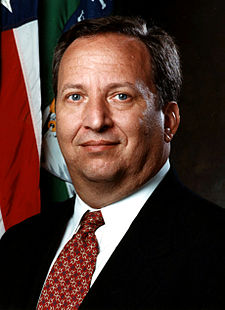
(http://3.bp.blogspot.com/-K9EkHXI2H10/ThoSNc9ro4I/AAAAAAAAD3Q/4dILpUXl8UY/s1600/Summers.jpg)


I have to admit to a profound dislike for  former Harvard President and
former Obama (and Clinton) advisor Larry Summers.  Besides the fact that, at
least going by a number of reports of people who have  known him, he can only
be characterized as a dick, he represents precisely what  is wrong with a
particularly popular mode of thinking in this country and,  increasingly, in
the rest of the world.

Lawrence was famously forced to resign as  president of Harvard in 2006
because of a no-confidence vote by the faculty  (wait, academics still have any
say in how universities are run? Who knew?)  because of a variety of
reasons, including his conflict with academic star  Cornel West, financial
conflict of interests regarding his dealings with  economist Andrei Shleifer,
and
particularly his remarks to the effect that  perhaps the scarcity of women in
science and engineering is the result of innate  intellectual differences.

Now I have acquired yet another reason to  dislike Summers, while reading
Debra Satz's _Why Some Things  Should not Be for Sale _
(http://www.amazon.com/Why-Some-Things-Should-Sale/dp/0195311590/ref=sr_1_1?s=books&ie=UTF8&qid=13
10320351&sr=1-1) :  The Moral Limits of Markets,  which I highly recommend
to my libertarian friends, as much as I realize of  course that it will be
entirely wasted on them. The book is a historical and  philosophical analysis
of ideas about markets, and makes a very compelling case  for why thinking
that "the markets will take care of it" where "it" is pretty  much anything
of interest to human beings is downright idiotic (as well as  profoundly
unethical).But I'm not concerned here with Satz's book per se, as  much as with
the instance in which she discusses for her purposes, a memo  written by
Summers when he was chief economist of the World Bank  ...

The  memo was intended for internal WB use only, but it caused a public
uproar when  the, surely not left-wing, magazine The  Economist leaked it to
the public. Here is an  extract from the memo (emphasis mine): "Just between
you and me, shouldn't the  World Bank be encouraging more migration of the
dirty industries to the less  developed countries? I can think of three
reasons: 1. The measurement of the  costs of health-impairing pollution depends
on
the foregone earnings from  increased morbidity and mortality. From this
point of view a given amount of  health-impairing pollution should be done in
the country with the lowest cost,  which will be the country with the lowest
wages. I think the  economic logic behind dumping a load of toxic waste in
the lowest wage country  is impeccable and we should face up to that. 2. The
 costs of pollution are likely to be non-linear as the initial increments
of  pollution probably have very low cost ... Only the lamentable facts that
so much  pollution is generated by non-tradable industries (transport,
electrical  generation) and that the unit transport costs of solid waste are so
high prevent  world-welfare enhancing trade in air pollution and waste. 3.
The demand for a  clean environment for aesthetic and health reasons is likely
to have very high  income elasticity ... Clearly trade in goods that embody
aesthetic pollution  concerns could be welfare enhancing.

The  problem with the  arguments against all of these proposals for more
pollution in least developed  countries (intrinsic rights to certain goods,
social concerns, lack of adequate  markets, etc.)could  be turned around and
used more or less effectively against every Bank proposal  for
liberalization. "Now,  pause for a minute, go back to the top of the memo, and
read it
again.  I  suggest that if you find nothing disturbing about it, your empathic
circuitry  needs a major overhaul or at the very least a serious tuneup.
But it's  interesting to consider why.  As both The  Economist (who called the
memo "crass") and Satz  herself note, the economic logic of the memo is
indeed impeccable.

If  one's only considerations are economic in nature, it does make perfect
sense for  less developed countries to accept (for a — probably low —
price) the waste  generated by richer countries, for which in turn it makes
perfect sense to pay a  price to literally get rid of their shit. And yet, as I
mentioned, the leaking  of the memo was accompanied by an outcry similar to
the one generated by the  equally infamous  "_Ford Pinto  memo_
(http://www.dummies.com/how-to/content/true-conspiracy-the-ford-pinto-memorandum.html)
 "
back in 1968.  Why? Here I actually have a take that is somewhat different
from, though complementary to, that of Satz.

For  her, there are three ethical objections that can be raised to the
memo: first,  she maintains that there is unequal vulnerability of the parties
involved in the  bargain. That is, the poor countries are in a position of
marked disadvantage  and are easy for the rich ones to exploit.  Second, the
less developed  countries likely suffer from what she calls weak agency,
since they tend  to be run by corrupt governments whose actions are not in the
interest of the  population at large (whether the latter isn't also true of
American plutocracy  is, of course, a matter worth pondering).  Third, the
bargain is likely to  result in an unacceptable degree of harm to a number of
individuals (living in  the poor countries) who are not going to
simultaneously enjoy any of the profits  generated from the "exchange.

"I  think all these reasons surely hold, but I would go further and talk of
 precisely the sorts of things Summers himself mentions in the memo,
particularly intrinsic rights to certain goods and social concerns. I simply do

not buy the fundamentalist (yes, I'm using the term on purpose) libertarian
idea  that economics is all there is or that should count in pretty much
all human  transactions and social problems. The hallmark of a just society is
precisely  that it does consider issues of intrinsic rights — not just to
life and  property, as the libertarians would have it — but also to health,
education,  housing and jobs.

The whole  point of living in a structured society, as  opposed to Hobbes'
war of all against all, is so that our lives are not going to  be "solitary,
poor, nasty, brutish and short." Which means that what Summers  dismisses
as "social concerns" really ought to be central to the way we  structure our
societies.

Economic  systems ought to be the servants of human flourishing, not its
masters.

The  only serious question here is what was someone like Summers doing in
both the  Clinton and Obama administrations? The answer is that this (and
plenty of other  inconvenient or disturbing facts, depending on your political
persuasion)  clearly shows that both Clinton and Obama were moderate
centrists, certainly not  the "socialists" and "radicals" that
Republican-generated
nonsense would have  them be.

By  the way, did you notice Summers' point that if one objected to his memo
on  ethical grounds one may just as well object to pretty much every policy
 suggested by the World Bank? Ponder the consequences, then start asking
for the  closing or radical restructuring of the World Bank.[image  error]

--
--
Centroids: The Center of the Radical Centrist Community
<[email protected]>
Google Group: http://groups.google.com/group/RadicalCentrism
Radical Centrism website and blog: http://RadicalCentrism.org

---
You received this message because you are subscribed to the Google Groups
"Centroids: The Center of the Radical Centrist Community" group.
To unsubscribe from this group and stop receiving emails from it, send an email
to [email protected].
For more options, visit https://groups.google.com/d/optout.