“Fiscal and monetary policy both have a place in policymakers’ toolkits.
Perhaps the ideal combination would be to use fiscal to stimulate the economy
and monetary to cool it down.”
This makes sense to me, but my first glance at the chart made me think of an
entirely different explanation for the split between productivity and hourly
compensation… technology.  We have leveraged each worker with robotics and
other technological wonders.  This has decimated the historical “assembly line”
worker who made a great living, thanks to his or her labor union.


Those who have the technical ability to develop and run the high-tech devices
are doing fine, those who lack those skills are flipping burgers (maybe a
machine does that too) at McDonalds.  Hence, the lower system-wide average
hourly wage.  I think that fiscal policy and monetary policy are the tails
wagging the dog regarding this metric.


Chris


From: [email protected]
[mailto:[email protected]] On Behalf Of Centroids
Sent: Monday, August 7, 2017 9:27 AM
To: Centroids Discussions <[email protected]>
Subject: [RC] How to Use Fiscal and Monetary Policy to Make Us Rich Again -
Evonomics


I think he's on to something, but it feels a bit naive. Fiscal policy earned
its contempt in the 1970s, the way monetary is earning it now. I suspect we
need something new, not just a return to the past.


How to Use Fiscal and Monetary Policy to Make Us Rich Again - Evonomics
http://evonomics.com/how-to-use-fiscal-monetary-policy-make-us-rich/
(via Instapaper <http://www.instapaper.com/> )

  _____

During the post war Golden Age, from 1950 to 1973, US median real wages more
than doubled. Today, they are lower than they were when Jimmy Carter was
President <https://fred.stlouisfed.org/series/LEU0252881900A> . If you want an
explanation why Americans are pessimistic about their future, that is as good a
reason as any. In a recent article, Noah Smith
<https://www.bloomberg.com/view/articles/2017-04-24/cracking-the-mystery-of-labor-s-falling-share-of-gdp>
  examines the various causes of the slide in labor’s share of national income
and finds most explanations wanting. With a blind spot common amongst
economists he doesn’t even investigate the most obvious: politics.

 <http://evonomics.com/wp-content/uploads/2017/08/1.png>

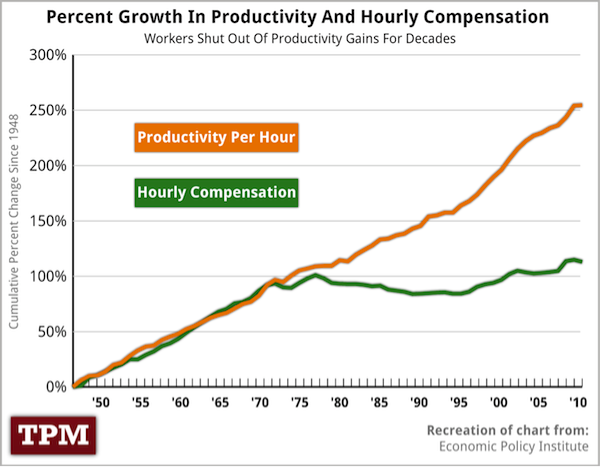
Take a look at this chart. From the end of World War II, productivity rose
steadily. Until the 1972 recession wages went up alongside it. Both dipped,
both recovered and then, right around the time Ronald Reagan became President,
productivity continued its upward trajectory but wages stopped following. If
wages had continued to track productivity increases, the average American would
earn twice as much as he does today and America would undoubtedly be a calmer
and happier nation.

Collectively we are richer than we were 40 years ago, as we should be,
considering the incredible advances in technology since them, but today the
benefits of productivity increases no longer go to workers but rather to owners
of stocks, bonds, and real estate. Wages don’t go up, but asset prices do.
Rising productivity, that is to say the ability to make more goods and services
with fewer inputs of labor and capital should make us all more prosperous. That
it hasn’t can only be a distributional issue.

The timing suggests Ronald Reagan had something to do stagnating wages. That
makes sense. Reagan cut taxes on the rich, deregulated the economy, eviscerated
the labor unions and created the neoliberal order that still rules today. But
perhaps an even more significant change is the tiny, technical and tedious
shift from fiscal to monetary policy.

Government has two ways of affecting the economy: monetary and fiscal policy.
The first involves the setting of interest rates, the other government tax and
spending policy. Both fiscal and monetary policy work by putting money in
people’s pockets so they will spend and thereby stimulate the economy but
fiscal focuses on workers while monetary mostly benefits the already rich.
Since Ronald Reagan, even under Democratic presidents, monetary has been the
policy of choice. No wonder wages stopped going up but real estate, stock and
bond prices have gone through the roof. During the Golden Age we shared the
benefits of technological progress through wages gains. Since Reagan, we have
allocated them through asset price inflation.


Get Evonomics in your inbox


Fiscal policy, by increasing government spending, creates jobs and so raises
wages even in the private sector. Monetary policy works mostly through the
wealth effect. Lower interest rates almost automatically raise the value of
stocks, bonds, and other real assets. Fiscal policy makes workers richer,
monetary policy makes rich people richer. This, I suspect, explains better than
anything else why monetary policy, even extreme monetary policy remains more
respectable than even conventional monetary policy.

During the Golden Age, fiscal was king. Wages rose steadily and everybody was
richer than their parents. Recessions were short and shallow. Economic policy
makers’ primary task was insuring full unemployment. Anytime unemployment rose
over a certain level, a government spending boost or tax cut would get the
economy going again. And since firms were confident the government would never
allow a steep downturn, they were ready and willing to invest in new technology
and increased productive capacity. The economy grew faster (and more equitably)
than it ever has before or since.

During the 1960s, Keynesian economists thought they could “fine tune” the
economy, using Philips curve trade offs between inflation and unemployment.
Stagflation in the 1970s shattered that optimism. Inflation went up but so did
unemployment. New Classical economists decided in the long run, Keynesian
stimulus couldn’t increase GDP, it could only accelerate inflation.
Keynesianism stopped being cool. According to Robert Lucas, graduate students,
would “snicker” whenever Keynesian concepts were mentioned.

In policy circles, Keynesians were replaced by monetarists, acolytes of Milton
“Inflation is always and everywhere a monetary phenomenon” Friedman. Volcker in
America and Thatcher in Britain decided the only way to stomp out inflationary
expectations was to cut the money supply. This, despite their best efforts,
they were unable to do. Controlling the money supply proved almost impossible
but monetarism gave Volcker and Thatcher the cover to manufacture the deepest
recession since the Great Depression.

By raising interest rates until the economy screamed Volcker and Thatcher
crushed investment and allowed unemployment to rise to levels unthinkable just
a few years before. Businessmen, union leaders, and politicians pleaded for a
rate cut but the central bankers were implacable. Ending inflationary
expectations was worth the cost, they insisted. Volcker and Thatcher succeed in
crushing inflation, not by cutting the money supply, but rather with an old
fashioned Phillips curve trade off. Workers who fear for their jobs don’t ask
for cost of living increases. Inflation was history.

The Federal Funds Rate hit 20% in 1980. Now even after a few hikes, it is
barely over 1%. The story of the past 30 years is of the most stimulative
monetary policy in history. Anytime the economy stumbled, interest rate cuts
were the automatic response. Other than military Keynesianism and tax cuts,
fiscal policy was relegated to the ash heap of history. Reagan of course
combined tax cuts with increased military spending but traditional peacetime
infrastructure stimulus was tainted by the 1970s stagflation and for
policymakers remained beyond the pale.

Fiscal stimulus came back, momentarily, at the peak of the financial crisis.
China’s investment binge combined with Obama’s stimulus package probably
stopped the Great Recession from being as catastrophic as the Great Depression
but by 2010, fiscal stimulus was replaced by its opposite, austerity. According
to elementary macroeconomics, when the private sector is cutting back its
spending, as it was still doing in the wake of the financial crisis, government
should increase its spending to take up the slack. But Obama in America,
Cameron in Britain and Merkel in the EU insisted that government cut spending,
even as the private sector continued to retrench.

It is rather shocking, for anyone who has taken Econ 101 that in 2010, when the
global economy had barely recovered from the worst recession since the Great
Depression, politicians and pundits were calling for lower deficits, higher
taxes and less government spending even as monetary policy was maxed out. Rates
were already close to zero so central banks had no more room to cut.

So, instead of going to the tool box and taking out their tried and tested
fiscal kit, which would have created jobs and had the added benefit of
improving infrastructure, policymakers instead invented Quantitative Easing,
which in essence is monetary policy on steroids. Central Banks promised to buy
bonds from the private sector, increasing their price, thereby shoveling money
towards bond owners. The idea was that by buying safe assets they would push
the private sector to buy riskier assets and by increasing bank reserves they
would stimulate lending but the consequence of all the Quantitative Easings is
that all of the benefits of growth since the financial crisis have gone to the
top 5% and most of that to the top 0.1%.

A feature or a bug? The men who rule the planet are happy that most of us think
economics is boring, that we would much rather read about R Kelly’s sexual
predilections than about the difference between fiscal and monetary policy but
were we to remember that spending money on infrastructure or health care or
education would create jobs, raise wages, and create demand which the economy
craves, we would have a much more equitable world.

One cogent objection to stimulative fiscal policy is that it has the potential
to be inflationary. Indeed the fundamental goal of macroeconomic policy is to
match the economy’s demand to its ability to supply. If fiscal policy gets out
of hand (as arguably it did in the 1960s when Lyndon Johnson tried to fund both
his Great Society and the Vietnam war without raising taxes), demand could
outstrip supply, creating inflation. But should that happen, we have the
monetary tools to cure any inflationary pressure. Rates today are still barely
above zero. Should inflation threaten, central banks can raise interest rates
and nip it in the bud.

Fiscal and monetary policy both have a place in policymakers’ toolkits. Perhaps
the ideal combination would be to use fiscal to stimulate the economy and
monetary to cool it down. Both Brexit and Trump should have told elites that
unless they share the benefits of growth, a populist onslaught could threaten
all our prosperity. The easiest way to return to Golden Age tranquility and
equality is to empower fiscal policy to invest in our future and create jobs
today.

2017 August 6


Donating = Changing Economics. And Changing the World.


Evonomics is free, it’s a labor of love, and it's an expense. We spend hundreds
of hours and lots of dollars each month creating, curating, and promoting
content that drives the next evolution of economics. If you're like us — if you
think there’s a key leverage point here for making the world a better place —
please consider donating. We’ll use your donation to deliver even more
game-changing content, and to spread the word about that content to influential
thinkers far and wide.

MONTHLY DONATION
$3 / month
$7 / month
$10 / month
$25 / month

ONE-TIME DONATION
You can also become a one-time patron with a single donation in any amount.


If you liked this article, you'll also like these other Evonomics articles...


<http://evonomics.com/please-not-another-bias-the-problem-with-behavioral-economics/>


Please, Not Another Bias! The Problem with Behavioral Economics
<http://evonomics.com/please-not-another-bias-the-problem-with-behavioral-economics/>


<http://evonomics.com/economists-discover-quasi-equlibriated-economic-sub-particle/>


Economists Discover Quasi-Equlibriated Economic Sub-Particle
<http://evonomics.com/economists-discover-quasi-equlibriated-economic-sub-particle/>


<http://evonomics.com/economists-stop-defending-milton-friedmans-pseudo-science/>


Economists Should Stop Defending Milton Friedman's Pseudo-science
<http://evonomics.com/economists-stop-defending-milton-friedmans-pseudo-science/>


 <http://evonomics.com/new-keynesian-economics-betrays-keynes/>

How New Keynesian Economics Betrays Keynes
<http://evonomics.com/new-keynesian-economics-betrays-keynes/>


BE INVOLVED


We welcome you to take part in the next evolution of economics. Sign up now to
be kept in the loop!

  _____


Sent from my iPhone

--
--
Centroids: The Center of the Radical Centrist Community
<[email protected] <mailto:[email protected]> >
Google Group: http://groups.google.com/group/RadicalCentrism
Radical Centrism website and blog: http://RadicalCentrism.org

---
You received this message because you are subscribed to the Google Groups
"Centroids: The Center of the Radical Centrist Community" group.
To unsubscribe from this group and stop receiving emails from it, send an email
to [email protected]
<mailto:[email protected]> .
For more options, visit https://groups.google.com/d/optout.

--
--
Centroids: The Center of the Radical Centrist Community
<[email protected]>
Google Group: http://groups.google.com/group/RadicalCentrism
Radical Centrism website and blog: http://RadicalCentrism.org

---
You received this message because you are subscribed to the Google Groups
"Centroids: The Center of the Radical Centrist Community" group.
To unsubscribe from this group and stop receiving emails from it, send an email
to [email protected].
For more options, visit https://groups.google.com/d/optout.