Note: There also was Christian influence on Buddhism

Buddhist influences on Christianity
Wikipedia
Some scholars believe that there exist significant Buddhist influences on
Christianity reaching back to Christianity's earliest days. Buddhism was known
in the pre-Christian Greek world, and hence the later Roman
Empire<https://en.wikipedia.org/wiki/Roman_Empire>, through the campaigns of
Alexander the Great<https://en.wikipedia.org/wiki/Alexander_the_Great> (see
Greco-Buddhism<https://en.wikipedia.org/wiki/Greco-Buddhism> and Greco-Buddhist
monasticism<https://en.wikipedia.org/wiki/Greco-Buddhist_monasticism>). Several
prominent early Christian fathers (Clement of
Alexandria<https://en.wikipedia.org/wiki/Clement_of_Alexandria> and St.
Jerome<https://en.wikipedia.org/wiki/Jerome>) were certainly aware of the
Buddha, even mentioning him in their
works.[1]<https://en.wikipedia.org/wiki/Buddhist_influences_on_Christianity#cite_note-McEvilley,_p391-1>[2]<https://en.wikipedia.org/wiki/Buddhist_influences_on_Christianity#cite_note-2>
 The notion of Buddhist influence in early Christian history, however, remains
controversial.


Some historians such as Jerry H.
Bentley<https://en.wikipedia.org/wiki/Jerry_H._Bentley> and Elaine
Pagels<https://en.wikipedia.org/wiki/Elaine_Pagels> suggest that there is a
possibility that Buddhism influenced the early development of
Christianity".[3]<https://en.wikipedia.org/wiki/Buddhist_influences_on_Christianity#cite_note-3>
 There have also been suggestions of an indirect path in which Indian Buddhism
may have influenced Gnosticism<https://en.wikipedia.org/wiki/Gnosticism> and
then
Christianity.[4]<https://en.wikipedia.org/wiki/Buddhist_influences_on_Christianity#cite_note-Thundy-4>
 Some scholars hold that the suggested similarities are coincidental since
parallel traditions may emerge in different
cultures.[5]<https://en.wikipedia.org/wiki/Buddhist_influences_on_Christianity#cite_note-Grau-5>

In the East, the syncretism<https://en.wikipedia.org/wiki/Syncretism> between
Nestorian Christianity<https://en.wikipedia.org/wiki/Nestorian_Christianity>
and Buddhism was deep and widespread along the Silk
Road<https://en.wikipedia.org/wiki/Silk_Road>, and was especially pronounced in
the medieval Church of the East in
China<https://en.wikipedia.org/wiki/Church_of_the_East_in_China>.[6]<https://en.wikipedia.org/wiki/Buddhist_influences_on_Christianity#cite_note-6>
 There are also historical documents showing the syncretic nature of
Christianity and Buddhism in Asia such as the Jesus
Sutras<https://en.wikipedia.org/wiki/Jesus_Sutras> and Nestorian
Stele<https://en.wikipedia.org/wiki/Nestorian_Stele>.[not verified in
body<https://en.wikipedia.org/wiki/Wikipedia:Citation_needed>]


Despite suggestions of surface level analogies, Buddhism and
Christianity<https://en.wikipedia.org/wiki/Buddhism_and_Christianity> have
inherent and fundamental differences at the deepest levels, such as
monotheism<https://en.wikipedia.org/wiki/Monotheism>'s place at the core of
Christianity and Buddhism's orientation towards
non-theism<https://en.wikipedia.org/wiki/Non-theism>.[7]<https://en.wikipedia.org/wiki/Buddhist_influences_on_Christianity#cite_note-Numrich10-7>[8]<https://en.wikipedia.org/wiki/Buddhist_influences_on_Christianity#cite_note-Lim34-8>
 The majority of modern scholars who have studied both Buddhism and
Christianity hold that there is no direct historical evidence of any influence
by Buddhism on early
Christianity.[9]<https://en.wikipedia.org/wiki/Buddhist_influences_on_Christianity#cite_note-Buswell-9>[10]<https://en.wikipedia.org/wiki/Buddhist_influences_on_Christianity#cite_note-Leslie140-10>[11]<https://en.wikipedia.org/wiki/Buddhist_influences_on_Christianity#cite_note-PaulaF26-11>
 Scholars generally consider any such influence implausible given that first
century Jews are highly unlikely to have been open to far eastern concepts that
appeared opposed to some of their basic
beliefs.[12]<https://en.wikipedia.org/wiki/Buddhist_influences_on_Christianity#cite_note-Eddy53-12>

Early Christianity
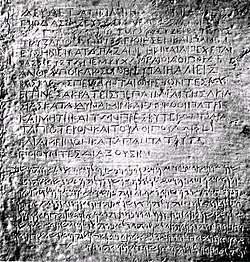
[https://upload.wikimedia.org/wikipedia/commons/thumb/1/10/AsokaKandahar.jpg/250px-AsokaKandahar.jpg]<https://en.wikipedia.org/wiki/File:AsokaKandahar.jpg>
Bilingual edict (Greek<https://en.wikipedia.org/wiki/Greek_language> and
Aramaic<https://en.wikipedia.org/wiki/Aramaic>) 3rd century BC by Indian
Buddhist King Ashoka, see Edicts of
Ashoka<https://en.wikipedia.org/wiki/Edicts_of_Ashoka>, from
Kandahar<https://en.wikipedia.org/wiki/Kandahar>. This edict advocates the
adoption of "godliness" using the Greek term
Eusebeia<https://en.wikipedia.org/wiki/Eusebeia> for
Dharma<https://en.wikipedia.org/wiki/Dharma>.
Kabul<https://en.wikipedia.org/wiki/Kabul> Museum.
Suggestions of influence

Will Durant<https://en.wikipedia.org/wiki/Will_Durant>, noting that the Emperor
Ashoka<https://en.wikipedia.org/wiki/Ashoka_the_Great> sent
missionaries<https://en.wikipedia.org/wiki/Missionary>, not only to elsewhere
in India and to Sri Lanka, but to
Syria<https://en.wikipedia.org/wiki/Ancient_Syria>,
Egypt<https://en.wikipedia.org/wiki/Ancient_Egypt> and
Greece<https://en.wikipedia.org/wiki/Ancient_Greece>, first speculated in the
1930s that they may have helped prepare the ground for Christian
teaching.[13]<https://en.wikipedia.org/wiki/Buddhist_influences_on_Christianity#cite_note-13>
 Buddhism was prominent in the eastern Greek world
(Greco-Buddhism<https://en.wikipedia.org/wiki/Greco-Buddhism>) and became the
official religion of the eastern Greek successor kingdoms to Alexander the
Great<https://en.wikipedia.org/wiki/Alexander_the_Great>'s empire
(Greco-Bactrian Kingdom<https://en.wikipedia.org/wiki/Greco-Bactrian_Kingdom>
(250 BC-125 BC) and Indo-Greek
Kingdom<https://en.wikipedia.org/wiki/Indo-Greek_Kingdom> (180 BC - 10 CE)).
Several prominent Greek Buddhist missionaries are known
(Mahadharmaraksita<https://en.wikipedia.org/wiki/Mahadharmaraksita> and
Dharmaraksita<https://en.wikipedia.org/wiki/Dharmaraksita>) and the Indo-Greek
king Menander I<https://en.wikipedia.org/wiki/Menander_I> converted to
Buddhism, and is regarded as one of the great patrons of Buddhism. (See Milinda
Panha<https://en.wikipedia.org/wiki/Milinda_Panha>.) Some modern historians
have suggested that the pre-Christian monastic order in Egypt of the
Therapeutae<https://en.wikipedia.org/wiki/Therapeutae> is possibly a
deformation of the Pāli word
"Theravāda<https://en.wikipedia.org/wiki/Theravada>,"[14]<https://en.wikipedia.org/wiki/Buddhist_influences_on_Christianity#cite_note-14>
 a form of Buddhism, and the movement may have "almost entirely drawn (its)
inspiration from the teaching and practices of Buddhist
asceticism".[15]<https://en.wikipedia.org/wiki/Buddhist_influences_on_Christianity#cite_note-15>
 They may even have been descendants of
Asoka<https://en.wikipedia.org/wiki/Asoka>'s emissaries to the
West.[16]<https://en.wikipedia.org/wiki/Buddhist_influences_on_Christianity#cite_note-16>


It is true that Buddhist gravestones from the Ptolemaic
period<https://en.wikipedia.org/wiki/Ptolemaic_period> have also been found in
Alexandria in Egypt, decorated with depictions of the Dharma
wheel<https://en.wikipedia.org/wiki/Dharmacakra>, showing the Buddhists were
living in Hellenistic Egypt at the time Christianity
began.[17]<https://en.wikipedia.org/wiki/Buddhist_influences_on_Christianity#cite_note-17>
 The presence of Buddhists in
Alexandria<https://en.wikipedia.org/wiki/Alexandria> has led one author to
note: "It was later in this very place that some of the most active centers of
Christianity were established".[citation
needed<https://en.wikipedia.org/wiki/Wikipedia:Citation_needed>] The early
church father Clement of
Alexandria<https://en.wikipedia.org/wiki/Clement_of_Alexandria> (died 215 AD)
was also aware of Buddha, writing in his Stromata (Bk I, Ch XV): "The Indian
gymnosophists<https://en.wikipedia.org/wiki/Gymnosophists> are also in the
number, and the other barbarian philosophers. And of these there are two
classes, some of them called
Sarmanæ<https://en.wikipedia.org/wiki/%C5%9Arama%E1%B9%87a> and others
Brahmins<https://en.wikipedia.org/wiki/Brahmin>. And those of the Sarmanæ who
are called "Hylobii" neither inhabit cities, nor have roofs over them, but are
clothed in the bark of trees, feed on nuts, and drink water in their hands.
Like those called Encratites in the present day, they know not marriage nor
begetting of children. Some, too, of the Indians obey the precepts of
Buddha<https://en.wikipedia.org/wiki/Buddha> (Βούττα) whom, on account of his
extraordinary sanctity, they have raised to divine
honours."[18]<https://en.wikipedia.org/wiki/Buddhist_influences_on_Christianity#cite_note-18>


<https://en.wikipedia.org/wiki/Buddhist_influences_on_Christianity#cite_note-18>

Nicolaus of Damascus<https://en.wikipedia.org/wiki/Nicolaus_of_Damascus>, and
other ancient writers, relate that in AD 13, at the time of
Augustus<https://en.wikipedia.org/wiki/Augustus> (died AD 14), he met in
Antioch<https://en.wikipedia.org/wiki/Antioch> (near present day
Antakya<https://en.wikipedia.org/wiki/Antakya> in
Turkey<https://en.wikipedia.org/wiki/Turkey> just over 300 miles from
Jerusalem<https://en.wikipedia.org/wiki/Jerusalem>) an embassy with a letter
written in Greek from the Southern India Pandya Empire was delivered while
Caesar was in the Island of Samos. This embassy was accompanied by a sage who
later, naked, anointed and contented, burnt himself to death at
Athens.[19]<https://en.wikipedia.org/wiki/Buddhist_influences_on_Christianity#cite_note-19>
 The details of his tomb inscription specified he was a
Shramana<https://en.wikipedia.org/wiki/Shramana>, "his name was
Zarmanochegas<https://en.wikipedia.org/wiki/Zarmanochegas>", he was an Indian
native of Bargosa, and "immortalized himself according to the custom of his
country." Cassius Dio<https://en.wikipedia.org/wiki/Cassius_Dio>
[20]<https://en.wikipedia.org/wiki/Buddhist_influences_on_Christianity#cite_note-20>
 and Plutarch<https://en.wikipedia.org/wiki/Plutarch>
[21]<https://en.wikipedia.org/wiki/Buddhist_influences_on_Christianity#cite_note-21>
 cite the same story. Historian Jerry H.
Bentley<https://en.wikipedia.org/wiki/Jerry_H._Bentley> (1993) notes "the
possibility that Buddhism influenced the early development of Christianity" and
that scholars "have drawn attention to many parallels concerning the births,
lives, doctrines, and deaths of the Buddha and
Jesus".[22]<https://en.wikipedia.org/wiki/Buddhist_influences_on_Christianity#cite_note-Bentley_1993-22>


<https://en.wikipedia.org/wiki/Buddhist_influences_on_Christianity#cite_note-Bentley_1993-22>

In 1894, the book The Unknown Life of Jesus Christ by Nicolas
Notovitch<https://en.wikipedia.org/wiki/Nicolas_Notovitch> introduced the idea
that an adult Jesus traveled to India and was influenced by Buddhism before
starting his ministry<https://en.wikipedia.org/wiki/Ministry_of_Jesus> in
Galilee<https://en.wikipedia.org/wiki/Galilee>. The book was widely
disseminated and became the basis of other
theories.[23]<https://en.wikipedia.org/wiki/Buddhist_influences_on_Christianity#cite_note-23>[24]<https://en.wikipedia.org/wiki/Buddhist_influences_on_Christianity#cite_note-Ehrm252-24>
 Notovitch's theory was controversial from the beginning and was widely
criticized.[25]<https://en.wikipedia.org/wiki/Buddhist_influences_on_Christianity#cite_note-25>[26]<https://en.wikipedia.org/wiki/Buddhist_influences_on_Christianity#cite_note-Wil84-26>
 Once his story had been re-examined by historians, Notovitch confessed to
having fabricated the
evidence.[26]<https://en.wikipedia.org/wiki/Buddhist_influences_on_Christianity#cite_note-Wil84-26>[27]<https://en.wikipedia.org/wiki/Buddhist_influences_on_Christianity#cite_note-McG-27>

Rejections of influence


<https://en.wikipedia.org/wiki/Buddhist_influences_on_Christianity#cite_note-28>

Most scholars believe there is no historical evidence of any influence by
Buddhism on Christianity, Paula
Fredriksen<https://en.wikipedia.org/wiki/Paula_Fredriksen> stating that no
serious scholarly work has placed the origins of
Christianity<https://en.wikipedia.org/wiki/Origins_of_Christianity> outside the
backdrop of 1st century Palestinian
Judaism.[11]<https://en.wikipedia.org/wiki/Buddhist_influences_on_Christianity#cite_note-PaulaF26-11>[verification
 needed<https://en.wikipedia.org/wiki/Wikipedia:Verifiability>] Leslie
Houlden<https://en.wikipedia.org/wiki/Leslie_Houlden> states that although
modern parallels between the teachings of Jesus and Buddha have been drawn,
these comparisons emerged after missionary contacts in the 19th century and
there is no historically reliable evidence of contacts between Buddhism and
Jesus.[29]<https://en.wikipedia.org/wiki/Buddhist_influences_on_Christianity#cite_note-Les140-29>


<https://en.wikipedia.org/wiki/Buddhist_influences_on_Christianity#cite_note-Les140-29>

Other scholars such as Eddy and Boyd state that there is no evidence of a
historical influence by outside sources on the authors of the New Testament,
and most scholars agree that any such historical influence on Christianity is
entirely implausible given that first century
monotheistic<https://en.wikipedia.org/wiki/Monotheistic>
Galilean<https://en.wikipedia.org/wiki/Galilean> Jews would not have been open
to what they would have seen as pagan
stories.[12]<https://en.wikipedia.org/wiki/Buddhist_influences_on_Christianity#cite_note-Eddy53-12>[30]<https://en.wikipedia.org/wiki/Buddhist_influences_on_Christianity#cite_note-Collins-30>
 The Macmillan Encyclopedia of Buddhism states that theories of influences of
Buddhism on early Christianity are without historical
foundation.[9]<https://en.wikipedia.org/wiki/Buddhist_influences_on_Christianity#cite_note-Buswell-9>

Modern scholarship has roundly rejected any historical basis for the travels of
Jesus to India or Tibet or influences between the teachings of Christianity and
Buddhism, and has seen the attempts at parallel symbolism as cases of
parallelomania<https://en.wikipedia.org/wiki/Parallelomania> which exaggerate
the importance of trifling
resemblances.[29]<https://en.wikipedia.org/wiki/Buddhist_influences_on_Christianity#cite_note-Les140-29>[30]<https://en.wikipedia.org/wiki/Buddhist_influences_on_Christianity#cite_note-Collins-30>[31]<https://en.wikipedia.org/wiki/Buddhist_influences_on_Christianity#cite_note-Voorst17-31>[32]<https://en.wikipedia.org/wiki/Buddhist_influences_on_Christianity#cite_note-Borg303-32>


<https://en.wikipedia.org/wiki/Buddhist_influences_on_Christianity#cite_note-Borg303-32>

There are inherent and fundamental differences between Buddhism and
Christianity, one significant element being that while Christianity is at its
core monotheistic<https://en.wikipedia.org/wiki/Monotheistic> and relies on a
God as a Creator<https://en.wikipedia.org/wiki/God_in_Christianity>, Buddhism
is generally non-theistic<https://en.wikipedia.org/wiki/Non-theistic> and
rejects the notion of a Creator God which provides divine values for the
world.[7]<https://en.wikipedia.org/wiki/Buddhist_influences_on_Christianity#cite_note-Numrich10-7>[8]<https://en.wikipedia.org/wiki/Buddhist_influences_on_Christianity#cite_note-Lim34-8>


<https://en.wikipedia.org/wiki/Buddhist_influences_on_Christianity#cite_note-Lim34-8>

The central iconic imagery<https://en.wikipedia.org/wiki/Iconography> of the
two traditions underscore the difference in their belief structure, when the
peaceful death of Gautama Buddha<https://en.wikipedia.org/wiki/Gautama_Buddha>
at an old age is contrasted with the harsh image of the crucifixion of
Jesus<https://en.wikipedia.org/wiki/Crucifixion_of_Jesus> as a willing
sacrifice for the atonement for the
sins<https://en.wikipedia.org/wiki/Atonement_in_Christianity> of
humanity.[10]<https://en.wikipedia.org/wiki/Buddhist_influences_on_Christianity#cite_note-Leslie140-10>
 Buddhist scholars such as Masao Abe<https://en.wikipedia.org/wiki/Masao_Abe>
see the centrality of crucifixion in Christianity as an irreconcilable gap
between the two belief
systems.[33]<https://en.wikipedia.org/wiki/Buddhist_influences_on_Christianity#cite_note-Abe99-33>[34]<https://en.wikipedia.org/wiki/Buddhist_influences_on_Christianity#cite_note-Suzuki113-34>

Post Apostolic Age
Church Fathers
See also: Buddhism and the Roman
world<https://en.wikipedia.org/wiki/Buddhism_and_the_Roman_world>

Clement of Alexandria<https://en.wikipedia.org/wiki/Clement_of_Alexandria>
referred to Buddhists and
wrote:[2]<https://en.wikipedia.org/wiki/Buddhist_influences_on_Christianity#endnote_Clement2>

"Among the Indians are those philosophers also who follow the precepts of
Boutta (Βούττα), whom they honour as a god on account of his extraordinary
sanctity."

— Clement of Alexandria, Stromata<https://en.wikipedia.org/wiki/Stromata>
(Miscellanies), Book I, Chapter XV
[https://upload.wikimedia.org/wikipedia/commons/thumb/d/d1/HippolytusGrav.JPG/180px-HippolytusGrav.JPG]<https://en.wikipedia.org/wiki/File:HippolytusGrav.JPG>
17th century engraving of
Hippolytus<https://en.wikipedia.org/wiki/Hippolytus_of_Rome>

<https://en.wikipedia.org/wiki/Hippolytus_of_Rome>

Early 3rd–4th century Christian writers such as
Hippolytus<https://en.wikipedia.org/wiki/Hippolytus_of_Rome> and
Epiphanius<https://en.wikipedia.org/wiki/Epiphanius_of_Salamis> write of one
Scythianus<https://en.wikipedia.org/wiki/Scythianus> who visited India around
50 CE, whence he brought the "doctrine of the Two Principles". Scythianus'
pupil Terebinthus<https://en.wikipedia.org/wiki/Terebinthus> supposedly
presented himself as a "Buddha" ("he called himself Buddas" Cyril of
Jerusalem<https://en.wikipedia.org/wiki/Cyril_of_Jerusalem>) and became well
known in Judaea<https://en.wikipedia.org/wiki/Iudaea_Province> and was said to
have conversed with the apostles and to have brought books back from his trade
with India. The same author says his books and knowledge were taken over by
Mani<https://en.wikipedia.org/wiki/Mani_(prophet)>, and became the foundation
of the Manichean
doctrine<https://en.wikipedia.org/wiki/Manicheism>.[a]<https://en.wikipedia.org/wiki/Buddhist_influences_on_Christianity#cite_note-36>

"Terebinthus, his disciple in this wicked error, inherited his money and books
and heresy, and came to Palestine, and becoming known and condemned in Judaea
he resolved to pass into Persia: but lest he should be recognised there also by
his name he changed it and called himself Buddas."

— Cyril of Jerusalem<https://en.wikipedia.org/wiki/Cyril_of_Jerusalem>, Sixth
Catechetical Lecture Chapter
22-24[35]<https://en.wikipedia.org/wiki/Buddhist_influences_on_Christianity#cite_note-newadvent.org-35>

Saint Jerome<https://en.wikipedia.org/wiki/Jerome> (4th century CE) mentions
that the Buddhist belief of Buddha's birth from a virgin as their "opinion
[...] authoritatively handed down that Budda, the founder of their religion,
had his birth through the side of a
virgin,"[36]<https://en.wikipedia.org/wiki/Buddhist_influences_on_Christianity#cite_note-37>
 (the Buddha was, according to Buddhist tradition, born from the hip of his
mother).[37]<https://en.wikipedia.org/wiki/Buddhist_influences_on_Christianity#cite_note-38>
 It has been suggested that this virgin birth legend of Buddhism influenced
Christianity.[1]<https://en.wikipedia.org/wiki/Buddhist_influences_on_Christianity#cite_note-McEvilley,_p391-1>

Gnosticism


Gnosticism<https://en.wikipedia.org/wiki/Gnosticism> comprised a number of
small Christian sects which existed in the 2nd-5th centuries, and were rejected
by mainstream Christians as heretics<https://en.wikipedia.org/wiki/Heretics>.
There were some contacts between Gnostics and Indians, e.g. Syrian
gnostic<https://en.wikipedia.org/wiki/Gnosticism> theologian Bar
Daisan<https://en.wikipedia.org/wiki/Bar_Daisan> describes in the 3rd century
his exchanges with missions of holy men from India (Greek: Σαρμαναίοι,
Sramanas), passing through Syria<https://en.wikipedia.org/wiki/Syria> on their
way to Elagabalus<https://en.wikipedia.org/wiki/Elagabalus> or another Severan
dynasty<https://en.wikipedia.org/wiki/Severan_dynasty> Roman
Emperor<https://en.wikipedia.org/wiki/Roman_Emperor>. His accounts are quoted
by Porphyry<https://en.wikipedia.org/wiki/Porphyry_(philosopher)> (De abstin.,
iv, 17
[3]<https://en.wikipedia.org/wiki/Buddhist_influences_on_Christianity#endnote_Porphyry>)
 and Stobaeus<https://en.wikipedia.org/wiki/Stobaeus> (Eccles., iii, 56, 141).


This has given rise to suggestions by Zacharias P. Thundy that Buddhist
tradition may have influenced Gnosticism and hence
Christianity.[4]<https://en.wikipedia.org/wiki/Buddhist_influences_on_Christianity#cite_note-Thundy-4>
 Thundy has also considered possible influences through the Jewish sect
Therapeutae<https://en.wikipedia.org/wiki/Therapeutae>, which he suggests could
have been Buddhists in the first
century.[38]<https://en.wikipedia.org/wiki/Buddhist_influences_on_Christianity#cite_note-Thundy-a-39>


<https://en.wikipedia.org/wiki/Buddhist_influences_on_Christianity#cite_note-Thundy-a-39>

However, Gnosticism was harshly rejected by Christians and c. 180
Irenaeus<https://en.wikipedia.org/wiki/Irenaeus> wrote against them at length
in his On the Detection and Overthrow of the So-Called
Gnosis<https://en.wikipedia.org/wiki/On_the_Detection_and_Overthrow_of_the_So-Called_Gnosis>,
 generally called Against
Heresies.[39]<https://en.wikipedia.org/wiki/Buddhist_influences_on_Christianity#cite_note-Magill-40>
 By the third century non-Christian Indians were also considered heretics by
the Christians who condemned their
practices.[4]<https://en.wikipedia.org/wiki/Buddhist_influences_on_Christianity#cite_note-Thundy-4>


<https://en.wikipedia.org/wiki/Buddhist_influences_on_Christianity#cite_note-Thundy-4>

Elaine Pagels<https://en.wikipedia.org/wiki/Elaine_Pagels> has encouraged
research into the impact of Buddhism on Gnosticism, but she holds that although
intriguing, the evidence of any influence is
inconclusive.[5]<https://en.wikipedia.org/wiki/Buddhist_influences_on_Christianity#cite_note-Grau-5>[40]<https://en.wikipedia.org/wiki/Buddhist_influences_on_Christianity#cite_note-Pagel-41>
 She further concludes that these parallels might be coincidental since
parallel traditions may emerge in different
cultures.[5]<https://en.wikipedia.org/wiki/Buddhist_influences_on_Christianity#cite_note-Grau-5>[40]<https://en.wikipedia.org/wiki/Buddhist_influences_on_Christianity#cite_note-Pagel-41>

--
--
Centroids: The Center of the Radical Centrist Community
<[email protected]>
Google Group: http://groups.google.com/group/RadicalCentrism
Radical Centrism website and blog: http://RadicalCentrism.org

---
You received this message because you are subscribed to the Google Groups
"Centroids: The Center of the Radical Centrist Community" group.
To unsubscribe from this group and stop receiving emails from it, send an email
to [email protected].
For more options, visit https://groups.google.com/d/optout.