I would be sure to turn the power down and put a fan on it
for repeater use.  the heat sink on the beast is pretty
big though.
Numbers.
TLD19428
TRD1804BB
TCN4727A

Does this mean that the tx is 142 - 150.8?


On Fri, 28 Mar 2008 12:05:10 -0700
  Mike Morris WA6ILQ <[EMAIL PROTECTED]> wrote:
> At 11:19 AM 03/28/08, you wrote:
>>I have a Compa Station with the model number
>>C73RTB-1106C.
>>
>>I am looking for some help figuring out what this is
>>split, etc and how to make it into a repeater.
>
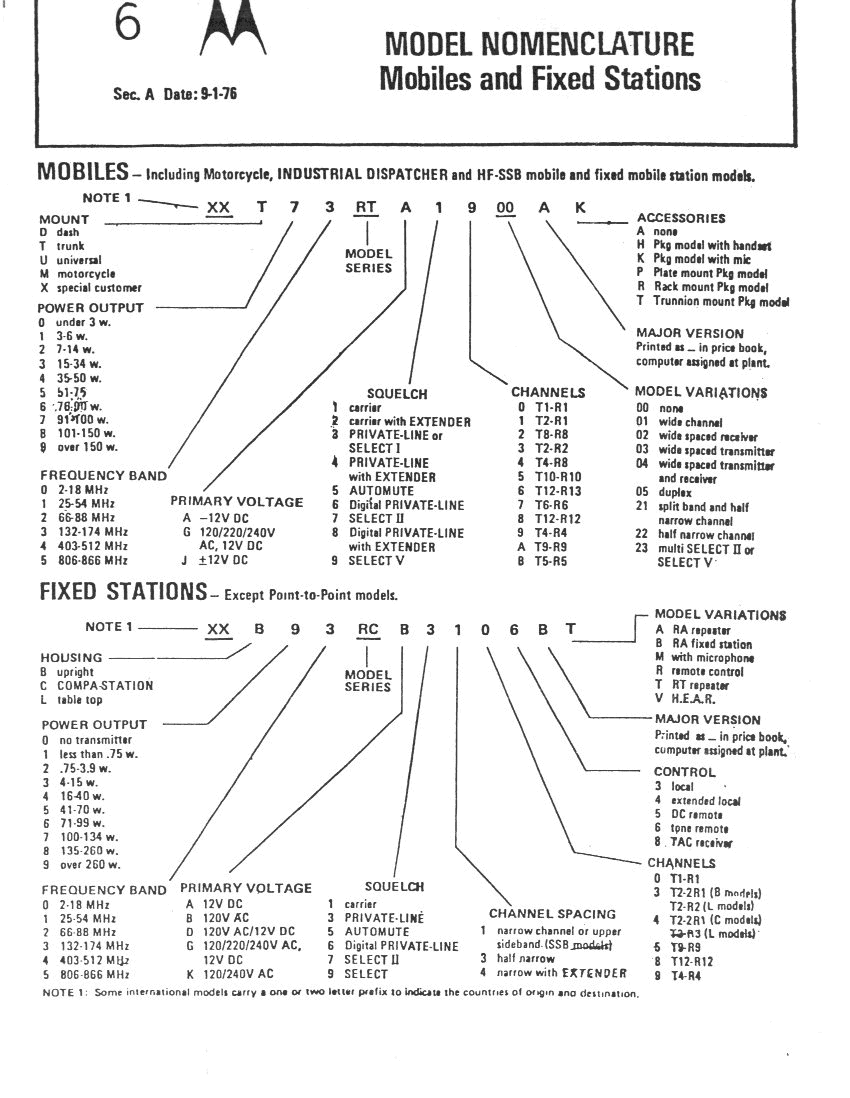
> The 73RTB is a 90-100w intermittent duty (20 % duty
> cycle) Micor base built for the 136-174MHz frequency
> band.  An RCB would be continuous duty.
> The 1106 is a carrier squelch wireline controlled base.
> If it was a 3106 it would be PL.  Adding tone is a
>simple
> process once you get the parts.
> See the bottom half of this page:
> <http://www.repeater-builder.com/micor/pix/micor-mobile-and-base-model-numbers.gif>
>
> And remember 20% is twenty seconds of transmit time
> every 100 seconds.  That's not to say that it won't
> transmit for 20 minutes, but it will get hot doing so.
>
> I do not recommend making an intermittent duty radio
> into a repeater unless:
> a) it's a learning experience (i.e. don't make it a
> prime repeater for an area).
> b) you have spares for when the PA deck will blow up.
> c) you run it at reduced power with some sort of
> thermostatic controlled cooling.
>
> The Micor series was built for a specific range of that
>band,
> such as 136-150, 150-162, 160-174.  I may not have the
> edge frequencies exact (all my manuals are in storage),
> but that's close.  If you have a high range radio,
>forget it.
> A 150-162 can be stretched, a low range is designed for
> 2m.
>
> Look at the assemblies for a three letter / 4 digit
>number
> and then at this table -
> <http://www.repeater-builder.com/rbtip/micorvhfboardnumbers.html>
>
>>First things first is that there is no power leads hooked
>>up except for the one to the control board box.  I can
>>see
>>where there are places for heavy cables from the power
>>supply to the transmitter.  Is there seperate power for
>>the receiver or does that come from the ribbon cable?
>
> Ribbon cable?
> You must have a really old unit.  Most of the ones I've
> seen are the unified chassis system
> Look for any TxD numbers and let us know what they are.
> the x can be any letter, but most commonly will be R, T,
>or L.
>
>>How can I get this thing to key up to see what the TX
>>frequency is?
>
> Plug a microphone into the unit.
>
>>If I find out the TX freq can I sweep the
>>recv side with a freq generator to figure out where it
>>opens up?
>
> If the channel element is there it will have a frequnecy
> label on it.
>
>>Are these crystal controlled or can they be adjusted to
>>get the right frequency pair?
>
> A crystal is mounted in side a prepackaged oscillator,
>called
> a channel element.  See
> <http://www.repeater-builder.com/micor/micor-element-info.html>
> If the elements are even there.
>
>>Thanks,
>>Vern
>
> More info here:
> <http://www.repeater-builder.com/rbtip/micor-index.html>
>
> Mike
>