leonvermeulen.substack.com<https://leonvermeulen.substack.com/p/when-narratives-outrun-evidence>
When Narratives Outrun Evidence
LEON VERMEULEN
8–10 minutes
________________________________
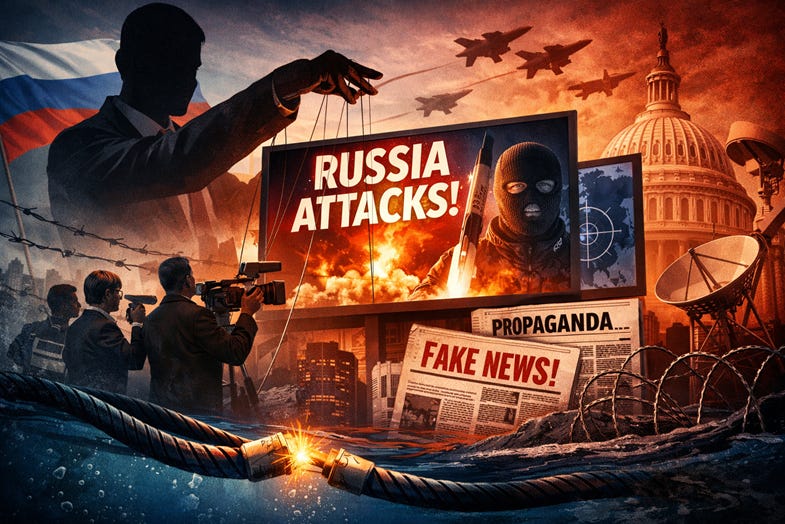
<https://substackcdn.com/image/fetch/$s_!ysh8!,f_auto,q_auto:good,fl_progressive:steep/https%3A%2F%2Fsubstack-post-media.s3.amazonaws.com%2Fpublic%2Fimages%2F2b84c122-3f58-45d2-b0c3-8e32e6d0f10e_785x524.png>[https://substackcdn.com/image/fetch/$s_!ysh8!,w_1456,c_limit,f_auto,q_auto:good,fl_progressive:steep/https%3A%2F%2Fsubstack-post-media.s3.amazonaws.com%2Fpublic%2Fimages%2F2b84c122-3f58-45d2-b0c3-8e32e6d0f10e_785x524.png]<https://substackcdn.com/image/fetch/$s_!ysh8!,f_auto,q_auto:good,fl_progressive:steep/https%3A%2F%2Fsubstack-post-media.s3.amazonaws.com%2Fpublic%2Fimages%2F2b84c122-3f58-45d2-b0c3-8e32e6d0f10e_785x524.png>
Published: 15 March 2026

On 12 March 2026, the head of Finland’s intelligence service, Juha Martelius,
delivered a quiet but significant message. Investigations into recent damage to
undersea cables in the Baltic Sea had found no evidence of deliberate Russian
sabotage.

For months, however, many Western officials and media outlets had suggested the
incidents were part of Russian “hybrid warfare.” Ships had been seized,
suspicions amplified, and the narrative of hostile sabotage widely circulated.
Yet the investigation now indicates that the most likely cause was far more
mundane: maritime accidents involving anchors dragged by ships in harsh weather.

The correction was factual. But it arrived long after the original narrative
had already shaped public perception.

This pattern raises an uncomfortable question for Western democracies: what
happens when accusations spread faster than evidence — and when the media
amplifies them before verification?

The Baltic cable case is not unique. In recent years, several widely publicised
claims involving alleged Russian actions were later revised, weakened, or
disproven.

The so-called “Havana Syndrome” case is one example. For years, reports
suggested that diplomats suffering neurological symptoms were victims of secret
“directed energy weapons” deployed by a foreign adversary, often implied to be
Russia. Yet in 2023, the U.S. intelligence community concluded it was “very
unlikely” that any foreign actor was responsible.

Another episode emerged in 2020 when media reports claimed Russian intelligence
had offered bounties to militants in Afghanistan to kill U.S. soldiers. The
story dominated headlines. Later, the assessment was downgraded to “low to
moderate confidence,” largely based on uncorroborated detainee testimony.

In November 2022, when a missile struck a village in Poland near the Ukrainian
border, early reports suggested a Russian strike on NATO territory. Within
hours the story had spread globally. Yet the investigation soon determined that
the missile was a Ukrainian air-defence interceptor, launched to counter a
Russian barrage.

Similarly, the sabotage of the Nord Stream pipelines in 2022 was initially
attributed in much public commentary to Russia destroying its own
infrastructure. Subsequent investigations shifted focus toward possible
non-state or pro-Ukrainian actors, and no direct evidence linking Moscow to the
attack has been publicly confirmed.

Even smaller episodes follow the same pattern. In 2025, claims that a flight
carrying Ursula von der Leyen had been targeted by Russian GPS jamming were
widely reported. Later aviation data suggested the disruption had been
exaggerated and that the flight landed normally with functioning navigation
systems.

Each case differs in detail. But collectively they illustrate a recurring
phenomenon: dramatic allegations appear first; corrections arrive later and far
more quietly.

This dynamic matters because human psychology privileges first impressions.

When a dramatic accusation appears — particularly during geopolitical tension —
it creates an immediate emotional narrative. People remember the headline
announcing sabotage, attack, or conspiracy. Far fewer follow the technical
investigations that appear months later.

The result is what communication scholars often describe as the “continued
influence effect.” Even when information is later debunked, the original claim
continues to shape perceptions.

In geopolitical contexts, this can have profound consequences.

A narrative of hostile sabotage can justify new security measures, military
deployments, or intelligence authorities. By the time investigations clarify
the facts, the political decisions justified by the initial claim may already
be in place.

In that sense, the utility of the accusation may outlive its accuracy.

In democratic societies, the institution meant to prevent this dynamic is the
free press.

The media’s role is not merely to repeat what governments say. It is to verify,
contextualise, and challenge official claims before presenting them to the
public as fact.

This responsibility becomes especially critical during international crises,
when governments themselves may have strong incentives to shape public
narratives.

Three principles are essential.

First, skepticism must precede amplification. When officials make explosive
claims — sabotage, covert attacks, foreign conspiracies — journalists should
treat those statements as hypotheses rather than established facts until
evidence emerges.

Second, reporting must reflect uncertainty honestly. Headlines that repeat
allegations without evidence risk transforming speculation into perceived
reality.

Third, when initial reporting proves incorrect, corrections must be as visible
as the original claim. Quiet follow-ups months later cannot undo the impact of
front-page accusations.

Without these safeguards, the press risks drifting from watchdog to megaphone.

The danger is not limited to foreign policy debates.

Constant exposure to exaggerated or inaccurate claims gradually erodes public
trust in institutions. Citizens begin to suspect that governments manipulate
information for political ends. The media, perceived as complicit, loses
credibility as well.

The consequences ripple through society.

Public discourse becomes more polarised as competing narratives replace shared
facts. Trust in journalism declines. And once audiences lose confidence in the
press, they may dismiss accurate reporting along with false claims.

In extreme cases, information environments dominated by fear and accusation can
normalisfe hostility toward perceived enemies, whether foreign or domestic.

Democracy depends on informed citizens. When information itself becomes
strategically manipulated, that foundation weakens.

The Finnish cable investigation illustrates another recurring problem: the
asymmetry between accusation and correction.

Initial reports of possible Russian sabotage generated extensive coverage
across major international outlets. Yet the later conclusion — that no evidence
of deliberate action had been found — received far less attention.

The imbalance is understandable. Dramatic allegations make headlines; technical
investigations rarely do.

But the imbalance has consequences. When corrections lack the prominence of the
original claims, the public memory remains anchored to the earlier narrative.

In the long run, this pattern feeds the perception that information itself has
become a strategic tool in geopolitical competition.

The strength of democratic societies has always rested on a fundamental
principle: power must be questioned.

A free press exists precisely because governments cannot be expected to police
their own narratives. Journalists serve as the independent check that prevents
official claims from becoming unquestioned truths.

If the media instead becomes a clerical service that merely transcribes
government statements, it risks losing its role as the Fourth Estate.

And once that trust disappears, rebuilding it becomes extraordinarily difficult.

In the modern information environment, propaganda is no longer confined to
authoritarian regimes. Every government understands the strategic value of
narrative.

That reality makes the role of independent journalism more important than ever.

The challenge is not simply to report what powerful institutions say. It is to
ensure that evidence, not narrative, shapes public understanding.

Because in democratic societies, truth is not merely a moral principle.

It is a strategic asset — and once lost, it is painfully hard to recover.

Note:
As off the 15th of March 2026. none of the main Western media publications has
reported the findings of Finland’s intelligence services that it has found no
evidence of deliberate Russian sabotage to the undersea cables in the Baltic.

Leon Vermeulen is an independent historian and commentator specialising in
European memory, conflict, and reconciliation

--
http:www.antic.org
---
You received this message because you are subscribed to the Google Groups
"SERBIAN NEWS NETWORK" group.
To unsubscribe from this group and stop receiving emails from it, send an email
to [email protected].
To view this discussion visit
https://groups.google.com/d/msgid/senet/PH0PR13MB54463234E261385513C9A58DAE4CA%40PH0PR13MB5446.namprd13.prod.outlook.com.