<[email protected]> wrote:

  > thanks mike !
  > man! what  an ordeal you've been dealing with! good thing  that at
  > least you  seem to somewhat enjoy this mechanical process  and are
  > resourceful and inventive enough to move through obstacles you run
  > into. i'm  thoroughly  impressed   and  send  you way-way-way-well
  > deserved blessings for reaching your objective. soon !

  > thanks for the detail. it was fascinating. but a bit intimidating,
  > i must  admit. i think i'll continue to hang out my laundry  on my
  > clothing line,  to the continued huge chagrin of  my shi-shi-la-la
  > neighbors.

  >angel

  Hi angel,

  Thanks for  taking the time to read it and the  nice  compliments. I
  forgot to mention, the lint that builds up in the dryer is  not only
  a fire  hazard,  it is also a terrible source of  mold  spores. Mold
  just loves  cotton lint. This is the reason I had to  spend  so much
  time taking  the dryer apart to clean it. Here's a quote from  a web
  page:

    "Plant fibres such as cotton, flax (linen), jute and hemp are very
    susceptible to attack by cellulolytic (cellulose-digesting) fungi.
    Indeed, the  complete degradation of cellulose can be  effected by
    enzymes, produced by the fungi and known as cellulases..."

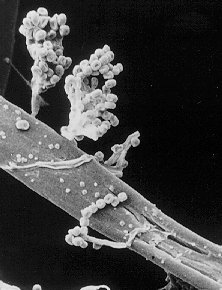
  The mold that grows is invisible and requires high  magnification to
  see it.  Here's a scaning electron microscope image of  mold growing
  on a cotton fibre:

    http://fungus.org.uk/images/mildew.jpg

  And here's the url for the article:

    http://fungus.org.uk/nwfg/rot.htm

  Mold spores  are everywhere. Doctors are starting to  recognize that
  clothing spreads  aspergillus  spores  that can  be  deadly  to some
  patients. Here's a quote:

    "Hospital patients  who are immunocompromised, for example  due to
    AIDS, chemotherapy,  or organ transplants, are  highly susceptible
    to opportunistic  fungal infections caused by  inhaling  spores of
    the fungus Aspergillus. Spore-related illnesses such  as pulmonary
    aspergillosis can  account for up to 40% of deaths  among leukemia
    patients. If bone marrow transplant patients become  infected, the
    death rate  may  exceed 90%. Infectious  disease  specialists know
    that bacteria  can   spread   disease  via  contaminated clothing.
    Recently, researchers  published the first  research  showing that
    clothing also spreads Aspergillus spores."

  The article was published by the National Institute of Environmental
  Health Sciences,  which tends to give some credibility.  If  you are
  interested, the full article is here:

    http://ehpnet1.niehs.nih.gov/docs/2001/109-8/forum.html

  But you do not have to be a patient in a hospital to be  affected by
  spores. My own experience shows that many of the vague symptoms that
  afflict people are very similar to the symptoms I experience  due to
  different types of mold.

  Unfortunately, even  high  quality  cs has  no  effect  on  the mold
  toxins, so it does little to relieve the symptoms.

  The spores  are  not  affected  by anything  we  can  do  in  a home
  environment. Ozone  is  the only thing left to  try,  but  it cannot
  penetrate the  cloth and kill buried spores. Ozone  is  difficult to
  measure without  very expensive equipment, so  the  concentration is
  difficult to  control.  I am working on a machine that  I  hope will
  solve all  these  problems, and will report the results  here  if it
  works.

Regards,

Mike Monett


--
The Silver List is a moderated forum for discussing Colloidal Silver.

Instructions for unsubscribing are posted at: http://silverlist.org

To post, address your message to: [email protected]

Address Off-Topic messages to: [email protected]

The Silver List and Off Topic List archives are currently down...

List maintainer: Mike Devour <[email protected]>