Sudan, ISIS and radical Islam: examining a contradictory approach –
Muhammed Osman
Posted on May 18, 2015
<http://africanarguments.org/2015/05/18/sudan-isis-and-radical-islam-examining-a-contradictory-approach-muhammed-osman/>
by AfricanArgumentsEditor
<http://africanarguments.org/author/africanargumentseditor/>
 [image: SudanISIS]
<http://africanarguments.org/wp-content/uploads/2015/05/SudanISIS.jpg>
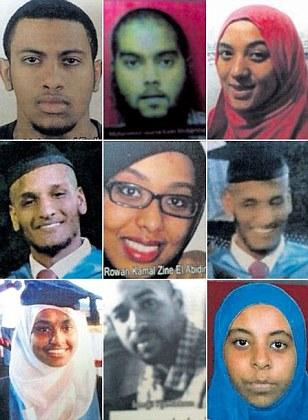
The 9 British-Sudanese medical students now reported to be in
ISIS-controlled Syria.

When Sudan’s Vice-President Hassabo Abdul Rahman declared on 22nd March
2015 the “non-existence of any signs of extremism or [related] terrorism”
in his country, the irony could not have been greater. Just a day earlier a
group of nine Sudanese university students, four women and five men, had
traveled in secret to Turkey and then into ISIS-controlled territory in
Syria.

Most of the students, who are all in their early twenties, were born and
raised in the UK and returned to Sudan to attend university. They all
studied at, or recently graduated from, the University of Medical Studies
and Technology (UMST) in the capital Khartoum.

UMST is the country’s top private university for rich kids. Political
activities there are strictly prohibited. However, Ahmad Babikir, the dean
of student affairs at UMST, acknowledged that some radical Sheikhs were
allowed to give speeches and lectures at the university under the auspices
of the Islamic Civilization Association (ICA), an extracurricular student
body.

Regardless of whether these students went to Syria to fight with ISIS or
not, the fact that UMST, which is owned by a member of the ruling party,
Mamoun Hummidah, who is also the Khartoum State Minister of Health, allowed
only an Islamist group to operate in the campus with little oversight while
banning all other political groups, is a microcosm of a wider problem
underlying the rise of radical Islam in Sudan. This problem is the internal
contradiction of the country’s Islamist government which, on the one hand
plays a role in the spreading of this ideology, while on the other tries to
contain it.

To understand these contradictions and their effects, a little contextual
background is required. Sudan, being a peripheral political entity in its
relations to the Islamic World, has traditionally been a haven for
religious ideologies with a tolerant version of Sufism being the dominant
form. Religious ideologies ranging from the revolutionary style of
Al-Mahhdiya to the reform-minded ideology of Mahmoud Mohammed Taha,
functioned as a vehicle of attachment to the outside world and as a basis
for political action.

In recent decades Sudan has witnessed the rise of fundamentalist and
radical versions of political Islam. This was influenced by the mass
migration of Sudanese to Gulf Countries, especially Saudi Arabia, which
promotes a literalist interpretation of Islam known as ‘Salafism’.

Another factor in this change was the rise to power in 1989 of the current
Islamist government which, in its early years, introduced its ambitious
‘civilizational project’ – a social re-engineering program aimed at
transforming Sudanese society to bring it into line with their puritanical
Islamist vision. A distinction should, however, be made between the
Islamist government and Salafist and other fundamentalist groups in terms
of organizational style. While the traditional Muslim Brotherhood of Sudan
has historically been top-down in structure, Salafist groups preach a
grassroots, bottom-up approach.

This bottom-up method to Islamisizing society lends itself to a variety of
different positions and standpoints. Most Salafist groups in Sudan do not
condone violence, claiming to focus exclusively on theology while preaching
obedience to the government. At the same time, some radical offshoots have
been responsible for the bulk of Islamist-related violence in the country.

The advent of violence committed by radical Islamists in Sudan can be
traced back to the early 1990s, in the first decade of the current
government. At that time, Sudan was effectively a pariah state that
harbored exiled Islamists and jihadists, including Usama Bin Laden.
Following a divisive internal split in the ruling party in 1999, the
government sought to break its isolation by repairing its foreign relations.

In 1993 a group of ultra-extremists led by a Yemeni man named Abdullah
al-Khulaifi stormed a mosque in Omdurman and opened fire on worshippers,
killing twenty five. Seven years later, in 2000, a similar incident
occurred when an Islamist extremist attacked a mosque in northern Omdurman
killing 27 and injuring 10 others. Both incidents were labeled as acts of
Takfiris (radical Salafist groups who brand other Muslims as infidels).

In 2007, the authorities discovered that an Islamist cell was planning to
launch attacks on Westerners in Sudan when a bomb they were constructing
exploded by mistake at their house in Al-Salama neighborhood in southern
Khartoum. On the eve of 2008, a group of extremists assassinated John
Granville, a US citizen and employee of USAID, and his driver Abdul Rahman
Abbas in the heart of Khartoum.

Following a firefight, in November 2012, security authorities arrested
thirty members of a radical Islamist cell which had set up a camp in the
Al-Dinder forest in the central state of Sennar in order to train Jihadists
and send them to join the war against French forces in Mali. Twenty three
of them were released in June 2014
<http://www.sudantribune.net/%D8%A7%D9%84%D8%B3%D9%88%D8%AF%D8%A7%D9%86-%D9%8A%D9%81%D8%B1%D8%AC-%D8%B9%D9%86,8453>
after they “renounced” their views.

The truth is that radical Islam in Sudan has been on the rise, and there’s
a link between this phenomenon and the internal contradictions of a regime
struggling to preserve its Islamism-based legitimacy in the face of the
widespread domestic perception of its corruption.

The prevailing complaints about government corruption have allowed radical
and Salafist groups to campaign successfully using the argument that the
problem is not in Islam itself but in the government’s imperfect
implementation of it. In recent years, these groups managed to attract an
increasingly significant following in universities. One reason for this is
the fact that the government has drastically eroded political life in
universities, in particular by cracking down on the activities of the
secular opposition.

When it comes to dealing with radical Islam, the government has found
itself in a bind. Due to its Islamist nature, the government cannot afford
to be seen cracking down on the groups that represent the extreme
interpretations of the same ideology it adheres to for fear of being
further viewed as compromising on the principles of political Islam.

But at the same time, the government cannot risk giving radical Islamists
too much space, and so it seeks to contain them. Radical actions by
islamists in Sudan would negatively affect the moderate image that the
regime has been trying to project to the outside world and could even allow
violent splinter groups to carry out further attacks inside the country.

The government may sometimes detain a radical Sheikh or two, for example if
they were to go public about their support for ISIS or are seen to be
encouraging violence. However, the relationship between the government and
radical Islamist groups is also symbiotic – both sides being useful to each
other’s agendas.

For the government, radical Islamist groups serve as a scaremongering tool
to prevent the West from contemplating regime change in Sudan, for fear
that it might produce a more Islamist replacement.

For radical and fundamentalist Islamist groups, the government’s Islamist
nature allows them to advance their own agendas by exploiting its weakness
such as corruption and the public discontent with worsening economic
conditions. One example of this is how Islamist groups and individuals
lobbied inside the parliament in 2009 to have an article banning female
genital cutting dropped from the draft Child Protection Act.

More recently, Islamist groups and political parties forged a coalition
called the Islamic Constitution Front with the single goal of making the
government adopt an ‘Islamic’ Constitution to replace the current interim
one which was adopted in 2005.

The ruling party may have concluded its farcical elections in April with
the expected outcome of President Bashir being re-elected and its MPs
winning a large majority in the parliament, but this does not change
realities on the ground – including the compromises the government has to
make in dealing with radical Islam.

*Muhammad Osman is a Sudanese freelance journalist and researcher based in
Khartoum. He can be reached at *[email protected]* and @Meltilib
on Twitter.*
If you enjoyed this post, please consider leaving a comment
<http://africanarguments.org/2015/05/18/sudan-isis-and-radical-islam-examining-a-contradictory-approach-muhammed-osman/#comments>
or subscribing to the RSS feed <http://africanarguments.org/feed/> to have
future articles delivered to your feed reader.
 This entry was posted in Making Sense of the Sudans
<http://africanarguments.org/category/making-sense-of-sudan/>. Bookmark the
permalink
<http://africanarguments.org/2015/05/18/sudan-isis-and-radical-islam-examining-a-contradictory-approach-muhammed-osman/>.
2 thoughts on “Sudan, ISIS and radical Islam: examining a contradictory
approach – Muhammed Osman”

   1.  Sarah says:
    May 19, 2015 at 12:47 am

<http://africanarguments.org/2015/05/18/sudan-isis-and-radical-islam-examining-a-contradictory-approach-muhammed-osman/#comment-67418>

   Interesting article, but one must remember that there are differing
   factions even within the Islamists who originally founded the gov, some of
   whom from the outset condemned the vicious corruption within the party.
   Best to not oversimplify – Mahmoud Mohamed Taha has been held up as a
   paragon after his death, but in life he was just as commonly seen as a
   madman, the same as the Mahdi – both of them on missions of “reforming
   Islam” that were doomed, just on different extremes. I would say Sudan
   would do best with a type of ‘neutral’ Islamist government, that allows for
   sharia to be practiced (as this is what most of the population sincerely
   scripturally believe in, Sufi or Salafi or Sunni or otherwise), hence
   taking away from the attraction of radical cells, whilst taking into
   account the multiculturalism (and multi-religionism) of the country (and
   the need for toleration and lack of persecution) instead of basically
   pretending to be Arab.
     2.  cordonedsudan says:
    May 20, 2015 at 11:08 am

<http://africanarguments.org/2015/05/18/sudan-isis-and-radical-islam-examining-a-contradictory-approach-muhammed-osman/#comment-67488>

   the problem with that Sarah, is that I am an atheist Sudanese. Where am
   I to fit in this suggested neutral Islamist nation?

   If I am regarded as an equal member of society, then why should my
   neighbor’s religion be put on a pedestal above my non-belief?

   And how will my rights be guaranteed? Will the state identify my
   religion on ID cards? How would that impact federal budget allocation?

   And what matrix of beliefs will be inferred by the governing
   establishment? My neighbor’s Islam? Or the other neighbor?

   And what about those practicing Sudanese who do not support a political
   Islam-oriented state? What of them? Are they to subscribe to arbitrary
   state decrees on what does and doesn’t constitute Islam?

   There is no good that can come from having reason give way to an
   irrational state apparatus. The data is very clear on that (our
   understanding of that data, not so much).

   The tragedy with cursory wishes for a political Islam reboot is the
   willful denial that we are living in the best possible one. That is the
   story of Sudan.

--
To post to this group, send email to [email protected]
To unsubscribe from this group, send email to
[email protected]
Visit this group at https://groups.google.com/d/forum/southsudankob
View this message at
https://groups.google.com/d/msg/southsudankob/topic-id/message-id
For more options, visit https://groups.google.com/d/optout
---
You received this message because you are subscribed to the Google Groups
"South Sudan Info - The Kob" group.
To unsubscribe from this group and stop receiving emails from it, send an email
to [email protected].
To post to this group, send email to [email protected].
Visit this group at http://groups.google.com/group/SouthSudanKob.
To view this discussion on the web visit
https://groups.google.com/d/msgid/SouthSudanKob/CAJb14oryCnTtn4yVpL5PL%3DsfPagVtXjnqcdX-OxyPBZRMkPYFQ%40mail.gmail.com.
For more options, visit https://groups.google.com/d/optout.