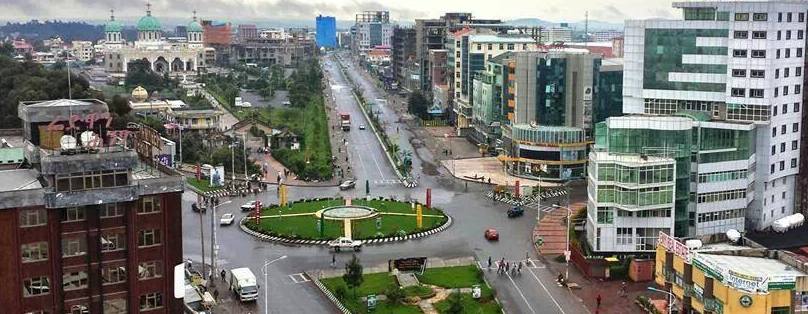
Addis Ababa’s Transformation – By Ismail Einashe
Posted on August 4, 2015
<http://africanarguments.org/2015/08/04/addis-ababas-transformation-by-ismail-einashe/>
by AfricanArgumentsEditor
<http://africanarguments.org/author/africanargumentseditor/>
[image: Ismail_Einashe]
<http://africanarguments.org/wp-content/uploads/2013/05/Ismail_Einashe-e1403246225739.jpg>The
Ethiopian capital Addis Ababa is going through one of the fastest rates of
urban growth in the world. In Amharic ‘Addis Ababa’ means ‘new flower’, and
Menelik II founded the city at the end of the 19th century. For much of its
history, Addis was a small town, at the centre of an ancient empire.

Today Addis is experiencing a rapid rate of urban transformation, which
will see its 4.5 million population double to 8.1 million by 2040. This
highlights UN’s estimates that Africa’s global share of urban dwellers will
double to 25% in the next 35 years.

Last week, Barack Obama became the first American president to visit Addis
Ababa. He addressed
<http://africanarguments.org/2015/08/04/obama-in-addis-by-richard-dowden/>
leaders at the African Union, a large glistening glass edifice built with
Chinese labour and financing. His visit underscores how far Ethiopia has
come – from the 1984 famine, which cemented the nation in the West’s
popular imagination, to the fastest growing economy on the continent.

The International Monetary Fund (IMF) ranks Ethiopia as among the top five
growing economies in the world. Ethiopia has experienced a decade of
continuous growth in GDP, averaging 10.3% – although the economy is
expected to slow a bit this year to 8.5% and pick up slightly in 2016 to
8.7%.

Ethiopia has transformed itself over the past decade, and will now spend
the equivalent of 10% of its GDP annually on infrastructure projects over
the course of the next decade. It has also massively reduced poverty –
according to the World Bank, Ethiopia reduced its poverty levels by 33%
since 2000, in large part because of its consistent economic growth
and agricultural investment, and what the bank described as
Ethiopia’s “pro-poor” investments.

However, Ethiopia still remains one of the poorest nations in the world.
Its per capita income is $470, below the regional average.
Ethiopia eventually wants to reach middle-income status.

Ethiopia remains a largely agrarian society. It also has Africa’s second
largest population at 94.1 million – and which because of the very high
fertility rate is expected to rise to 278 million by 2050. Like much of
Africa, Ethiopia is young: the median age is just 18.

Some infrastructure projects outside the capital have gained international
attention, particularly the Grand Ethiopian Renaissance Dam (GERD), in
construction on the Blue Nile, which will be Africa’s largest source of
hydro energy. It has caused serious tensions with the Nile river upstream
nations, Egypt and Sudan.

But Addis Ababa is at the heart of Ethiopia’s rapid growth, the crown jewel
in this China-style infrastructure splurge.

*Construction and repression *

Arriving in Addis, the scale of change in the city is huge: everywhere
there’s the hum of construction noise, countless workers roam the streets –
and a new metro system, the first in sub-Saharan Africa, is under
construction. Addis showcases Ethiopia’s soaring ambitions. There’s a new
confidence in the air.

The Addis Ababa and Oromia Special Zone Integrated Development Master Plan
is at the heart of the city’s urban change. For two years urban planners
sat in an office block in the city to create this plan – which will see
surrounding towns incorporated into the city, creating one of the largest
urban spaces in Africa.

The issue has been that Addis Ababa is encircled by Oromo-majority areas.
The Oromo constitute the largest of Ethiopia’s 80 ethnic groups, and Oromia
the largest of Ethiopia’s nine ethnic-based regions. Most of the
communities who live on the outskirts of the city depend on farming and
livestock, but like most in Ethiopia these farmers do not own the land, the
state does.

Farmers have been moved, their land forcibly seized, those
who oppose changes arrested. Many Oromos see these urban development
changes as a land-grab, an attack on Oromo identity which has sparked
protest. Those who oppose the plans have been met with repression.

There were huge protests in 2014 at Ambo Univeristy, outside Addis Ababa in
the Oromia region, in which 17 people reportedly died
<http://www.africa-confidential.com/article/id/5607/Addis_plan_touches_off_riots>
and over 25,000 people, including villagers, took to the streets.Though the
pace of changes in Ethiopia may be impressive, the price paid has been in
disruption and violence.

*Beer and business opportunities*

Even so, it seems little can dampen the good mood music in the city.
Business confidence is growing. In one of the swanky hotel bars in the Bole
area I met a group of Dutch, British and South African brewery specialists
who were in Addis Ababa for ‘opportunities’ in the beer industry.

One man, an Afrikaner from South Africa, spoke about how Ethiopia was
‘opening up’; and with its large population, like in Nigeria where he had
worked previously, it provided ample opportunities for the multinational
beer company he worked for.

They had bought up smaller beer companies across the continent – something
other companies did not do, he said, a strategic error. His colleague, a
Dutch man, shook his head, saying ‘Heineken passed on an opportunity’. Now,
he says, many European beer companies are keen to get a slice of the
growing purchasing power of the Ethiopian middle classes. In a city
littered with hundreds of bars, it’s easy to see why Africa’s second most
populous nation would draw in the investors.
[image: Addis-Ababa-Bole]
<http://africanarguments.org/wp-content/uploads/2015/08/Addis-Ababa-Bole-e1438697121290.jpeg>

Bole, Addis Ababa. Photo credit: Addis Ababa Online

Bole, which gives Addis Ababa’s shining new airport its name, has changed
remarkably. I spent some of my childhood here and today it’s
barely recognisable. The march of progress should not mean trampling on
history and heritage. Sadly much of Addis’s unique architectural history is
being eroded.

I returned to Addis at the start of the rainy season. The only area that
brings me some comfort is Mekarto, home to the city’s largest market, but
even here dramatic change is underway.

The Taitu Hotel, one of the most famous landmarks of the city ever since it
was built in the early 1900s, burned down in January. It was depicted in
Evelyn Waugh’s 1938 satirical novel Scoop, and later was home to the
Jazzamba Lounge, part of the legendary 1960s/70s Ethio-Jazz scene. In some
ways, Taitu was a symbol of old Addis that’s disappearing under the weight
of progress.

The urban population of Addis has grown nearly three times since the 1970s,
but what has been more remarkable is the spatial growth of the city: its
land area has expanded
<http://www.newgeography.com/content/003203-the-evolving-urban-form-addis-abeba>
to twelve times the size it was in the 1970s.

With growth has come lower population density, as Addis has spread out into
an ever-increasing urban sprawl. Now, at the edge of the city new
developments litter the earth, some gated communities for the rich,
underscoring the growing income inequality in the city.

Knight Frank, a large property consultancy based in London, listed Addis
Ababa in its annual wealth report as a city with potential for growth in
high net-worth individuals – a group whose population has doubled since
2007 and is expected to double again by 2024.

Ethiopia’s biggest supporter, in Addis and elsewhere, has been China. A
new light railway system (LRT), with a price tag of $475m, is being built
in the city. Wandering through Addis, the construction of the LRT dominates.

Most of the railway is above ground, new high-ways that rip through the
city, so stark and visible in their presence. Young labourers dig up the
earth, juxtaposed against the old Addis of shantytowns, where houses made
of mud and recycled steel pile on top of each other.

The Chinese are financing this 20 mile LRT system which will furnish Addis
with two lines, though there are plans to increase this to four. Some 85
percent of the funding comes from the Exim Bank of China, and the work was
contracted out to the China Railway Engineering Corporation.

China is also responsible for the newly completed 481-mile railway, which
links landlocked Ethiopia with Djibouti’s Red Sea port. The primary purpose
of the line is to export goods from Ethiopia’s fast growing economy. There
are also plans afoot to connect the railway from Djibouti all the way to
the Gulf of Guinea – which shows the scale of Chinese ambition in Africa.

*Democracy and development*

Change in Ethiopia has come without democracy. In May there were
parliamentary elections. No-one thought anyone but the EPRDF, which has
ruled the nation with an iron grip since overthrow of the Derg government
of Mengistu, would win.

In fact, the EPRDF and its allies won every single seat. The opposition
does not have a single MP. These election results did not provoke much of a
reaction in Western countries, only the occasional press release stating
their ‘disappointment’. Ethiopia is today not so much an aid darling but a
model of development, something outsiders are keen to focus on.

Addis is a multi-ethnic cosmopolitan melting pot, home to an increasingly
diverse population. The city’s residents take pride in their new city – the
skyscrapers, roads, and railways – the stuff of modernity.

Yet the gap between poor and rich is rising, the dramatic changes to the
city have brought violence and disruption, and those who have opposed the
changes of the city have faced repression. If Addis Ababa is to become a
global city, than it must find ways to incorporate the legitimate dreams of
all its residents in its ever-changing shape.

*Ismail Einashe is a journalist, researcher and an associate editor at
Warscapes magazine. You can follow him at @IsmailEinashe*

--
To post to this group, send email to [email protected]
To unsubscribe from this group, send email to
[email protected]
Visit this group at https://groups.google.com/d/forum/southsudankob
View this message at
https://groups.google.com/d/msg/southsudankob/topic-id/message-id
For more options, visit https://groups.google.com/d/optout
---
You received this message because you are subscribed to the Google Groups
"South Sudan Info - The Kob" group.
To unsubscribe from this group and stop receiving emails from it, send an email
to [email protected].
To post to this group, send email to [email protected].
Visit this group at http://groups.google.com/group/SouthSudanKob.
To view this discussion on the web visit
https://groups.google.com/d/msgid/SouthSudanKob/CAJb14oq42osqYNZpJJ4w0ZaG%2B6RiaYJwF5Fk%3DrxfkLSTaMj%3DfA%40mail.gmail.com.
For more options, visit https://groups.google.com/d/optout.