Pope Francis in Africa: the science and spirituality of climate change
Posted on November 25, 2015
<http://africanarguments.org/2015/11/25/pope-francis-in-africa-the-science-and-spirituality-of-climate-change/>
by Achim Steiner <http://africanarguments.org/author/achim-steiner/>
*Just days ahead of the COP21 climate change talks, Pope Francis is set to
address the ethical issue of climate change again.*
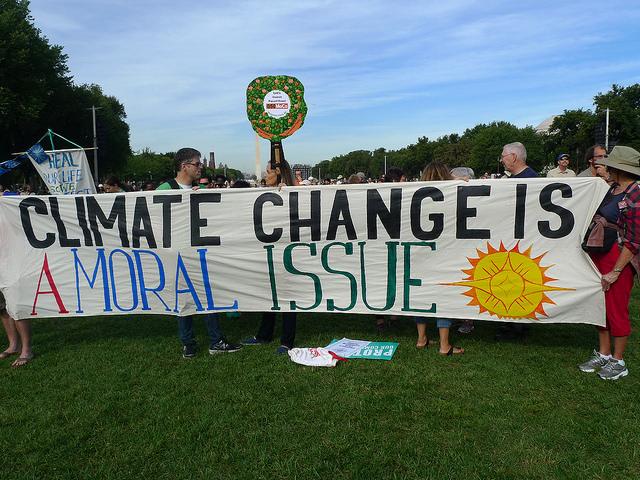
[image: Activists hold up a banner as Pope Francis' visit to the US.
Photograph by Susan Melkisethian.]
<http://africanarguments.org/wp-content/uploads/2015/11/climate-change-pope.jpg>
Activists hold up a banner as Pope Francis’ visit to the US. Photograph by
Susan Melkisethian.

As part of Pope Francis’ trip to Africa, he is set to visit the
headquarters of the United Nations Environment Programme (UNEP) in Nairobi
on 26 November. This visit will come just days before the start of the
seminal COP21 climate conference in Paris. Speaking from the heart of
Africa to the world, the Pope is expected to again address climate change,
an issue central to his tenure as Pontiff so far.

The Pope is in a unique position. As head of the smallest country in the
world, his ability to legislate on climate change may have limited impact.
But his religious authority speaks to 1.2 billion Catholics around the
globe and to even more who look to him as moral leader. He has imbued the
climate change debate with an ethical element that ties environmental
issues to his vision of a just and equal society. His leadership on climate
change has therefore had enormous impact.

Most other world leaders are in the inverse position. They may rely less on
moral authority, but often possess a distinct legislative ability to
concretely address climate change. So far, national governments have made
greenhouse gas reduction pledges of varying ambition. An analysis of
current pledges in UNEP’s Emissions Gap report
<http://www.unep.org/publications/ebooks/emissionsgapreport/> has shown
that the forecasted global temperature rise will still be upward of 3°C
with these commitments. The pledges are an encouraging departure from
business as usual, but this still marks an temperature increase with severe
consequences for the planet and its peoples.

Nations will have legitimate differences in Paris, but these should not
stand in the way of a meaningful outcome. As we arrive at COP21, we need
bold and assertive leadership that will help us overcome these
differences. After all, the agreement on anthropogenic climate change from
all corners of society is a consensus unprecedented in history. Science and
religion agree. The private sector, the finance world and consumers
continue a vocal drive toward sustainability. Citizens from the wealthiest
to the poorest are anxious about the impacts of a shifting environment. And
many local and regional governments have committed to act.

Since 1896, the scientific community has provided ever more data on the
impacts of anthropogenic climate change. Current scientific models predict
a future of climate change effects none of us wish to contemplate. Nor will
we wish to reflect on a past when we had the choice to act but didn’t.

Where scientists have approached climate change with figures, religious
leaders have made it an ethical issue. Pope Francis has said of climate
change that “decisive mitigation is a moral and religious imperative for
humanity”. His clarion call was echoed by Islamic leaders in August, when
signatories to the Islamic Climate Change Declaration called for all
countries to phase out greenhouse gas emissions as soon as possible.
Buddhist and Hindu leaders have made similar appeals.

Recognising the growing risks of inaction, institutional investors have
begun to divest their portfolios of carbon-intensive assets. The Portfolio
Decarbonization Coalition is a group of investors who have pledged to
divest themselves of $100 billion-worth of these assets by year end. They
have already surpassed this goal. Businesses have recognised the future
costs of climate change, consumers’ demand for sustainability, and the
corresponding opportunities. Technologies such as Kenya’s enormously
popular M-Kopa which provides on-demand solar-generated electricity, have
shown the economic potential of climate change mitigation initiatives.

Civil society and NGOs have been vocal in emphasising the disproportionate
effect of climate change on the world’s disadvantaged and poor, who are
most vulnerable to its impacts. Their message ties directly with the
message of Pope Francis, that addressing climate change critical to
combatting inequality and social injustice.

Local and regional governments meanwhile have taken heed of the warnings
and are beginning to make changes. The C40 network of cities, representing
over half a billion people around the world, is working on strategy to
address climate change. Regional governments have taken steps as well. In
California, the state has mandated an 80% cut in emissions by 2050.

Many strong words from global leaders have been uttered on the need to
address climate change. But the time for declarative statements has passed.
The window we have to take action is closer to shutting entirely with every
year that passes. Leaders are not simply companions to the process at
COP21. They are the ones who have the power to signal to the world with
concrete plans that anthropogenic climate change can and will be stopped.

Pope Francis has emphasised the relationship between humanity and nature
and has called for action to protect our common home. We echo his call. We
have a consensus as to the centrality of climate change to our common
future. What we need now is ambitious action and courageous leadership at
the highest levels.

*Achim Steiner is Executive Director of the United Nations Environment
Programme (UNEP).*
If you enjoyed this post, please consider leaving a comment
<http://africanarguments.org/2015/11/25/pope-francis-in-africa-the-science-and-spirituality-of-climate-change/#comments>
or subscribing to the RSS feed <http://africanarguments.org/feed/> to have
future articles delivered to your feed reader.
This entry was posted in African Politics Now
<http://africanarguments.org/category/politics-now/>. Bookmark the permalink
<http://africanarguments.org/2015/11/25/pope-francis-in-africa-the-science-and-spirituality-of-climate-change/>.

--
To post to this group, send email to [email protected]
To unsubscribe from this group, send email to
[email protected]
Visit this group at https://groups.google.com/d/forum/southsudankob
View this message at
https://groups.google.com/d/msg/southsudankob/topic-id/message-id
For more options, visit https://groups.google.com/d/optout
---
You received this message because you are subscribed to the Google Groups
"South Sudan Info - The Kob" group.
To unsubscribe from this group and stop receiving emails from it, send an email
to [email protected].
To post to this group, send email to [email protected].
Visit this group at http://groups.google.com/group/SouthSudanKob.
To view this discussion on the web visit
https://groups.google.com/d/msgid/SouthSudanKob/CAJb14opXUOnL04%2BXsJqm2kMqUWv-0%2BG4VNx7bDviKNeR5n6Q%2Bg%40mail.gmail.com.
For more options, visit https://groups.google.com/d/optout.