Burundi must avoid repeating the mistakes of Arusha
Posted on November 25, 2015
<http://africanarguments.org/2015/11/25/burundi-must-avoid-repeating-the-mistakes-of-arusha/>
by Izobukiza <http://africanarguments.org/author/izobukiza/>
*Negotiations in Burundi cannot come soon enough, but as in the 2000 Arusha
Accords, a focus on quick short-term solutions will only come back to haunt
the country. *
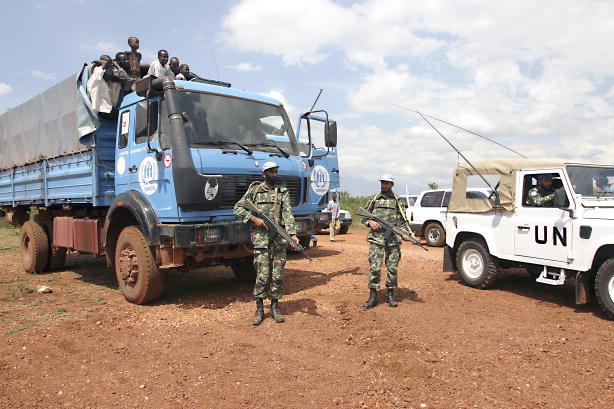
[image: A UN peacekeeping contingent in Burundi as part of the Arusha
Accord of 2000. Photograph by UN Photo/Martine Perret.]
<http://africanarguments.org/wp-content/uploads/2015/11/burundi-arusha.jpg>
A UN peacekeeping contingent in Burundi as part of the Arusha Accord of
2000. Photograph by UN Photo/Martine Perret.

Since independence, Burundi has gone through a series of crises. And
following 1972, 1988, and 1993, the country is now living through another.

This one comes 15 years after the historic Arusha Peace Accord, which
mobilised the great and powerful of that time, including Bill Clinton and
Nelson Mandela, as brokers in order to bring an end to a bloody 12-year
civil war. Among other things, the Accord sought to contain or diffuse the
ethnic imbalances within the political and military spheres.

By contrast to that civil war, which was largely fought along ethnic
Tutsi-Hutu lines, the current crisis was sparked by President Pierre
Nkurunziza seeking a third term in office in contravention of the Arusha
agreement.

Over the months of April and May, protesters took to the streets in
opposition to this move. Resistance started as peaceful demonstrations and
were repressed with disproportionate force by police. But over the course
of the year, with Nkurunziza running and winning a third term in July, the
situation has escalated.

Several hundred Burundians have now been killed, thousands have fled the
country, and the economy has collapsed. In the face of this, as well as
international pressure, the government is gradually realising that there is
no other way out of the crisis but to negotiate with its opponents. While
violence in the country continues, Uganda’s President Yoweri Museveni is
understood to be working on the list of people who will be invited for
negotiations with some delegations already in Kampala, but talks have yet
to start officially.

When they do, what lessons can be learnt from the Arusha Accord and its
seeming breakdown 15 years later?

*What should be negotiated?*

Perhaps the most acute problem at the centre of Burundi’s ills today is the
absence of the rule of law. Both the Hutu and Tutsi communities suffered
mass atrocities in the civil war, but those responsible never faced
justice. Everyone agrees that the current crisis is mainly political rather
than ethnic, but the same impunity has continued around the more recent
killings.

This situation can be traced back to the Arusha Peace Accord. The agreement
recommended a commission for truth and reconciliation, which was meant to
bring light to past crimes and end impunity but never materialised.
Meanwhile, the accord’s failure to establish an independent judiciary has
contributed to this impunity and bad governance.

The priority for those who negotiated the Accord was power-sharing and an
end to the violence rather than justice. The coming negotiations should
therefore make sure the same mistake of focusing on the short-term over the
long-term is not made again.

At the beginning of the current crisis, the main objective of the
opposition was simply to prevent Nkurunziza’s third presidential term.
However, if this remains the group’s only goal in talks, they will only
serve to replace the person at the top of a bad system without addressing
the core problems of impunity and injustice. This would be a missed
opportunity to bring true change the country so badly needs. Unless the
protagonists find fresh inspiration, the negotiations are likely to revolve
around power-sharing once again. It is also likely, as happened in Arusha,
that those responsible for the ongoing massacres will seek some level of
immunity, all in the name of finding a compromise.

Another mistake that could arise in the negotiations, and one that
international actors may push, is a rush to organise fresh elections. This
should be resisted. Rather, what might help today – as was the case 15
years ago – is to realise that in the current context of mistrust,
especially with some politicians seeking to resurrect ethnic tensions,
elections are perhaps the last thing Burundi needs.

What might be more effective is a technical government (a so-called
national unity government) in which powers are balanced between
protagonists, and more importantly in which the judiciary is
independent. The problems of Burundi are deep and impossible to solve in a
few days of negotiations, but, as imperfect as it would be, it is possible
to negotiate a technical government balanced by a functional and
independent judiciary and a strong civil society. The coming three to five
years could then be used to disarm all militias and armed groups, and to
engineer a large and open consultation in the country to define its future
direction.

During this time, political parties, civil society and independent media
could reorganise and play their democratic role. It would additionally
allow time to set up an independent commission to investigate all massacres
and crimes against humanity, including economic crimes since independence,
and to bring the culprits to justice. It would also allow time for setting
up a sort of Marshall Plan to save the country from imminent economic
collapse, including resettling refugees and displaced people. Only at the
end of these three to five years would elections be organised.

*Who will be part of these negotiations?*

The question of who will be involved in the talks is crucial. Many
opposition leaders and members of civil society have coalesced around a
platform called CNARED (*Conseil National pour le Respect de l’Accord
d’Arusha et de l’État de Droit au Burundi*). This movement is made up of
people with very different visions for the future of the country and whose
only common ground is to see the current president pushed out of office.
Some of its members are well known for their opportunism, and some are
believed to be directly or indirectly involved in past or ongoing crimes.
Such personalities would benefit from a continuation of the status quo in
terms of how the government operates and the country’s weak institutions.

In view of this, if Burundi is not to repeat the mistakes of Arusha in
which a similar situation prevailed, the individuals who take part of the
negotiations matter hugely. If it becomes a club of old players, then the
same causes will produce the same effects. The floor should therefore be
opened for fresher minds who have not been involved in past atrocities and
governments, who have no personal economic interests to defend, and who
hold a long term vision for Burundi rather than a short-sighted
power-sharing attitude.

It is crucial that youth both in country and diaspora as well as civil
society are well represented. Efforts should be made to give space to men
and women of integrity from all ethnic and social backgrounds who have
previously been forced into silence by a system that privileges mediocrity
and lawlessness.

*The demand for change*

Whether these conditions for negotiations will be met remains to be seen,
but what is clear is that there is an unprecedented demand in Burundi for
change and respect for the rule of law. The determination of the youth who
have taken to the streets both in Burundi and abroad this year demonstrate
their deep-seated sense of disenfranchisement with the status quo.

Those who will be negotiating have a moral duty to not ignore these groups.
They have sacrificed everything, including many of their lives, and will
not settle for more of the same old system. They deserve better, and will
demand it.

*Izobukiza is a Burundian public health scientist who currently lives
abroad. He lived through the 1993 crisis in Burundi and narrowly escaped
death several times. He left the country to pursue postgraduate studies and
after that continued to work in and on Africa, with his base in Europe.*
If you enjoyed this post, please consider leaving a comment
<http://africanarguments.org/2015/11/25/burundi-must-avoid-repeating-the-mistakes-of-arusha/#comments>
or subscribing to the RSS feed <http://africanarguments.org/feed/> to have
future articles delivered to your feed reader.
This entry was posted in African Politics Now
<http://africanarguments.org/category/politics-now/>, The Central Africa
Forum <http://africanarguments.org/category/the-central-africa-forum/>.
Bookmark the permalink
<http://africanarguments.org/2015/11/25/burundi-must-avoid-repeating-the-mistakes-of-arusha/>.

--
To post to this group, send email to [email protected]
To unsubscribe from this group, send email to
[email protected]
Visit this group at https://groups.google.com/d/forum/southsudankob
View this message at
https://groups.google.com/d/msg/southsudankob/topic-id/message-id
For more options, visit https://groups.google.com/d/optout
---
You received this message because you are subscribed to the Google Groups
"South Sudan Info - The Kob" group.
To unsubscribe from this group and stop receiving emails from it, send an email
to [email protected].
To post to this group, send email to [email protected].
Visit this group at http://groups.google.com/group/SouthSudanKob.
To view this discussion on the web visit
https://groups.google.com/d/msgid/SouthSudanKob/CAJb14oruLCF%2B8eL8FiiYZPfWGNgERjtLePqagJs-%3D6RdakLXYg%40mail.gmail.com.
For more options, visit https://groups.google.com/d/optout.