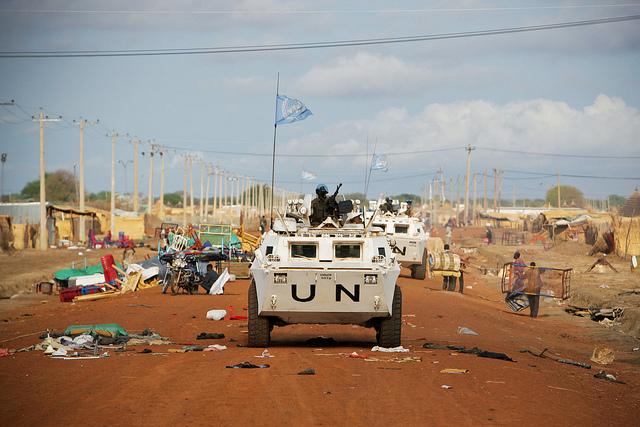
UN peacekeepers in South Sudan: Protecting some of the people some of the
time
Posted on December 15, 2015
<http://africanarguments.org/2015/12/15/un-peacekeepers-in-south-sudan-protecting-some-of-the-people-some-of-the-time/>
by Lucy Hovil <http://africanarguments.org/author/lucy-hovil/>
*While the UN’s actions are appreciated by the thousands seeking refuge in
protected sites, there are millions more outside who are suffering. The UN
peacekeeping mission has simply not done enough.*
[image: UN peacekeepers in Abyei, near the border between Sudan and South
Sudan. Credit: UN Photo/Stuart Price.]
<http://africanarguments.org/wp-content/uploads/2015/12/unmiss.jpg>
UN peacekeepers in Abyei, near the border between Sudan and South Sudan.
Credit: UN Photo/Stuart Price.

Two years ago, war broke out in South Sudan. What started off as a
political power struggle between President Salva Kiir and his former
vice president Riek Machar was quickly manipulated into ethnically-aligned
violence that spread with extraordinary speed and intensity. Civilians
quickly became the prime target.

As violence escalated, the United Nations peacekeeping mission in South
Sudan (UNMISS) took the unprecedented decision to open its gates to
thousands of civilians fleeing violence. While the opening of a number of
Protection of Civilian (PoC) sites across the country did not prevent mass
violence, there is no doubt that it reduced the number of people killed or
injured.

As one man living in a PoC site in Juba said: “If it was not because of
peacekeepers, all of us would have been killed.” The speed with which the
decision was taken to open the gates was crucial in saving lives. It was
also a direct response to the shadow that fell over peacekeeping missions
during the 1994 genocide in Rwanda, when the gates stayed closed and
thousands were killed as a result.

A report
<http://www.refugee-rights.org/Publications/Papers/2015/ProtectingSomeofthePeopleFINAL.pdf>
launched today by the International Refugee Rights Initiative
<http://www.refugee-rights.org/> presents the views of a number of these
civilians, many of whom who are still living in one of the PoC sites. Two
years on, they remain grateful for the protection offered by the camps but
are also disappointed that the UN has not been able to do more. Despite the
UN’s presence, atrocities have still been committed, and civilians are
frustrated that protection appears to be available only inside the camp.

As a woman living in the PoC site in Bor said, “They tell us they can only
protect us if we stay here. They say that if you go out far from the camp,
we can’t protect you.” And while they might be safer inside the camps
(although on occasion the camps themselves have been attacked), the
humanitarian situation is dire. People have been reduced to eating leaves
and burning plastic to cook the small amount of food they have as there is
nothing else left.

Once again, civilians are bearing the brunt of a war they did not start.
Defined by the scale and nature of atrocities
<http://www.peaceau.org/en/article/final-report-of-the-african-union-commission-of-inquiry-on-south-sudan>,
this war has forced itself into the heart of communities to devastating
effect. The use of ethnicity by those in power as a tool for mobilising
constituents within the conflict has been a particularly pernicious
strategy. It has torn apart the social fabric that had already been
weakened by decades of conflict and injustice, and the legacies of this
current conflict at both a local and national level are hard to exaggerate.

And not only are these atrocities themselves appalling, but they make the
resolution of conflict much, much harder. Even where peace agreements,
power sharing deals and electoral processes are put in place, the legacies
of atrocities stick like glue to communities long after those with the
weapons have been officially disarmed and the international community has
moved onto the next crisis. As a member of the donor community said, “We
have to acknowledge the collective failure of the international community.
And UNMISS has played a big part in that.”

Set against this context, it is clear that the need for better responses to
situations of conflict in which atrocities take place could not be more
pressing. The opening up of PoC sites was certainly a step in the right
direction albeit one that needs careful evaluation, and has set a precedent
for future outbreaks of violence – whether in South Sudan or other places
where peacekeeping forces are operating. As one man said, “There should
always be a camp like this ready for civilians in danger.”

While their actions are appreciated by the thousands in the sites, there
are millions more outside who are suffering. They have simply not done
enough.

For UNMISS, the challenges it faces are considerable: with its mandate
<http://www.un.org/en/peacekeeping/missions/unmiss/mandate.shtml> expanding
to monitor the implementation of a peace agreement signed in August 2015,
there is a real danger that the protection of civilians will only be
diluted further. This would be a disaster in a context in which the
trajectory of the conflict continues to deteriorate in spite of the peace
agreement.

Yet the existence of the peace agreement presents a conundrum: on the one
hand, there is little faith in the agreement and much to suggest that the
parties will return to war; on the other, if the agreement is not
supported, it will definitely fail with devastating consequences for
civilians.

In addition to internal complications of poor governance and a weak state
structure, the conflict’s geopolitical positioning further complicates the
situation. With both government and opposition allegedly stockpiling
weapons (which are in plentiful supply); and with another internal war
taking place over the border in neighbouring Sudan’s Blue Nile and Southern
Kordofan states, coupled with long-established networks for destabilisation
at the disposal of neighbouring governments, many of the ingredients remain
in place for a protracted conflict.

Ultimately, of course, the antidote to these atrocities is not a
peacekeeping force, which can never be anything more but palliative, but an
inclusive political solution to the conflict and accountability for what
has taken place – a solution that goes beyond the redistribution of power
among a small minority who have access to weapons and the inclination to
use them.

But in the meantime, while some protection for some of the people some of
the time is undoubtedly better than no protection at all, it offers little
comfort to the majority of civilians whose lives, as a result, remain
fundamentally unsafe.

*Lucy Hovil is a Senior Researcher at International Refugee Rights
Initiative. Follow her on twitter at @LucyHovil
<http://twitter.com/LucyHovil>*.
If you enjoyed this post, please consider leaving a comment
<http://africanarguments.org/2015/12/15/un-peacekeepers-in-south-sudan-protecting-some-of-the-people-some-of-the-time/#comments>
or subscribing to the RSS feed <http://africanarguments.org/feed/> to have
future articles delivered to your feed reader.
This entry was posted in African Politics Now
<http://africanarguments.org/category/politics-now/>, Making Sense of the
Sudans <http://africanarguments.org/category/making-sense-of-sudan/>.
Bookmark the permalink
<http://africanarguments.org/2015/12/15/un-peacekeepers-in-south-sudan-protecting-some-of-the-people-some-of-the-time/>.

--
To post to this group, send email to [email protected]
To unsubscribe from this group, send email to
[email protected]
Visit this group at https://groups.google.com/d/forum/southsudankob
View this message at
https://groups.google.com/d/msg/southsudankob/topic-id/message-id
For more options, visit https://groups.google.com/d/optout
---
You received this message because you are subscribed to the Google Groups
"South Sudan Info - The Kob" group.
To unsubscribe from this group and stop receiving emails from it, send an email
to [email protected].
To post to this group, send email to [email protected].
Visit this group at https://groups.google.com/group/SouthSudanKob.
To view this discussion on the web visit
https://groups.google.com/d/msgid/SouthSudanKob/CAJb14ookTUWNV4x8uASF5Tkgn3ufshvM5vnCTTeORtTYO6w_4w%40mail.gmail.com.
For more options, visit https://groups.google.com/d/optout.