Can Zambia’s opposition unseat President Lungu in the 2016 elections?
Posted on December 15, 2015
<http://africanarguments.org/2015/12/15/can-zambias-opposition-unseat-president-lungu-in-the-2016-elections/>
by Sishuwa Sishuwa <http://africanarguments.org/author/sishuwa-sishuwa/>
*With the economy faltering, Lungu will face a strong challenge at
the polls. His ability to stay in power will be determined by a range of
factors including some complex electoral mathematics. *
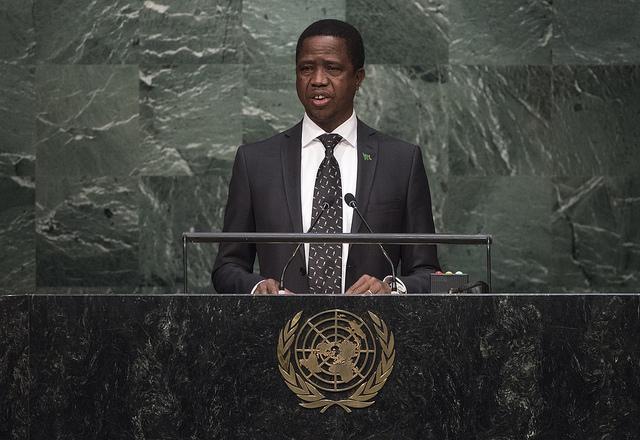
[image: Zambia's President Edgar Lungu speaking at the UN General Assembly
in 2015. Credit: UN Photo/Cia Pak.]
<http://africanarguments.org/wp-content/uploads/2015/12/lungu-zambia.jpg>
Zambia’s President Edgar Lungu speaking at the UN General Assembly in 2015.
Credit: UN Photo/Cia Pak.

With less than a year to go before Zambia’s presidential and general
elections, President Edgar Lungu and his governing Patriotic Front (PF)
face a stern electoral challenge from the opposition United Party for
National Development (UPND) led by Hakainde Hichilema.

Lungu narrowly defeated Hichilema, 53, in the January 2015 presidential
by-election occasioned by the death of then president Michael Sata.  The
59-year-old lawyer obtained 48.3% of the 1,671,662 total votes cast, ahead
of Hichilema who polled 46.7% and the nine other opposition leaders who
shared the remaining 5%.

Out of Zambia’s ten provinces, Lungu won six: Eastern, his home area; the
five provinces from which the populist and Bemba-speaking Sata drew most of
his support; Lusaka, the capital; Copperbelt; and three Bemba-speaking
rural communities of Luapula, Muchinga and Northern provinces. In addition
to Southern province, where he comes from, Hichilema secured the
neighbouring Western, North-Western and Central provinces. At 32%, the
national voter turnout was the lowest recorded for a presidential election
in Zambia’s history.

Since his ascension to power, Lungu has presided over a deteriorating
economy beset by falling copper prices, a crippling energy crisis that has
badly affected production, a 60% depreciation of the Kwacha against major
convertible currencies since January, a sharp increase in inflation (from
7% in January to 19.5% in November), and a budget deficit of 8% of GDP
(relative to the 4.6% originally projected in the 2015 budget).

It may be too early to predict the outcome of the 2016 polls, which, if
Lungu assents to the recently passed Constitution of Zambia Bill, will be
held on 11 August. But what is certain is that this gloomy economic picture
threatens to undermine Lungu’s electoral prospects and has heightened
Hichilema’s hopes.

In an attempt to divert public discussion from its lack of fiscal and
monetary discipline and excessive public extravagance, the government has
blamed the economic challenges on adverse climatic conditions like poor
rainfall and on external factors such as the slowing of the Chinese
economy. For its part, the opposition has dismissed the government’s
explanations and accused Lungu of lacking competence.

In October, the President sought divine intervention when he declared a Day
of National Prayer and asked Zambians to lobby God for solutions. A
successful business magnate, Hichilema is now trying to position himself
and his party as Zambia’s saviour – though he has yet to offer any clear
plans as to how he would rescue the collapsing economy. Considering his
extremely narrow defeat in January 2015, the UPND leader has, in the last
few weeks, talked up his chances of unseating the incumbent in 2016. But
can he really do so? Four major factors are likely to determine the outcome.

*The impact of urban unrest *

The collapse of copper prices and critical power shortages have led to
about 8,000 mining job losses on the influential Copperbelt, worsening the
already soaring national unemployment rate. The impact has been instant. On
2 December, close to 200 discharged miners rioted in Chingola in protest
against the layoffs, their reduced retrenchment packages and the
government’s lacklustre response. State police used tear gas and force to
disperse and arrest the demonstrators and other Copperbelt residents
remonstrating against the high cost of living and chanting anti-PF slogans.
A few days later, disaffected miners held similar protests in the other
mining towns of Kitwe and Mufulira.

There is consensus in the global mining industry that the price of copper,
which accounts for 70% of Zambia’s export earnings, may remain low for a
considerable time, unless unforeseen factors alter this adverse outlook.
This means the country’s bleak economic position may be prolonged, and that
the rising urban unrest is set to intensify. The flashpoints are likely to
spread to other urban centres such as Ndola on the Copperbelt and Lusaka,
where the escalating prices of essential commodities and a recent 70% hike
in electricity tariffs amidst daily power outages have triggered public
outrage.

Of particular concern to Lungu is that the Copperbelt and Lusaka together
contributed nearly half (47%) of his national tally as he secured 71% of
the presidential vote on the Copperbelt and 61% in the capital. Any slump
in his support in these two provinces, relative to any success Hichilema
has in identifying himself with popular protests and marshaling the support
of disgruntled social groups, will almost certainly deal a fatal blow to
President Lungu’s re-election chances. In other words, what Hichilema needs
to secure the presidency is to win his main constituencies with huge
margins and closely trail Lungu in PF strongholds.

*Turnout and over a million new voters*

On 9 December 2015, the Electoral Commission of Zambia announced that it
had added 1.4 million new voters, mostly youth, to the national electoral
roll. Since the voter registration exercise is set to continue until March
2016, this number is likely to rise. In view of the fact that young people
are the hardest hit by unemployment and the general economic woes, with the
country’s youth dependency ratio officially standing at 91.3%, the majority
of them are likely to vote on economic concerns rather than ethnic or party
considerations. Given Lungu’s dismal record on the economy, such a scenario
favours Hichilema.

One of the important features of the 2015 poll was that voter turnout, on
average, was higher in UPND than PF strongholds. Another was that
Hichilema, despite accusations of regional inclination, generally fared
better in the PF constituencies than Lungu did in UPND bases. If both
trends are repeated in 2016, Lungu, who will not have the benefit of a Sata
sympathy vote at the next polls, may be in serious trouble.

These variables suggest that the next election is Hichilema’s to lose.
However, given the political ineptitude of the UPND campaign strategy
which, in an effort to improve the party’s performance in PF’s
Bemba-speaking strongholds, prioritises the recruitment of tokenist ‘ethnic
big men and women’ rather than grassroots mobilisation and the
establishment of local structures, he might just manage it.

*Constitutional reform: an incentive for electoral alliances? *

Historically, opposition electoral alliances in Zambia have been fraught
with challenges owing mainly to the unwillingness of competing political
figures to forego individual presidential ambitions and support their
colleagues. In the 2015 presidential by-election, for instance, the
aggregate vote for opposition parties exceeded the ruling PF’s. Had the
main opposition parties developed a more positive political programme than
a mere dislike of the PF and forged an electoral alliance similar to the
Movement for Multiparty Democracy (MMD), the broad coalition that defeated
founding President Kenneth Kaunda and his nationalist United National
Independence Party in 1991, Lungu would have lost.

One factor that partly explains the failure of past opposition electoral
alliances has been the lack of constitutional backing for collaboration,
prompting mistrust among potential partners that the winning candidate may
not honour pre-election deals. However, this situation will change ahead of
the 2016 polls.

In early December, the PF took to Parliament the Constitution of Zambia
Bill, which contains popular clauses such as the requirement that a winning
presidential candidate should secure a minimum of “50 per cent + 1” and
that the Vice-President should be elected alongside the President. The
proposed legislation was passed and when it becomes law, it could change
the political landscape quite radically.

As neither Lungu nor Hichilema enjoy outright national support, it is
likely that party coalitions in the first or second round of the
presidential elections will be needed to determine a winner. In such a
scenario, if the opposition were to unite behind Hichilema’s candidature,
Lungu’s defeat would be a foregone conclusion. But this eventuality is far
from certain, owing mainly to serious divisions within the rapidly
disintegrating MMD, whose 20-year stay in power was terminated by Sata’s PF
in 2011.

Going into the 2015 poll, the former ruling party split into three
factions. One group backed party president Nevers Mumba, while another,
comprising several MPs including the relatively influential Felix Mutati,
whom Mumba had defeated for the MMD leadership, endorsed Hichilema. The
third faction, led by former Republican and MMD president Rupiah Banda who
made a dramatic return to active politics after Sata’s death, supported
Lungu.

Banda, who hails from the same language group and province as Lungu,
endorsed the PF candidate after the Supreme Court thwarted his attempt to
oust Mumba from the leadership of the MMD and install himself as the
party’s presidential nominee. In protest against the court ruling, he
abandoned the MMD and urged his supporters to vote for the very ruling
party candidate whom he had earlier sought to challenge. The net result of
this factionalism was the fragmentation of the MMD vote, which went in
three directions, with Mumba commanding almost nothing. In comparison to
the 35.6% support that Banda received in the 2011 presidential election,
Mumba managed to secure only 0.8% four years later.

What this context underlines is the illusory nature of the support that
both Hichilema and Lungu received in the 2015 presidential election, since
it may well have been dependent on what would normally have been MMD votes
as well as on traditional UPND and PF votes. Now that the Constitution may
force political parties to forge electoral alliances in order to succeed,
the MMD vote is likely to be the lurking factor at the next polls.

If Lungu signs the proposed Constitution into law, Hichilema’s chances may
therefore be affected by whether he will be facing an MMD-PF coalition
(either formally or in some sort of loose alliance). If the vote on the
Constitutional Bill, which saw PF and MMD MPs voting together, is anything
to go by, the answer may be in the affirmative. In fact, there is already
growing talk that MMD’s Mutati may support Lungu at the next polls, either
in his own right or, if his reported bid to oust Mumba from the party
leadership succeeds, with the organisational backing of the party. If
Mutati, who is said to have support from the Copperbelt and Bemba-speaking
regions, is chosen as Lungu’s running mate or, as MMD leader, enters into
an alliance with PF, he may hurt the electoral prospects of Hichilema, who
is seen by some outside his party bases as leading an anti-Bemba political
movement. (The Bemba-speaking language group is the largest in Zambia,
accounting for 41% of the nation’s population according to the 2010 census.)

How the MMD’s internal politics unfold over the next few months will thus
have an important and perhaps decisive bearing on the election. If
Hichilema manages to persuade all influential opposition figures, including
Mutati, to support him, political turnover may be achieved.

*The role of a critical free press*

One of the main platforms of opposition voices and dissent since the
reintroduction of multiparty politics in the early 1990s has been *The Post*,
a newspaper that made its name exposing government excesses and corrupt
deals, promoting a free press, and fostering transparency and
accountability. Over the last few months, the daily publication has played
an important role in covering the unfolding social unrest on the
Copperbelt. This has effectively highlighted the underperformance of Lungu
and raised public consciousness of people’s struggles and their desire for
political change. With its national presence and capacity to affect public
opinion, *The Post*’s critical portrayal of Lungu has unleashed a
noticeable backlash against him and earned it the ire of the governing
authorities.

For instance, in September, Lungu made ill-advised comments that amounted
to a death threat to the newspaper’s editor-in-chief, Fred M’membe, a few
days before unknown assailants fired a bullet from an AK-47 into the
publication’s newsroom. The following month, the government attempted to
shut down the critical tabloid on tax-related claims, but the High Court
halted the move. More recently, on 10 December, a combined team of armed
state police, intelligence officers and revenue collectors raided The
Post’s head office over alleged tax evasion and went away with company
computers and documents. Again, the High Court declared the move illegal
and ordered the revenue authority to return the seized items.

Critics point to these developments as evidence of Lungu’s growing
desperation and fears that *The Post* may damage his re-election chances.
Conclusions that the ruling authorities are simply out to either paralyse
the operations of the newspaper or close it altogether are hard to dismiss
for two main reasons. First, several PF-aligned publications and other
companies that owe the revenue authority huge debts in tax revenue have not
been treated in a similar way. Second, senior government officials,
including Lungu and the Minister of Information, have previously threatened
to shut down the tabloid for its critical positions against the
establishment, reinforcing perceptions that the revenue authority’s actions
against it are politically motivated. If the government succeeds in closing
the only established and credible platform for opposition parties, it would
strike a serious blow to their electoral chances and underline Lungu’s
increasing authoritarianism and intolerance of dissent. Conversely, the
prospects for an opposition victory are high if *The Post* remains in
operation, as the disenchantment arising from an informed public may work
against the governing party.

*A two-horse race*

Given the absence of credible opinion polls and the considerable time
remaining before the elections, any prediction concerning the 2016 polls
should be regarded as tentative and treated with caution. But what is
almost certain for now is that unless other opposition parties such as
Edith Nawakwi’s Forum for Democracy and Development or Wynter Kabimba’s
Rainbow gain momentum and emerge as viable alternatives, the 2016
presidential elections will be a race between Lungu and Hichilema – a
tragic choice between the economically-incompetent PF and the increasingly
populist UPND, whose leader spent the January campaign promising free
education, free fertiliser and almost every budget-busting proposal he
could think of.

*Sishuwa Sishuwa is a Zambian scholar and political analyst based at the
University of Oxford.*
If you enjoyed this post, please consider leaving a comment
<http://africanarguments.org/2015/12/15/can-zambias-opposition-unseat-president-lungu-in-the-2016-elections/#comments>
or subscribing to the RSS feed <http://africanarguments.org/feed/> to have
future articles delivered to your feed reader.
This entry was posted in African Politics Now
<http://africanarguments.org/category/politics-now/>. Bookmark the permalink
<http://africanarguments.org/2015/12/15/can-zambias-opposition-unseat-president-lungu-in-the-2016-elections/>.

--
To post to this group, send email to [email protected]
To unsubscribe from this group, send email to
[email protected]
Visit this group at https://groups.google.com/d/forum/southsudankob
View this message at
https://groups.google.com/d/msg/southsudankob/topic-id/message-id
For more options, visit https://groups.google.com/d/optout
---
You received this message because you are subscribed to the Google Groups
"South Sudan Info - The Kob" group.
To unsubscribe from this group and stop receiving emails from it, send an email
to [email protected].
To post to this group, send email to [email protected].
Visit this group at https://groups.google.com/group/SouthSudanKob.
To view this discussion on the web visit
https://groups.google.com/d/msgid/SouthSudanKob/CAJb14oqruf6Cp1WCJhe%2BGrwmoDDnwQ0BRkhhWZs628aRE9H%2BcA%40mail.gmail.com.
For more options, visit https://groups.google.com/d/optout.