Zimbabwe’s media under siege again
Posted on December 16, 2015
<http://africanarguments.org/2015/12/16/zimbabwes-media-under-siege-again/>
by Problem Masau <http://africanarguments.org/author/problem-masau/>
*Through arrests of journalists and threatening speeches, the government is
signalling its intent to repress Zimbabwe’s media. And it will likely get
worse.*
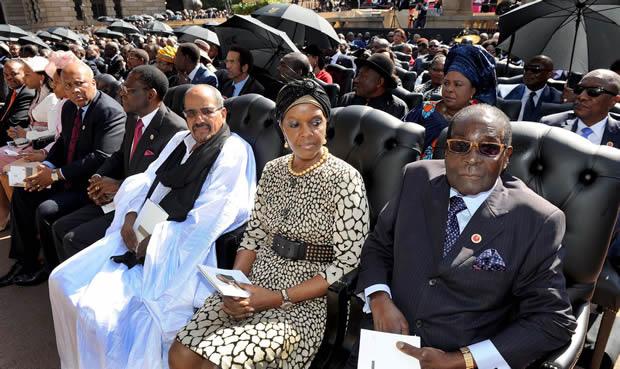
[image: Grace Mugabe and Robert Mugabe have both given highly critical
speeches about Zimbabwe's media recently. Credit: GCIS.]
<http://africanarguments.org/wp-content/uploads/2015/12/zimbabwe-media.jpg>
Grace Mugabe and Robert Mugabe have both given highly critical speeches
about Zimbabwe’s media recently. Credit: GCIS.

In 2013, there was a brief but bright window in which Zimbabwe’s media were
filled with cautious optimism that a more open environment might be
beckoning. A new constitution with an expanded bill of rights had been
approved by Parliament earlier in the year, and the Minister of Information
Jonathan Moyo − newly re-appointed after the ruling ZANU-PF’s convincing
victory in general elections − made a point of visiting newsrooms to meet
with journalists and publishers. An Information and Media Panel of Inquiry
(IMPI) <http://www.herald.co.zw/impi-submits-report/> was established to
gather a wide range of views on how to improve the operations of the media.

However, this new chapter and new hope has not lasted long. Just two years
on, media houses are alarmed at the rate journalists have been arrested
recently and are growing more concerned as the rhetoric coming from members
of the government intensifies.

This October, President Robert Mugabe lambasted the privately-owned
newspapers NewsDay and The Standard, referring
<https://www.newsday.co.zw/2015/10/17/mugabe-attacks-newsday-standard-newspapers/>
to
them as the “opposition press” and ‘”those rubbish papers”. This was
followed up by Zimbabwe’s First Lady and head of ZANU-PF’s influential
women’s wing Grace Mugabe who recently called
<http://allafrica.com/stories/201510150201.html> journalists who had been
critical of her “uneducated” and “foolish”. And George Charamba, the
Presidential Spokesperson and Permanent Secretary in the Ministry of
Information, has further raised concerns by saying
<http://nehandaradio.com/2015/10/11/mugabe-spokesman-threatens-private-media/#sthash.8Dy55V6j.dpuf>,
ominously: “I will recommend most effective ways of controlling errant
behaviour in the newsroom. So you will have a piece of legislation that
seeks to restrain rather than to enable media practices.”

These loud and public critiques of the press have been backed up with
action too. For example, Itai Dzamara, a journalist, human rights activist
and critic of Mugabe, was bundled
<https://www.amnesty.org/en/latest/campaigns/2015/09/zimbabwe-where-is-itai-dzamara/>
into an unmarked vehicle in March 2015 and has not been seen since. In
November, freelance journalist Andrison Manyere
<http://www.misazim.com/index.php/component/k2/item/1893-police-hunt-journalist-over-mugabe-offensive-story>
was
arrested for covering an opposition demonstration. And reporters Angela
Jimu, <https://www.newsday.co.zw/2015/02/20/mohadi-sued-cop-beating-journo/>
 Edgar Gweshe
<http://www.financialgazette.co.zw/repression-fuelling-zims-regression/>
 and Privilege Musvanhiri
<http://www.misazim.com/index.php/updates/news/item/728-council-police-assault-arrest-journalist>
have been detained by police in recent months whilst doing their jobs, to
name just a few. Even state media journalists are no longer immune as
demonstrated when the Sunday Mail’s editor and two reporters were arrested
<http://www.herald.co.zw/editor-reporters-arrested/> last month after
publishing a story alleging senior police officer involvement in a
poaching syndicate which has left more than 22 elephants dead.

*Ramping up a clamp down*

Zimbabwe’s ZANU-PF government has a history of clamping down hard on the
media. In the early 2000s, for instance, when ZANU-PF’s political dominance
was being challenged more than ever, critical news outlets were accused of
being opposition mouthpieces and journalists were targeted. The
independently-owned Daily News was bombed twice − in 2000 and then again in
2001 − allegedly by individuals associated with the Zimbabwean military,
while its editor was arrested repeatedly. This media repression continued
through most of the 2000s, with journalist Edward Chikomba
<http://news.bbc.co.uk/2/hi/africa/6529887.stm> murdered in a particularly
tragic episode in 2007.

In 2009, following the agreement of a power-sharing deal between ZANU-PF
and the opposition MDC, the media enjoyed a slight reprieve, and some
previously banned newspapers were allowed to re-open. However, since Mugabe
romped to victory in the 2013 polls, there are fears that Zimbabwe’s
government has reverted back to its old ways.

Once again, several senior officials are complaining
<http://www.thezimbabwenewslive.com/zimbabwe-8898-mushowe-threatens-private-media.html>
loudly
about what they claim are concerted efforts by the private media to tarnish
the image of ZANU-PF while journalists are facing detention more
frequently. The government has also been suggesting a tightening of media
laws to address what they say is a dearth of ethics and professionalism.
Writing in his weekly column
<http://www.herald.co.zw/proppress-behold-an-unnameable-malformation/>,
Nathaniel Manheru, an anonymous writer who is widely believed to be the
Information Ministry’s George Charamba, hinted that a cure for what he
referred to as “unprofessional”, “hateful” and “confrontational” reporting
was imminent.

This new state of affairs has left much of Zimbabwe’s media highly
concerned. Ibbo Mandaza, director of the Southern African Political and
Economic Series Trust and former publisher of the now defunct Daily Mirror
and Sunday Mirror, even goes as far as to say that the current persecution
of journalists has taken Zimbabwe back not just to a decade ago, but to the
country’s pre-colonial era.

“Zimbabwe’s media is under siege. We have been taken back to the
Rhodesian period,” he says. “The state is now ruling without being
accountable to people.”

“There is too much censorship of the media, especially state-owned
media houses,” continues Mandaza. “Look at the Zimbabwe Broadcasting
Corporation − it is now like the Rhodesia Broadcasting Corporation (RBC).
Everything broadcasted there is being censored by the state…We have a state
which has come with a very strong law and order department to deal with any
democratic voices.”

In Zimbabwe’s media environment today, there are growing echoes of the
2000s as the government’s rhetoric ramps up and arrests continue. Many
journalists are also awaiting with bated breath the possibility of new
legislation, as being hinted at by high-level officials. It remains to be
seen what that might entail, but some observers, such as Pedzisai Ruhanya,
a media analyst based in Harare, believe the situation for Zimbabwe’s media
may well get worse before it gets better.

“If you look at how the state has been at the centre of all the attack of
journalists, it tells you that there will not be any changes, but
journalists should brace for more difficult times especially 2018 [when
elections will be held] which is likely going a tough contestation between
ZANU-PF and opposition forces,” he says.

*Problem Masau is a Zimbabwean journalist.*
If you enjoyed this post, please consider leaving a comment
<http://africanarguments.org/2015/12/16/zimbabwes-media-under-siege-again/#comments>
or subscribing to the RSS feed <http://africanarguments.org/feed/> to have
future articles delivered to your feed reader.
This entry was posted in African Politics Now
<http://africanarguments.org/category/politics-now/>. Bookmark the permalink
<http://africanarguments.org/2015/12/16/zimbabwes-media-under-siege-again/>.

--
To post to this group, send email to [email protected]
To unsubscribe from this group, send email to
[email protected]
Visit this group at https://groups.google.com/d/forum/southsudankob
View this message at
https://groups.google.com/d/msg/southsudankob/topic-id/message-id
For more options, visit https://groups.google.com/d/optout
---
You received this message because you are subscribed to the Google Groups
"South Sudan Info - The Kob" group.
To unsubscribe from this group and stop receiving emails from it, send an email
to [email protected].
To post to this group, send email to [email protected].
Visit this group at https://groups.google.com/group/SouthSudanKob.
To view this discussion on the web visit
https://groups.google.com/d/msgid/SouthSudanKob/CAJb14oqHGFvYEvgWS5nN%3DEvd3MUu_5PkG%2BAYo%3Du8fDeBzS4jRA%40mail.gmail.com.
For more options, visit https://groups.google.com/d/optout.