Nigeria: Buhari’s southern dilemma heating up
Posted on January 29, 2016
<http://africanarguments.org/2016/01/29/nigeria-buharis-southern-dilemma-heating-up/>
by Chris Newsom <http://africanarguments.org/author/chris-newsom/>
*With a cluster of hotly-contested election re-runs coming up and low oil
prices squeezing budgets, the next six months will be pivotal for the
Nigerian government.*
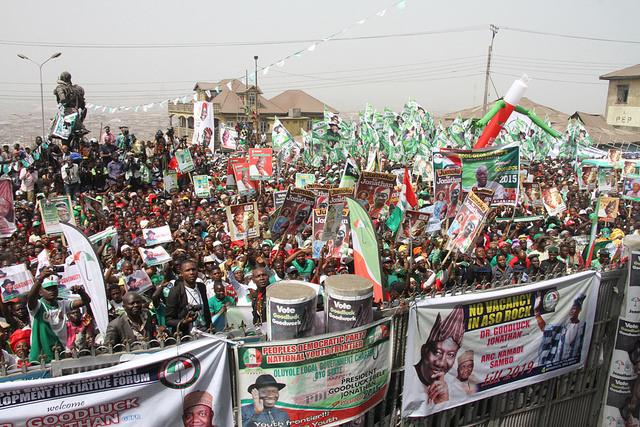
[image: Electioneering ahead of Nigeria's 2015 elections. Credit:
Heinrich-Böll-Stiftung.]
<http://africanarguments.org/wp-content/uploads/2016/01/nigeria-south.jpg>
Electioneering ahead of Nigeria’s 2015 elections. Credit:
Heinrich-Böll-Stiftung.

There are few moments in which being the president of Nigeria is easy, but
over the next six months, Muhammadu Buhari is likely to face some of his
toughest tests yet. How his administration deals with these issues could
define the government’s relationship with the country over the next four
years.

The two major challenges coming to a head in the near future are clear to
see. On the economic front, low oil prices are squeezing the government
budget and undermining the country’s economic prospects. Meanwhile, on the
political front, tensions in the Niger Delta and South East continue to
simmer as the local economy continues to contract and could heat up further
as election re-runs are held over the next few months.

What is less clear, however, is how far these two matters could interact
with one another to produce an even more troubling mix.

*Replaying the polls*

The most imminent hurdles facing Nigeria are the elections that need to be
re-held after a significant cluster of results from April 2015 were annulled
<http://africanarguments.org/2016/01/19/nigerias-contentious-court-rulings-reveal-need-for-electoral-reform/>.
These polls – most of which are in the south of the country – are required
to be repeated in the coming months after the original elections were
deemed to be fraught with irregularities and violence. Given how much there
is at stake, serious divisions could arise once again, and the presence of
militant groups that have been dormant since 2009 could be a significant
factor.

Re-run polls completed just this month in Bayelsa, a state in the Niger
Delta, point to these risks. In these recent elections, ‘former’ militants
openly took sides and became enforcers for the two major parties in what
became a violent contest – the number of fatalities is still being debated.
The political tension was such that members of the All Progressives
Congress (APC) on one side and the Peoples Democratic Party (PDP) on the
other both routinely lobbed accusations of bias at the security services
and electoral commission.

The process of setting the remaining polls is still somewhat unpredictable.
For instance, earlier this week the Supreme Court made a surprise verdict
as it overruled successive lower court judgements and decided to uphold the
original outcome of the Rivers state contest, restoring the PDP’s Nyesom
Wike as governor. However, for many of the election re-runs, the need for a
redo has been locked in with National Assembly and State Assembly elections
to be conducted in February and March, and sensitive governorship polls
likely to fall in June.

Many of these will be closely fought, but a few that will present
particular challenges include: the two Senate races in Abia state, which is
presently the site of many of the agitations calling for independence for
Biafra; the possible re-run of the governorship election in the oil-rich
southern state of Akwa Ibom; and the national assembly polls in which the
PDP former Senate President David Mark faces an intense contest in Benue
South.

Most of these elections are being framed as a test for the
newly-inaugurated Electoral Commission (INEC), which has already been
criticised over its conduct of elections in Kogi and Bayelsa. But the polls
will also be a serious test of credibility for federal and state
governments as well as security services amidst a rising sense of
insecurity.

*Economic ordeals*

If these challenges were not enough, they are also happening in the context
of significant economic travails. Low oil prices are cutting away at
government budgets; the Central Bank of Nigeria recently announced that non-oil
revenues fell
<http://www.vanguardngr.com/2016/01/cbn-blames-declining-non-oil-revenue-on-low-export-loans/>
from $10.5 billion in 2014 to $4.4 billion in 2015; and personal interviews
with oil executives suggest they are looking to cut their staff budgets in
half, whether by making large-scale redundancies or slashing salaries.

These economic impacts are not unrelated to the discontentment in the Niger
Delta and the growing calls for Biafran independence. While tagged as a
‘south east’ movement, recent protests around the issue of Biafra have
highlighted a capacity to bring out crowds across the Niger Delta and even
as far afield as Lagos.

The protests are particularly worrying because their central driving force
at present is Radio Biafra (broadcast from the UK), which has a virulently
anti-northern message. However, a common theme of the movement seems to be
the pool of frustrated youth who have seen their economic opportunities,
which were slender to begin with, evaporate more recently.

Indeed, the channelling of development and patronage funds to the Niger
Delta have contracted at a pace every bit as breath-taking as the collapse
in oil prices. Federal allocations to state governments in the region are
down by more than 50% in some cases
<http://economicconfidential.com/faac-shares-n485-4bn-for-august-2015/>,
while agencies such as the Niger Delta Development Commission (NDDC) are
facing a budget cut
<http://dailypost.ng/2015/12/26/2016-budget-breakdown-of-sums-allocated-to-presidency-mdas-others/>
of around 75%. This is part of a picture that is reflected nationally, but
the scale of the drop in the delta states is also magnified by certain
‘multipliers’, such as the fact that the oil industry employers currently
shedding jobs are also by far the biggest taxpayers.

Added to these worrying trends, the region has also experienced some other
more exceptional economic hits. For example, the Federal Government now
appears intent on cancelling the building of a new maritime university
<http://www.ngrguardiannews.com/2016/01/renewed-rage-in-niger-delta-region/>,
a plan conceived by the previous administration. It had been budgeted to
cost some $340 million and was to be located in the home town of Government
Tompolo, a prominent ‘ex-militant’ who is now facing charges of corruption.
The day after charges were filed against Tompolo, two major oil pipelines
were blown up
<http://www.vanguardngr.com/2016/01/militants-continue-bombing-in-delta/>
and other facilities were attacked amidst claims and counter claims over
precisely who was responsible.

*A pivotal moment*

This brew of challenges facing Nigeria is extraordinarily complicated, but
some of these tests can also be seen as opportunities.

For example, if INEC and the security services are able to conduct fair
elections in difficult states, the effects could be significant. Better
governance remains at the core of improving prospects in the Niger Delta
and this cannot be achieved without polls that see increased participation
from rural communities and middle-classes. This latter group has typically
had little confidence in the elections and tended to stay away from them.
Although there is not long to go before elections, exceeding the public’s
low expectations could set local democratisation on a more positive
trajectory.

In a broader sense, the current situation is also a crucial moment for the
Federal Government to communicate that it is not abandoning the mission of
development in the Niger Delta. Promising public commitments have been made
on items such as oil spill clean-ups in high-profile areas such as Ogoni.
But amidst cutbacks and clampdowns, it is important that these words are
converted into action.

Some of the quickest interventions will likely need to come down
established channels. This means the recent appointment of a new Managing
Director at the Niger Delta Development Commission (NDDC) will come under
additional spotlight. In her first few weeks, the new MD has highlighted
better governance, transparency, and engagement with civil society as being
crucial to turning around an institution notorious for patronage and
corruption. With few other ready levers, the NDDC’s conduct will be vital
to how the Federal Government engages with the region and it is now time
for the NNDC to put its money where its mouth is.

Last year, Nigeria navigated a difficult crossroads in the 2015 elections.
In the first six months of this year, the country is at another such
crossroads, this time centred on the Niger Delta and South East. The path
Buhari takes will affect the whole country and could define the rest of his
term.

*Chris Newsom is an analyst based in Nigeria and a programmes advisor to
Stakeholder Democracy Network (SDN).*
If you enjoyed this post, please consider leaving a comment
<http://africanarguments.org/2016/01/29/nigeria-buharis-southern-dilemma-heating-up/#comments>
or subscribing to the RSS feed <http://africanarguments.org/feed/> to have
future articles delivered to your feed reader.
This entry was posted in African Politics Now
<http://africanarguments.org/category/politics-now/>, The Nigeria Forum
<http://africanarguments.org/category/nigeria-political-forum/>. Bookmark
the permalink
<http://africanarguments.org/2016/01/29/nigeria-buharis-southern-dilemma-heating-up/>.

--
To post to this group, send email to [email protected]
To unsubscribe from this group, send email to
[email protected]
Visit this group at https://groups.google.com/d/forum/southsudankob
View this message at
https://groups.google.com/d/msg/southsudankob/topic-id/message-id
For more options, visit https://groups.google.com/d/optout
---
You received this message because you are subscribed to the Google Groups
"South Sudan Info - The Kob" group.
To unsubscribe from this group and stop receiving emails from it, send an email
to [email protected].
To post to this group, send email to [email protected].
Visit this group at https://groups.google.com/group/SouthSudanKob.
To view this discussion on the web visit
https://groups.google.com/d/msgid/SouthSudanKob/CAJb14oo10-NrkPySW-JOkigqKh_O7OJkHNKZ1xX3d3RnR-%3DZHA%40mail.gmail.com.
For more options, visit https://groups.google.com/d/optout.