What does Jammeh have to gain by making The Gambia an Islamic Republic?
Posted on January 28, 2016
<http://africanarguments.org/2016/01/28/why-does-jammeh-want-to-make-the-gambia-an-islamic-republic/>
by Adolphus Washington
<http://africanarguments.org/author/adolphus-washington/>
*President Yahya Jammeh has developed a reputation for surprising
announcements. What might be the reasons behind his latest?*
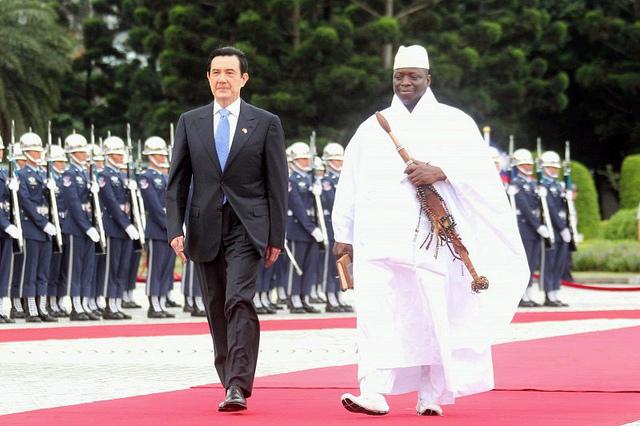
[image: President Yahya Jammeh on a visit to Taiwan before relations were
severed. Credit: Taiwan presidential office.]
<http://africanarguments.org/wp-content/uploads/2016/01/jammeh-islamic-republic.jpg>
President Yahya Jammeh on a visit to Taiwan before relations were severed.
Credit: Taiwan presidential office.

In a surprise announcement last month, President Yahya Jammeh declared
<http://www.statehouse.gm/2015-dialogue-tour_0930112015/tour-updates-day19-brufut-mtg_10122015.htm>
The Gambia an Islamic Republic. In a state TV broadcast, Jammeh – who has
gained a reputation for making unexpected pronouncements since becoming the
country’s leader in 1994 – pointed to the fact 95% of the population is
Muslim and said he wanted to dismantle any remaining vestiges of
colonialism.

In his address, the president also insisted that the rights of all citizens
– regardless of religion – would be safeguarded and that there would not be
a dress code for women. But it was not long before the latter promise was
broken and a presidential directive was issued requiring female public
sector employees to cover their hair during work hours. Another U-turn
followed close behind though, with the decision rescinded in a press
release explaining <http://allafrica.com/stories/201601141371.html> that:

“Women are His Excellency the president Sheikh Professor Alhaji Dr. Yahya
AJJ Jammeh-Babili Mansa’s best friends, they are his sisters and he is here
for their wellbeing and happiness at all times. That being the case, this
decision that makes them unhappy has been lifted.”

This side show generated attention in and outside the country, but this
back and forth aside, Jammeh’s decision to make The Gambia an Islamic
Republic raises a number of important legal, political and religious
questions.

*What’s behind the decision? *

The motivation behind Jammeh’s declaration is uncertain, but there are a
number of possible reasons beyond the official version.

One possibility is that the president is attempting to divert attention
away from the fact that the country’s economy is faltering, with high
unemployment contributing to scores of young Gambians risking their lives
to embark on the treacherous journey of migration
<http://www.migrationpolicy.org/article/gambia-migration-africas-smiling-coast>
to Europe.

In October, Jammeh called for an investigation into the “frequent and
mysterious sinking, capsizing etc. of boats carrying mostly Black African
migrants looking for greener pastures in the West only to end up in body
bags on European shores”. As important as this may be to highlight, Jammeh
could look closer to home where human rights abuses and poverty are
widespread to understand why so many are leaving The Gambia in the first
place.

Another motivation for making the country an Islamic Republic could be as a
way for Jammeh to consolidate his rule. For instance, if The Gambia were to
adopt a structure akin to Iran’s Islamic Republic in which the Supreme
Leader is the single most powerful official, Jammeh could seek this
position, giving him even more dominance over executive, legislative and
judicial branches of government as well as the military and media.

Finally, the decision to make The Gambia an Islamic Republic could be part
of a broader strategy of repositioning the country’s foreign relations.
Over the past few years, Jammeh has implemented a number of policies that
have moved the country away from Western donors. In 2013, he withdrew
<http://www.bbc.co.uk/news/uk-24376127> The Gambia from the Commonwealth;
in 2014, the president signed
<http://www.theguardian.com/world/2014/nov/21/gambian-leader-approves-anti-gay-law>
into a law legislation that could see gay people sentenced to life
imprisonment; and in 2015, he abruptly expelled
<http://uk.reuters.com/article/uk-gambia-eu-expulsion-idUKKBN0OM01J20150606>
the European Union Chargée d’Affaires without any clear justification or
explanation. These actions distanced The Gambia from its Western
partners and resulted in the withholding of millions of dollars in aid
<http://www.openaiddata.org/recipient_country/240/2013/>.

With the West reducing its assistance and The Gambia failing to attract
substantial Chinese attention despite breaking diplomatic ties with Taiwan
in 2013, The Gambia is increasingly leaning towards wealthy Gulf States
which are less likely to be concerned about poor human rights record and
weak rule of law. Jammeh has been on a charm offensive in courting these
partners, offering to host the conference on Islamic Civilisation later
this year and the Organisation of Islamic Conference in 2018. Making the
country an Islamic Republic could be a further sign of this shift in the
country’s shifting allegiances.

*Can Jammeh turn The Gambia into an Islamic Republic?*

Even for Jammeh, merely declaring The Gambia an Islamic Republic does not
make it so. And in order to work out how the country can make the
transition, Vice President Njie Saidy has requested that the Gambia Supreme
Islamic Council (GSIC) conduct research regarding the exact requirements of
an Islamic Republic before legislation is introduced.

However, opposition groups and dissidents in the diaspora have already
raised concerns that the move could be in violation of the constitution
without a long process including a popular referendum. For instance, the
diaspora group National Resistance Movement Gambia (NRMG) stated
<http://www.jollofnews.com/index.php/national-news/politics/958-gambians-react-to-jammeh-s-declaration-of-an-islamic-state>
:

“Declaring The Gambia an ‘Islamic State’ without the prerequisite
constitutional reforms is simply an insult to the Gambian people. Both the
second Republican Constitution and the one before, sell our country as a
‘Secular State’ which can be undone by a two thirds majority vote of the
National Assembly and a Referendum.”

This may well be true. However, even if these requirements are necessary
for Jammeh’s declaration to be made legal, they are unlikely to provide too
much of a hurdle. The ruling Alliance Patriotic Reorientation and
Construction (APRC) holds 43 of the 53 seats in the National Assembly. And
if a referendum is held, its conduct will likely reflect the country’s
recent elections which have been characterised by corruption and
intimidation.

Guessing the motives or future actions of Yahya Jammeh is no easy feat, but
one thing he has proven over the past two decades or so is that he usually
gets his way.

*Adolphus Washington is a London-based freelance writer with a focus on
sub-Saharan African affairs. He has an MSc in African Politics from the
School of Oriental and African Studies*.
If you enjoyed this post, please consider leaving a comment
<http://africanarguments.org/2016/01/28/why-does-jammeh-want-to-make-the-gambia-an-islamic-republic/#comments>
or subscribing to the RSS feed <http://africanarguments.org/feed/> to have
future articles delivered to your feed reader.
This entry was posted in African Politics Now
<http://africanarguments.org/category/politics-now/>. Bookmark the permalink
<http://africanarguments.org/2016/01/28/why-does-jammeh-want-to-make-the-gambia-an-islamic-republic/>.

--
To post to this group, send email to [email protected]
To unsubscribe from this group, send email to
[email protected]
Visit this group at https://groups.google.com/d/forum/southsudankob
View this message at
https://groups.google.com/d/msg/southsudankob/topic-id/message-id
For more options, visit https://groups.google.com/d/optout
---
You received this message because you are subscribed to the Google Groups
"South Sudan Info - The Kob" group.
To unsubscribe from this group and stop receiving emails from it, send an email
to [email protected].
To post to this group, send email to [email protected].
Visit this group at https://groups.google.com/group/SouthSudanKob.
To view this discussion on the web visit
https://groups.google.com/d/msgid/SouthSudanKob/CAJb14opPPzCzYsGpk35mEURfq9%3DyW3xFMp1SP7xMTaZpO9crSQ%40mail.gmail.com.
For more options, visit https://groups.google.com/d/optout.