---------- Forwarded message ----------
From: "Eric Reeves" <[email protected]>
Date: 20 Jun 2016 18:12
Subject: Politicizing Humanitarian Relief: The International Community
Continues to Accept Khartoum’s Humanitarian Blockade in the Nuba Mountains
and Blue Nile
To: "Eric Reeves" <[email protected]>
Cc:
*Politicizing Humanitarian Relief: **The International Community Continues
to Accept Khartoum’s Humanitarian Blockade in the Nuba Mountains and Blue
Nile*

Eric Reeves  |  June 20, 2016  |  http://wp.me/p45rOG-1Ue

Unseemly haste and a disgraceful refusal to accept the moral consequences
of their action have prompted European countries to accelerate
* rapprochement* with the Khartoum regime
<http://sudanreeves.org/2016/06/09/7319/> in order to step the flow of
African refugees to Europe. The European Union gives every sign of
increasing political, diplomatic, and economic ties to the National Islamic
Front/National Congress Party regime as a crude and ineffective means to
this end. We should note clearly that the assistance now offered to the
regime extends even to high-tech surveillance and registration
equipment—nominally to assist Khartoum in containing refugees in “closed
camps.”

This equipment will of course be used almost exclusively by the infamous
National Intelligence and Security Services, Military Intelligence, and
others in the vast security network that the regime depends on for its
survival. A report by the German newspaper *Der Spiegel* (May 13, 2016)
cites
<http://sudanreeves.org/2016/05/15/from-der-spiegel-questionable-deal-eu-to-work-with-sudans-despot-to-keep-refugees-out/>—without
denial or rebuttal—EU documents that contain truly extraordinary
revelations:

Minutes from the March 23 meetings and additional classified documents
obtained by SPIEGEL and the German public television station ARD show
"Report Mainz" show that the focus of the project is border protection. To
that end, equipment is to be provided to the countries in question.

>From these minutes we learn that:

Europe want[s] to send cameras, scanners and servers for registering
refugees to the Sudanese regime in addition to training their border police
and assisting with the construction of two camps with detention rooms for
migrants. *The German Ministry for Economic Cooperation and Development has
confirmed that action plan is binding*, although no concrete decisions have
yet been made regarding its implementation…

Germany and the other EU member states … seem determined to push ahead with
their pact with the [regime president, Omar al-Bashir]. Sudanese
authorities say there have been *numerous visitors from Germany in recent
weeks who were there to discuss the construction of closed camps**. *When
questioned about its role, Germany's GIZ issued a written reply that there
were no concrete plans in the country yet.

Was the EU aware of the dangerous waters into which they were venturing?
Evidently they did:

*The ambassadors of the 28 European Union member states had agreed to
secrecy.* *"Under no circumstances" should the public learn* what was said
at the talks that took place on March 23rd, the European Commission warned
during the meeting of the Permanent Representatives Committee. A *staff
member of EU High Representative for Foreign Affairs Federica Mogherini
even warned that Europe's reputation could be at stake.*

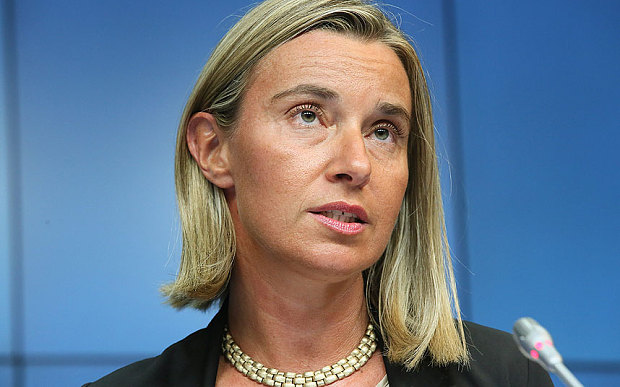
Astonishingly, Ms. Mogherini retains her job, and continues to make fatuous
statements about EU policy toward Sudan.

[image: mogherini_3022383b]
<http://sudanreeves.org/wp-content/uploads/2016/04/mogherini_3022383b.jpg>

*EU High Representative for Foreign Affairs Federica Mogherini*

This is an appropriate point at which to note something of Khartoum’s
regard for refugees and refugee issues. Most notably, more than 300,000
Darfuri refugees, desperate to return home, are trapped
<https://www.dabangasudan.org/en/all-news/article/refugees-in-eastern-chad-refuse-to-return-to-darfur>
in
eastern Chad by the regime’s ongoing genocidal counter-insurgency in Darfur
itself. All of Darfur is insecure, but the extent of ethnically-targeted
violence in East Jebel Marra
<http://sudanreeves.org/2016/02/17/changing-the-demography-violent-expropriation-and-destruction-of-farmlands-in-darfur-november-2014-november-2015/>
and
Jebel Marra during the past three dry seasons makes clear that a great many
of these refugees will have nothing to return to. The UN High Commission
for Refugees, tired of the refugee crisis in eastern Chad, is making
permanent settlement—with Chadian nationalization—the only alternative to
returning to Darfur. The UN’s World Food Program is doing its part by
allowing rations for refugee camps to drop to what is effectively only
about one third of the 2,100 kilocalories daily
<https://www.dabangasudan.org/en/all-news/article/darfur-refugees-in-eastern-chad-close-to-starving>
necessary
for health human existence.

[image: Screen-Shot-2016-04-27-at-5.18.08-PM-1024x326]
<http://sudanreeves.org/wp-content/uploads/2016/06/Screen-Shot-2016-04-27-at-5.18.08-PM-1024x326.png>

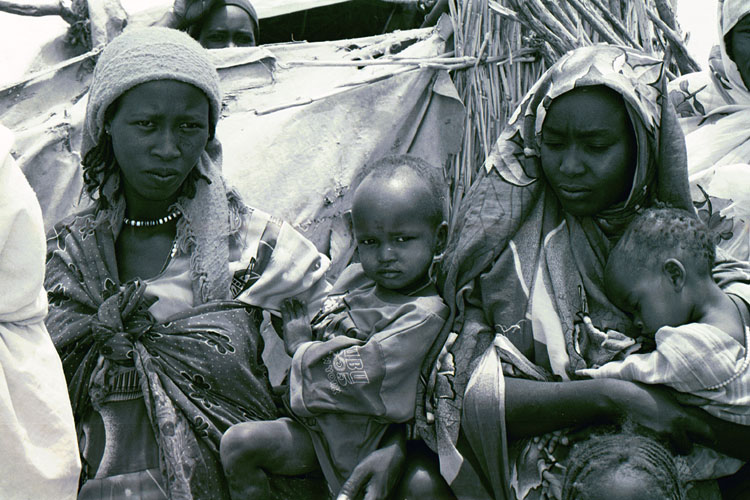
*Darfuri refugees in eastern Chad, 2009 (photograph by Mia Farrow)*

[image: chad3] <http://sudanreeves.org/wp-content/uploads/2016/04/chad3.jpg>

*Darfuri refugees in eastern Chad, 2016*

On another front in the world-wide refugee crisis, Human Rights Watch
recently reported on Khartoum’s forcible deportation of more than 400
Eritrean refugees
<https://www.hrw.org/news/2016/05/30/sudan-hundreds-deported-likely-abuse>—some
of whom had been formally recognized as such by UNHCR. Khartoum, Human
Rights Watch Reports, has also denied access to claimants to refugee status
<https://www.hrw.org/news/2016/05/30/sudan-hundreds-deported-likely-abuse>—an
extremely ominous sign. Both are conspicuous and egregious violations of
international humanitarian law.

Moreover, we may be sure that the high-tech, “closed camps” that Germany
has taken lead in committing to building will be nothing short of
concentration camps—with people “concentrated” on the basis of ethnicity,
nationality, race, and religion. And we may be sure that UNHCR will
continue to be denied access as the regime deems necessary. That such camps
will be built by Germany, given its own history with such camps, is utterly
shocking.

This concern for imposing a “refugee embargo” on people of African
nationalities is particularly perverse, since it mirrors Khartoum’s own
embargo on humanitarian relief aid to the civilian populations of South
Kordofan and Blue Nile. People in areas controlled by the Sudan People’s
Liberation Movement/Army-North (SPLM/A-N) have been denied international
assistance for five years.

Regime officials have made explicit their determination that these areas
will not “become another Darfur,” in which international humanitarian
organizations might provide food assistance to severely malnourished
children and adults, or provide desperately needed primary medical care. Of
course Darfur itself continues to suffer from dramatically declining
international humanitarian capacity and constant harassment of relief
organizations—including by means of violence. For all thirteen years of the
Darfur conflict Khartoum has systematically denied relief access to various
points in Darfur. The regime has expelled more than two dozen of the
world’s finest relief organizations during this time, as well as targeting
for expulsion senior officials of the UN and nongovernmental relief
organizations.

This is the face of the regime with which the EU is now negotiating with to
serve as bulwark against the African refugee flow to Europe. That such
negotiations should occur with no commitment to seeing the end of the
humanitarian blockade on South Kordofan and Blue Nile is especially
shameful—and reveals a deep cynicism about devoting the diplomatic and
political resources necessary to change Khartoum’s behavior, including
pressure in the form of EU financial and economic sanctions similar to
those of the U.S.

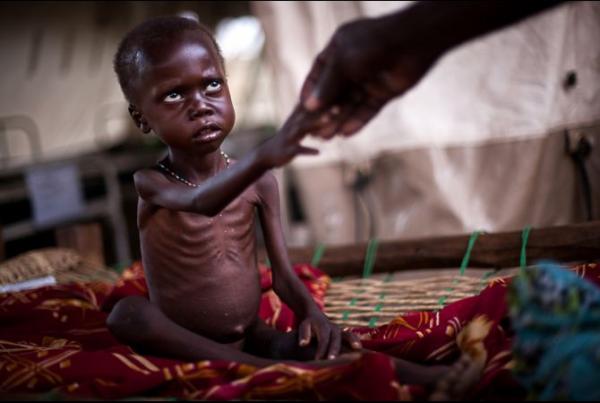
[image: south_kordofan_5_6_2012_1]
<http://sudanreeves.org/wp-content/uploads/2016/03/south_kordofan_5_6_2012_1.jpg>

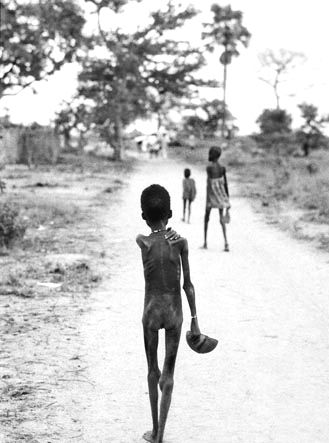
*Life in the Nuba Mountains of South Kordofan: a severely malnourished
child. We have no idea how many tens of thousands of such children there
are because Khartoum refuses to allow an international humanitarian
presence, and hence there are no resources with which to conduct broad
malnutrition assessments.*

[image: An26-Cargo-Aircraft-exterior]
<http://sudanreeves.org/wp-content/uploads/2015/12/An26-Cargo-Aircraft-exterior.jpg>

*An Antonov-26 "bomber" (retrofitted Russian-made cargo plane) used to drop
crude, shrapnel-loaded barrels bombs from high altitudes without benefit of
bomb-siting mechanisms.*

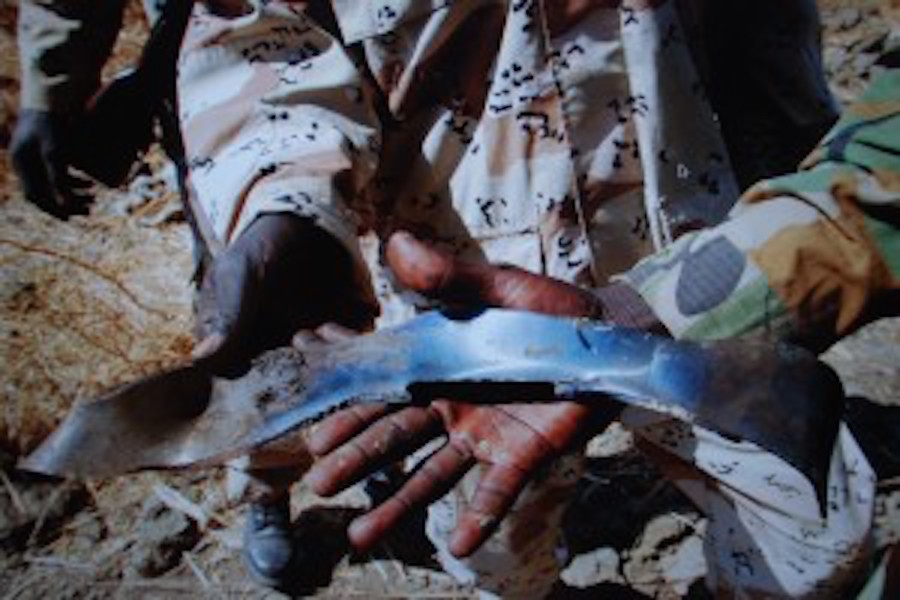
[image: p.-4-1-shrapnel-Kiir-Adem-300x200]
<http://sudanreeves.org/wp-content/uploads/2016/04/p.-4-1-shrapnel-Kiir-Adem-300x200.jpg>

*The shrapnel from the barrel bombs dropped by Antonovs can easily cut a
human body in half*

[image: photo] <http://sudanreeves.org/wp-content/uploads/2016/04/photo.jpg>

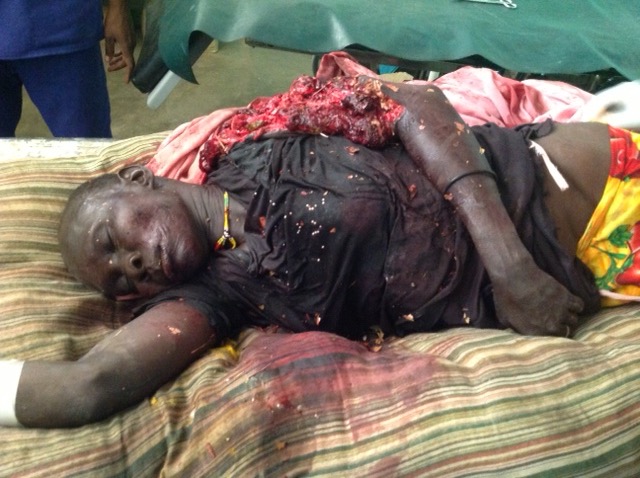
*There have been a staggering number of innocent civilians wounded in the
course of the past five years, many seen by Dr. Tom Catena, the only
surgeon operating in the Nuba Mountains (photograph 2016, Tom Catena)*

[image: p.9 #2--HRW 8.13.13 PM 8.13.13 PM 8.13.13 PM]
<http://sudanreeves.org/wp-content/uploads/2014/09/p.9-2-HRW-8.13.13-PM-8.13.13-PM-8.13.13-PM2.jpg>

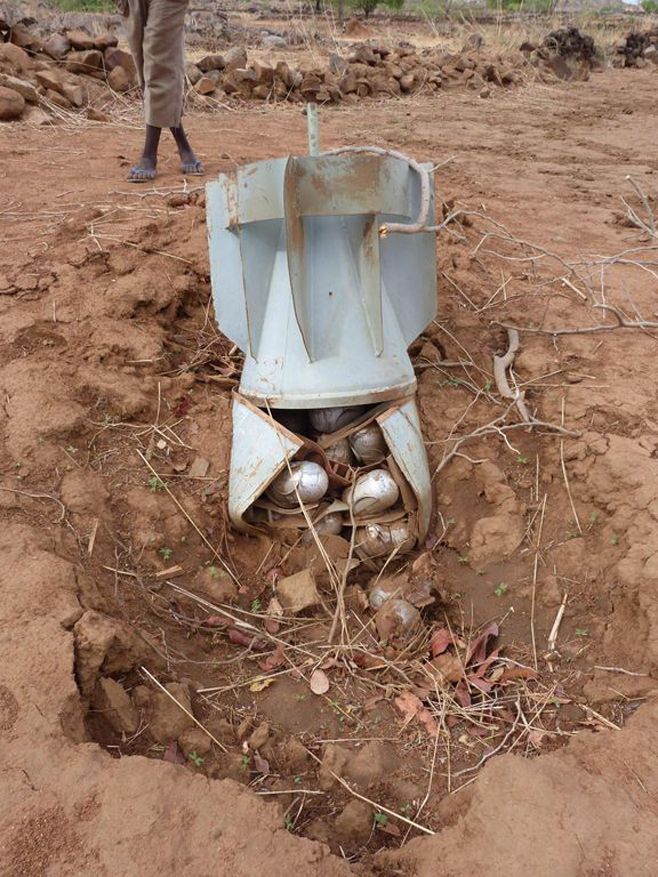
*Khartoum's use of inherently indiscriminate cluster bombs has been
extremely well documented*

The most conspicuous evidence of this cynicism is a willingness to see the
truly critical issue of humanitarian access linked directly to political
and military issues in the so-called “Roadmap for Peace.” The “Roadmap”
comes from Thabo Mbeki, leader of the now conspicuously incompetent African
Union High-Level Implementation Panel (AUHIP).
<http://sudanreeves.org/2016/03/22/thabo-mkebis-latest-roadmap-for-sudan-an-analysis-of-rejection-by-the-sudan-revolutionary-forces-srf-march-22-2016/>
(The
original “Roadmap” to have been “implemented” was Mbeki’s foolish
diplomatic effort of 2009, which failed miserably.) There are many issues
that might be discussed in connection with the various terms of the current
“Roadmap” so enthusiastically endorsed by the UN, the EU, the AU, and the
Obama administration in the U.S. What I wish to argue here is that whatever
the merits of the plan’s elements—and all in some sense require compliance
by Khartoum of a sort for which there is no historical evidence—it is a
diplomatic, finally moral error of the first order to link political and
military issues to humanitarian access.

Such linkage can take the form of “bundling” issues together, as Mbeki
insisted his Roadmap did:

For his part, Mbeki said the Roadmap met the most important demands of the
“Sudan Call” force including the comprehensive ceasefire and allowing
access to humanitarian relief in war areas besides the recognition of the
NUP and the Sudan Revolutionary Forces (SRF) as partners in the national
dialogue. *(**Sudan Tribune*, June 3, 2016
<http://www.sudantribune.com/spip.php?article59175>)

[image: mbekimugabe10a]
<http://sudanreeves.org/wp-content/uploads/2015/05/mbekimugabe10a.jpg>

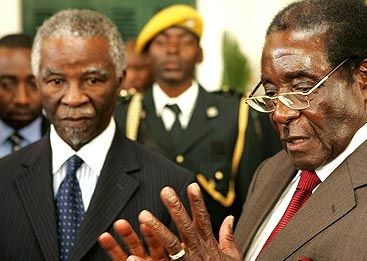
*AUHIP Chair Thabo Mbeki (left), here with Zimbabwe's savage dictator
Robert Mugabe, who enjoyed South African political support while Mbeki was
president of his country.*

Or the linkage can take implicit form in the ignoring of Khartoum’s
previous refusal to accept a call from the normally feckless African Union
Peace and Security Council (AUPSC):

[The AUPSC] Expresses its grave concern about the ongoing conflict and
humanitarian crisis in Darfur and the Two Areas, including the reported
violations of humanitarian law associated with the conflict, *and calls
upon the parties to urgently reach agreements to facilitate and allow
humanitarian assistance to reach those in need and to respect human rights
and International Humanitarian Law.* Council calls upon the Parties to take
all necessary measures to create conditions for the safe, voluntary and
dignified return of the displaced persons and refugees to their homes…
(Communiqué of the 539th meeting of the PSC on the activities of the AU
High-Level Implementation Panel (AUHIP) for Sudan and South Sudan, August
25, 2015
<http://www.peaceau.org/en/article/communique-of-the-539th-meeting-of-the-psc-on-the-activities-of-the-au-high-level-implementation-panel-auhip-for-sudan-and-south-sudan>
)

That the various urgings of the AUPSC were simply ignored by Khartoum seems
to have made no difference—either to the AUPSC itself or those
international actors professing a concern for humanitarian issues in Sudan.

Let’s be very clear about this. For a variety of expedient reasons, the
international community has found it appropriate to endorse an agreement, a
“Roadmap,” that finally makes relief for suffering and dying human beings
contingent upon various specific military and political steps, articulated
by Mbeki in his “Roadmap,” which was fashioned in close coordination with
the Khartoum regime itself. The agreement does not give singular priority
to humanitarian access, nor does it offer a clear plan for how such access
is to be achieved. It is revealing that Mbeki took the extraordinary step
of signing his own agreement despite rejections by the Sudan Revolutionary
Forces and political opposition groups in Addis: he and Khartoum remain the
only signatories.

[Radio Dabanga reports (June 20, 2016
<https://www.dabangasudan.org/en/all-news/article/sudan-appeal-sees-positive-points-in-auhip-roadmap>)
today that the opposition groups have agreed to sign the “Roadmap”
*provisionally*, which hardly makes the “Roadmap” a true agreement, since
whatever “provisions” the opposition groups have stipulated, they are
extremely unlikely to be meaningfully accepted by Khartoum. This
“provisional agreement” comes in the wake of heavy pressure on the
opposition groups in Addis from U.S. special envoy for the Sudans, Donald
Booth.]

By virtue of the international support for the Mbeki’s/Khartoum’s
“Roadmap,” as well as excessive and asymmetrical pressure on the opposition
groups, we may be sure that the “Roadmap” will remain configured as it is
at present, i.e., a lifting of the humanitarian blockade on South Kordofan
and Blue Nile will, in effect, remain politically and militarily
contingent. Nothing changes with “provisional agreement” to the “Roadmap”
by the opposition groups.

This is deeply immoral and sets an extraordinarily bad precedent for future
conflicts.
*KHARTOUM’S REFUSAL TO LIFT THE HUMANITARIAN BLOCKADE*

Shortly after fighting began in South Kordofan in June 2011, and
subsequently in Blue Nile in August 2011, the National Islamic
Front/National Congress Party imposed a broad humanitarian embargo on areas
in these two states under the control of the Sudan People’s Liberation
Movement/Army-North (SPLM/A-N). Militarily, the SPLM/A-N essentially
represents two divisions of the Sudan People’s Liberation Movement/Army
(SPLM/A) as it had been organized during the long civil war (1983 – 2005).
During that war, soldiers from both areas fought as part of the SPLA, and
fully expected that they would be included in a meaningful way in the
Comprehensive Peace Agreement (January 2005).

I well remember the determination of military and civil society leaders I
met with in January 2003, insisting to me in the most vehement of terms
that they would not be left out of the agreement that was clearly being
negotiated. This was a moment following the Machakos Protocol (July 2002),
guaranteeing South Sudan the right of a self-determination referendum, as
well as the Cessation of Hostilities Agreement of October 2002 (CoHA)—but
before the Naivasha negotiations were well begun. (Although I witnessed
first-hand the extent of Khartoum’s violations of the CoHA, fighting had
largely ended by February 2003.)

But despite their fierce determination not to be left out of this peace
agreement—as they felt they had been left out of the arrangements for
independence in 1956 and again with the Addis Ababa Peace Agreement
(1972)—in the end, negotiations at Naivasha, Kenya did not culminate with a
meaningful plan to address the profound grievances of the peoples of South
Kordofan and Blue Nile. They were granted instead largely opaque plans for
“popular consultations”—plans that never took meaningful form. The seeds of
conflict in 2011 were sowed with the CPA of 2005.

When Khartoum quickly moved to impose a humanitarian embargo in June 2011
it was a reprise of what had occurred in the 1990s, when, *inter
alia,* Khartoum
fired artillery shells at planes attempting to land in places such as Kauda
in the Nuba Mountains. Although the embargo was not airtight, either then
or now, the effect in terms of malnutrition rates and morbidity was
overwhelming. The same is true of Blue Nile currently.

In February 2012, the SPLM/A-N agreed to a humanitarian access proposal put
forward not only by the UN and African Union, but by the Arab League
<http://www.sudantribune.com/spip.php?article44516> as well. Even so,
Khartoum refused the agreement, and despite various ambiguous noises from
the regime about signing the agreement in some modified form, today—five
years after it was first imposed—the embargo is still in place as
Khartoum’s intransigence remains as great as ever.

For the past five years the people of South Kordofan have endured a
relentless bombing campaign targeting civilians and civilian agriculture.
Displacement must be measured in the hundreds of thousands, and local
reports indicate some populations have a very high percentage of Severe
Acute Malnutrition (SAM).
<http://sudanreeves.org/2015/01/18/the-people-and-children-of-the-nuba-mountains-under-intensifying-assault-their-voices-must-be-heard-18-january-2015/>
For
children, this is typically a death sentence. Overall mortality is very
great but we have no adequate data—about morality, morbidity, or
malnutrition. This is one extremely serious consequence of the absence of a
humanitarian presence. As always, children—as is the case throughout
Sudan—suffer most in such situations of acute deprivation.
<http://reliefweb.int/report/sudan/humanitarian-action-children-2016-sudan>

[image: Sudan-famine_15]
<http://sudanreeves.org/wp-content/uploads/2015/06/Sudan-famine_15.jpg>

*As it has done many times in the past 27 years of brutal, tyrannical rule,
the National Islamic Front/National Congress Party regime is attempting to
create famine as a weapon of war, currently in South Kordofan and Blue
Nile, as well as Darfur.*

[image: NUBA MONTAIN PEOPLE]
<http://sudanreeves.org/wp-content/uploads/2015/05/NUBA-MONTAIN-PEOPLE6.jpg>

*Khartoum's campaign of aerial bombardment, targeting civilians and
civilian agriculture, has driven many hundreds of thousands of people from
their homes in South Kordofan and Blue Nile--to caves, to other parts of
Sudan, and to South Sudanese refugee camps.*

And yet despite the brutality of Khartoum’s conduct of war in South
Kordofan and Blue Nile, despite the savagery of the ethnically-targeted
destruction, rape, and murder in Darfur, the international community is
prepared to link humanitarian access to other, non-humanitarian issues.
These issues must be resolved, to be sure, although to the extent they
depend upon Sudan enjoying a true “National Dialogue,” one part of the
Mbeki “Roadmap,” we have to date no evidence whatsoever that the Khartoum
regime takes such a “dialogue” seriously, but rather regards it as a means
of prevarication and delay
<http://sudanreeves.org/2015/05/28/the-minutes-of-the-security-and-military-committee-meeting-held-on-the-premises-of-the-high-academy-of-security-3-june-2014-part-1/>.
Viewed in the context of the regime’s astonishing record of reneging on
agreements—it is has never abided by a single one with any Sudanese
party…not one, not ever—it is simply incomprehensible that a plan relying
on unprecedented regime adherence to a signed agreement is taken seriously
by the UN, the AU, the EU, and the U.S., all of which have enthusiastically
endorsed the Mbeki “Roadmap.”

But most shamefully, none of these powerful international actors has faced
squarely the essential moral issue posed by the “Roadmap”: can humanitarian
access to desperately needy human populations ever be made contingent in
any way upon political and military agreements? The question is made more
urgent by Khartoum’s reprehensible record of violating, ignoring, and
abrogating agreements—and its longstanding, supremely callous disregard for
the well-being of the people of Sudan.

Humanitarian access to the South Kordofan and Blue Nile must be demanded
unequivocally and unconditionally. The same is true of humanitarian
delivery in Darfur. All economic assistance, all provision of new
technology, all military assistance, all political *rapprochement* should
be withheld until this most basic and essential demand is met.

--

Eric Reeves

[email protected]

www.sudanreeves.org

Twitter@SudanReeves

About Eric Reeves: http://sudanreeves.org/about-eric-reeves/


*All woodturning purchases benefit the work of Oxfam in Sudan and South
Sudan*

https://www.etsy.com/shop/EricReevesWoodturner

--
To post to this group, send email to [email protected]
To unsubscribe from this group, send email to
[email protected]
Visit this group at https://groups.google.com/d/forum/southsudankob
View this message at
https://groups.google.com/d/msg/southsudankob/topic-id/message-id
For more options, visit https://groups.google.com/d/optout
---
You received this message because you are subscribed to the Google Groups
"South Sudan Info - The Kob" group.
To unsubscribe from this group and stop receiving emails from it, send an email
to [email protected].
To post to this group, send email to [email protected].
Visit this group at https://groups.google.com/group/SouthSudanKob.
To view this discussion on the web visit
https://groups.google.com/d/msgid/SouthSudanKob/CAJb14oqU24VWqwCVE9QTHObpjnDdgPorG17-a7--VFXq74BtuA%40mail.gmail.com.
For more options, visit https://groups.google.com/d/optout.