Hi Dave,

Telefonica achieved considerable gains in efficiency dismantling the
copper network (85% gains in energy efficiency).
Read here:
https://www.xataka.com/empresas-y-economia/paso-cobre-adsl-a-fibra-ha-sido-beneficioso-para-todos-especialmente-para-telefonica

Regards,

David

> Date: Fri, 17 Mar 2023 09:38:03 -0700
> From: Dave Taht <[email protected]>
> To: Mike Puchol <[email protected]>
> Cc: Dave Taht via Starlink <[email protected]>, Rpm
>       <[email protected]>,  libreqos
>       <[email protected]>, bloat <[email protected]>
> Subject: Re: [Starlink] [Rpm]  On FiWi
> Message-ID:
>       <CAA93jw6EWH19Jo-pUJMX7QCi=GfHD8iWTDKCcRY=0teoe4v...@mail.gmail.com>
> Content-Type: text/plain; charset="utf-8"
>
> This is a pretty neat box:
>
> https://mikrotik.com/product/netpower_lite_7r
>
> What are the compelling arguments for fiber vs copper, again?
>
>
> On Tue, Mar 14, 2023 at 4:10 AM Mike Puchol via Rpm <
> [email protected]> wrote:
>
>> Hi Bob,
>>
>> You hit on a set of very valid points, which I'll complement with my views
>> on where the industry (the bit of it that affects WISPs) is heading, and
>> what I saw at the MWC in Barcelona. Love the FiWi term :-)
>>
>> I have seen the vendors that supply WISPs, such as Ubiquiti, Cambium, and
>> Mimosa, but also newer entrants such as Tarana, increase the performance
>> and on-paper specs of their equipment. My examples below are centered on
>> the African market, if you operate in Europe or the US, where you can
>> charge customers a higher install fee, or even charge them a break-up fee
>> if they don't return equipment, the economics work.
>>
>> Where currently a ~$500 sector radio could serve ~60 endpoints, at a cost
>> of ~$50 per endpoint (I use this term in place of ODU/CPE, the antenna
>> that
>> you mount on the roof), and supply ~2.5 Mbps CIR per endpoint, the
>> evolution is now a ~$2,000+ sector radio, a $200 endpoint, capability for
>> ~150 endpoints per sector, and ~25 Mbps CIR per endpoint.
>>
>> If every customer a WISP installs represents, say, $100 CAPEX at install
>> time ($50 for the antenna + cabling, router, etc), and you charge a $30
>> install fee, you have $70 to recover, and you recover from the monthly
>> contribution the customer makes. If the contribution after OPEX is, say,
>> $10, it takes you 7 months to recover the full install cost. Not bad,
>> doable even in low-income markets.
>>
>> Fast-forward to the next-generation version. Now, the CAPEX at install is
>> $250, you need to recover $220, and it will take you 22 months, which is
>> above the usual 18 months that investors look for.
>>
>> The focus, thereby, has to be the lever that has the largest effect on the
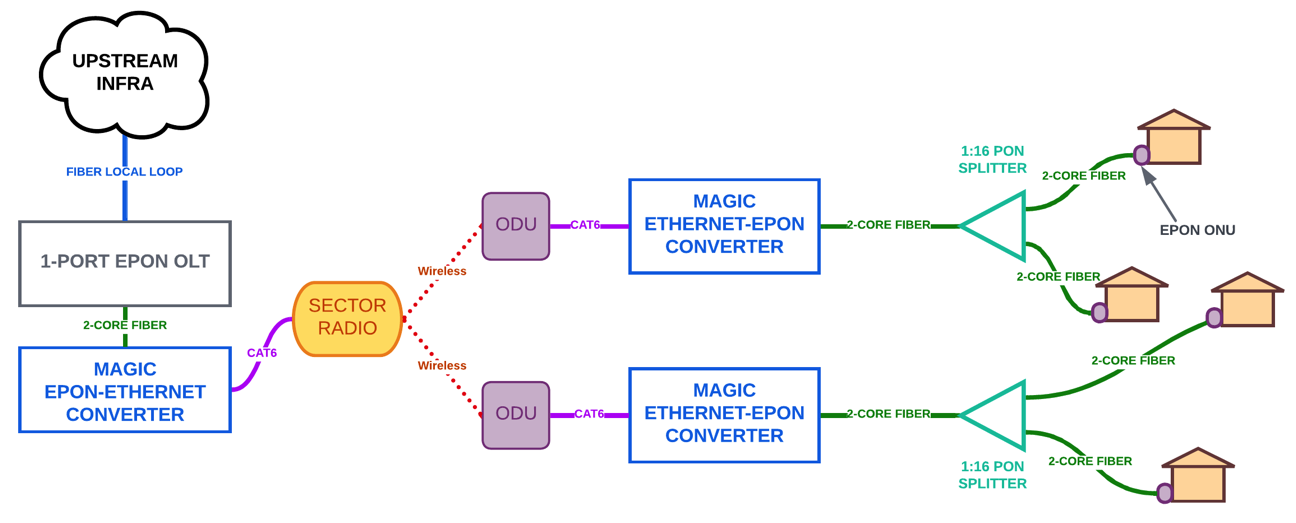
>> unit economics - which is the per-customer cost. I have drawn what my
>> ideal
>> FiWi network would look like:
>>
>>
>>
>> Taking you through this - we start with a 1-port, low-cost EPON OLT (or
>> you could go for 2, 4, 8 ports as you add capacity). This OLT has capacity
>> for 64 ONUs on its single port. Instead of connecting the typical fiber
>> infrastructure with kilometers of cables which break, require maintenance,
>> etc. we insert an EPON to Ethernet converter (I added "magic" because
>> these
>> don't exist AFAIK).
>>
>> This converter allows us to connect our $2k sector radio, and serve the
>> $200 endpoints (ODUs) over wireless point-to-multipoint up to 10km away.
>> Each ODU then has a reverse converter, which gives us EPON again.
>>
>> Once we are back on EPON, we can insert splitters, for example,
>> pre-connectorized outdoor 1:16 boxes. Every customer install now involves
>> a
>> 100 meter roll of pre-connectorized 2-core drop cable, and a $20 EPON ONU.
>>
>> Using this deployment method, we could connect up to 16 customers to a
>> single $200 endpoint, so the enpoint CAPEX per customer is now $12.5. Add
>> the ONU, cable, etc. and we have a per-install CAPEX of $82.5 (assuming
>> the
>> same $50 of extras we had before), and an even shorter break-even. In
>> addition, as the endpoints support higher capacity, we can provision at
>> least the same, if not more, capacity per customer.
>>
>> Other advantages: the $200 ODU is no longer customer equipment and CAPEX,
>> but network equipment, and as such, can operate under a longer break-even
>> timeline, and be financed by infrastructure PE funds, for example. As a
>> result, churn has a much lower financial impact on the operator.
>>
>> The main reason why this wouldn't work today is that EPON, as we know, is
>> synchronous, and requires the OLT to orchestrate the amount of time each
>> ONU can transmit, and when. Having wireless hops and media conversions
>> will
>> introduce latencies which can break down the communications (e.g. one ONU
>> may transmit, get delayed on the radio link, and end up overlapping
>> another
>> ONU that transmitted on the next slot). Thus, either the "magic" box needs
>> to account for this, or an new hybrid EPON-wireless protocol developed.
>>
>> My main point here: the industry is moving away from the unconnected. All
>> the claims I heard and saw at MWC about "connecting the unconnected" had
>> zero resonance with the financial drivers that the unconnected really
>> operate under, on top of IT literacy, digital skills, devices, power...
>>
>> Best,
>>
>> Mike
>> On Mar 14, 2023 at 05:27 +0100, rjmcmahon via Starlink <
>> [email protected]>, wrote:
>>
>> To change the topic - curious to thoughts on FiWi.
>>
>> Imagine a world with no copper cable called FiWi (Fiber,VCSEL/CMOS
>> Radios, Antennas) and which is point to point inside a building
>> connected to virtualized APs fiber hops away. Each remote radio head
>> (RRH) would consume 5W or less and only when active. No need for things
>> like zigbee, or meshes, or threads as each radio has a fiber connection
>> via Corning's actifi or equivalent. Eliminate the AP/Client power
>> imbalance. Plastics also can house smoke or other sensors.
>>
>> Some reminders from Paul Baran in 1994 (and from David Reed)
>>
>> o) Shorter range rf transceivers connected to fiber could produce a
>> significant improvement - - tremendous improvement, really.
>> o) a mixture of terrestrial links plus shorter range radio links has the
>> effect of increasing by orders and orders of magnitude the amount of
>> frequency spectrum that can be made available.
>> o) By authorizing high power to support a few users to reach slightly
>> longer distances we deprive ourselves of the opportunity to serve the
>> many.
>> o) Communications systems can be built with 10dB ratio
>> o) Digital transmission when properly done allows a small signal to
>> noise ratio to be used successfully to retrieve an error free signal.
>> o) And, never forget, any transmission capacity not used is wasted
>> forever, like water over the dam. Not using such techniques represent
>> lost opportunity.
>>
>> And on waveguides:
>>
>> o) "Fiber transmission loss is ~0.5dB/km for single mode fiber,
>> independent of modulation"
>> o) “Copper cables and PCB traces are very frequency dependent. At
>> 100Gb/s, the loss is in dB/inch."
>> o) "Free space: the power density of the radio waves decreases with the
>> square of distance from the transmitting antenna due to spreading of the
>> electromagnetic energy in space according to the inverse square law"
>>
>> The sunk costs & long-lived parts of FiWi are the fiber and the CPE
>> plastics & antennas, as CMOS radios+ & fiber/laser, e.g. VCSEL could be
>> pluggable, allowing for field upgrades. Just like swapping out SFP in a
>> data center.
>>
>> This approach basically drives out WiFi latency by eliminating shared
>> queues and increases capacity by orders of magnitude by leveraging 10dB
>> in the spatial dimension, all of which is achieved by a physical design.
>> Just place enough RRHs as needed (similar to a pop up sprinkler in an
>> irrigation system.)
>>
>> Start and build this for an MDU and the value of the building improves.
>> Sadly, there seems no way to capture that value other than over long
>> term use. It doesn't matter whether the leader of the HOA tries to
>> capture the value or if a last mile provider tries. The value remains
>> sunk or hidden with nothing on the asset side of the balance sheet.
>> We've got a CAPEX spend that has to be made up via "OPEX returns" over
>> years.
>>
>> But the asset is there.
>>
>> How do we do this?
>>
>> Bob
>> _______________________________________________
>> Starlink mailing list
>> [email protected]
>> https://lists.bufferbloat.net/listinfo/starlink
>>
>> _______________________________________________
>> Rpm mailing list
>> [email protected]
>> https://lists.bufferbloat.net/listinfo/rpm
>>
>
>
> --
> Come Heckle Mar 6-9 at: https://www.understandinglatency.com
> <https://www.understandinglatency.com/Dave>/
> Dave Täht CEO, TekLibre, LLC
> -------------- next part --------------
> An HTML attachment was scrubbed...
> URL:
> <https://lists.bufferbloat.net/pipermail/starlink/attachments/20230317/c9c62be3/attachment.html>
> -------------- next part --------------
> A non-text attachment was scrubbed...
> Name: Hybrid EPON-Wireless network.png
> Type: image/png
> Size: 149871 bytes
> Desc: not available
> URL:
> <https://lists.bufferbloat.net/pipermail/starlink/attachments/20230317/c9c62be3/attachment.png>
>
> ------------------------------
>
> Subject: Digest Footer
>
> _______________________________________________
> Starlink mailing list
> [email protected]
> https://lists.bufferbloat.net/listinfo/starlink
>
>
> ------------------------------
>
> End of Starlink Digest, Vol 24, Issue 39
> ****************************************
>
_______________________________________________
Starlink mailing list
[email protected]
https://lists.bufferbloat.net/listinfo/starlink