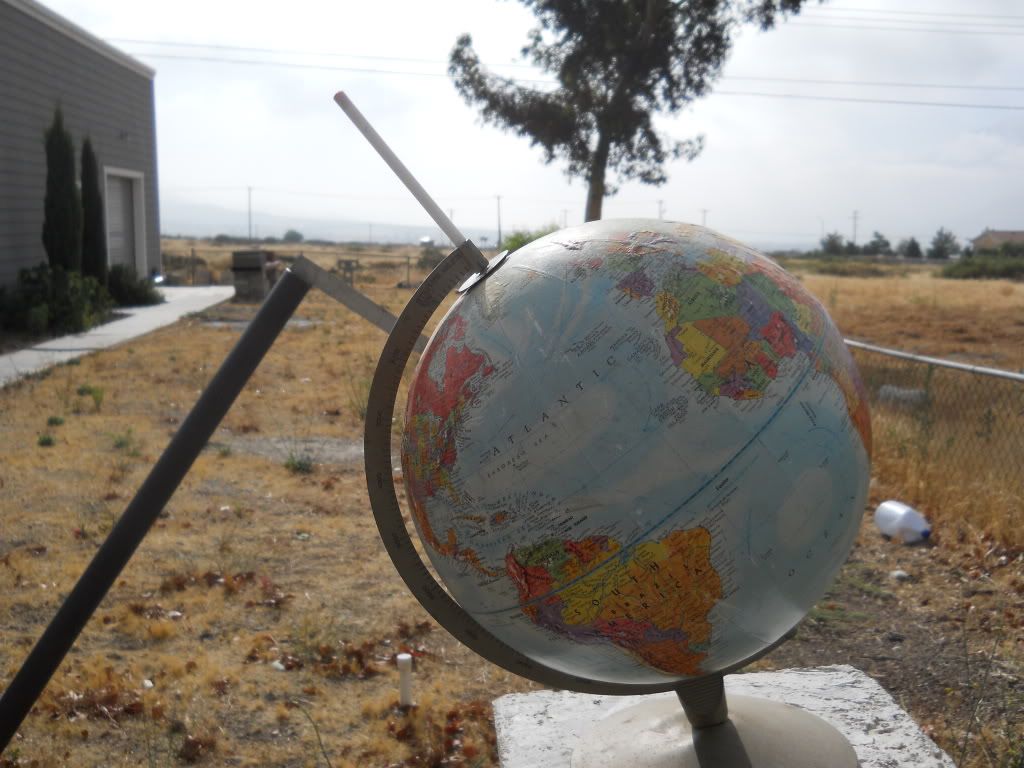
The angle your globe is currently oriented looks correct, so maintain that if
you remount it. However, unless you live in eastern Europe, you need to spin
the globe
 Your location should lie in the meridian plane, toward South (as you are in
the Northern hemisphere.) Your city will be directly on top. That way the globe
is an accurate miniature model of the Earth from the point of view of your
site.

Dave

Sent from my iPhone

On Jul 14, 2011, at 9:00 AM, Brent <[email protected]> wrote:

> Hi Willy;
>
> Ah ok, that makes sense.
>
> If you look at:
>
> http://i1195.photobucket.com/albums/aa396/JohnnyRingo131/globesundial005.jpg
>
> ...you will see an angled pipe in the background.
> That is the equatorial plane and the framing square inside of it is at a
> right angle or represents the earths' axis.
>
> If I sight up that square at night I find the north star.
>
> I'll try and mount my globe on that pipe and see what I get.
>
> thanks;
> brent
>
> On 7/14/2011 8:43 AM, Willy Leenders wrote:
>> Brent,
>>
>> The axis of your globe has to make an angel with the
>> horizontal plane, equal to the latitude.
>>
>> Se on my website such a sundial on page
>> http://www.wijzerweb.be/maaseik002A.html
>> Click on the thumbnail pictures to enlarge
>> The text is in dutch language.
>> Below a translation of the text after the word
>> 'Beschrijving' (description)
>>
>> The sundial has the look of a globe. Its axis is tilted to
>> the north at an angle of about 51° (the latitude of Maaseik)
>> with the horizontal plane. Meridian lines serve as the hour
>> lines. The meridian line of Maaseik is the 12-hour line. It
>> is directed to the south.
>> An auxiliary device has a tube on four supports. This device
>> is placed so that the sun shines through the tube and a
>> light spot falls on the globe. The meridian that pass
>> through the light spot indicates the hour.
>> The light spot indicates the place in the world where at
>> that time the sun is directly on the head of the people
>> standing there (at the zenith).
>> At the photograph (taken on May 28, 2003) it is a few
>> minutes after 16 hours (solar time in Maaseik). The sun is
>> at its zenith in the Atlantic, northeast of the Caribbean.
>>
>> Willy Leenders
>> Hasselt in Flanders (Belgium)
>>
>> Visit my website about the sundials in the province of
>> Limburg (Flanders) with a section 'worth knowing about
>> sundials' (mostly in Dutch): http://www.wijzerweb.be
>>
>>
>>
>>
>>
>>
>>
>> Op 14-jul-2011, om 16:36 heeft Brent het volgende geschreven:
>>
>>> I was think about putting my globe out in the sun and
>>> align the axis stand facing north/south. Then align my
>>> longitude due north.
>>> Then put a gnomon on the top as an extension of the axis
>>> to see if this would work as a longitude sundial.
>>>
>>> While I was contemplating this I noticed a little dial on
>>> top of my globe that I never paid attention to before. It
>>> looks like a sundial clock of some sort. It has daylight
>>> and darkness and numbered 6 to 12 then 12 to 6.
>>>
>>> Ahh, if I line up the little dial with my longitude and
>>> local time, it allows me to know the time around the world.
>>> Sorta, if the time lines followed longitude lines which
>>> they don't.
>>>
>>> What is this called and what's it for?
>>>
>>> thanks again;
>>> brent
>>>
>>> On 7/14/2011 7:08 AM, Brent wrote:
>>>> Hello;
>>>>
>>>> well that's cool, I never made that connection until now.
>>>>
>>>> Maybe if you sliced the earth in half at the equator and
>>>> drew lines on the bottom half from the core to the lines of
>>>> longitude on the surface you would end up with my dial face.
>>>>
>>>> A longitude clock.
>>>> Hmmm, I wonder if I could make a sundial based on this. It
>>>> might be a fun exercise.
>>>>
>>>> brent
>>>>
>>>> On 7/14/2011 3:52 AM, Frank Evans wrote:
>>>>> It's called longitude (well, nearly). More accurately, the
>>>>> westerly hour angle of the true sun (WHA), familiar to
>>>>> ancient navigators .
>>>>> Frank 55N 1W
>>>>>
>>>>> On 18/01/2011 20:03, Brent wrote: Hello;
>>>>>
>>>>> If you think about it, hours, minutes and seconds are an
>>>>> awkward system for using time.
>>>>>
>>>>> My idea would be to switch to a 360 degree clock.
>>>>> The earth is round and makes one complete revolution per
>>>>> day, 360 degrees. So why not measure time based on what
>>>>> angle of degree the earth happens to be at your location.
>>>>>
>>>>> Midnight could be 360 degrees
>>>>> 6AM 90 degrees
>>>>> Noon 180 degrees
>>>>> 6PM 270 degrees
>>>>>
>>>>> For conversions:
>>>>>
>>>>> Each hour would equal 15 degrees.
>>>>> Each degree would equal 4 minutes.
>>>>> Each degree would equal 240 seconds.
>>>>>
>>>>> So instead of saying it's 6:34am and 28 seconds
>>>>> it would be:
>>>>> 6x15 = 90
>>>>> 34/4 = 8.5
>>>>> 28/240 =.117
>>>>> The time would be 98.617 degrees
>>>>>
>>>>> Of course you wouldn't do conversions, you would just look
>>>>> at your new 360 degree watch.
>>>>>
>>>>> If I came to work at 98.617 degrees and left at 187.786
>>>>> degrees I have worked:
>>>>>
>>>>> 187.786 - 98.617 = 89.169 degrees
>>>>>
>>>>> Makes more sense to me.
>>>>>
>>>>> Did anyone ever tell time this way?
>>>>> It seems like it would work nicely with sundials.
>>>>>
>>>>> brent
>>>>> ---------------------------------------------------
>>>>> https://lists.uni-koeln.de/mailman/listinfo/sundial
>>>>>
>>>>>
>>>>
>>>> ---------------------------------------------------
>>>> https://lists.uni-koeln.de/mailman/listinfo/sundial
>>>>
>>>>
>>>
>>> ---------------------------------------------------
>>> https://lists.uni-koeln.de/mailman/listinfo/sundial
>>>
>>
>
> ---------------------------------------------------
> https://lists.uni-koeln.de/mailman/listinfo/sundial
>
---------------------------------------------------
https://lists.uni-koeln.de/mailman/listinfo/sundial