8 Types of Hindu Marriages According to
Manusmriti<http://mymarriagewebsite.com/8-types-of-hindu-marriages-according-to-manusmriti/>
According to “*Manusmriti*” (“Laws of Manu”), there are 8 types of Hindu
marriages.

Lord Brahma, the Hindu God of Creation, is the father of “*Manu*”
(Swyambhuvana Manu). “*Manu*” is considered the father of all mankind, and
all humans are descendants of “*Manu*“. “*Manu*” is the equivalent of the
Biblical Adam. The Sanskrit name for Humans is “Manav” which is a
derivation of “*Manu*”


“*Manu*” (Swyambhuvana Manu) is said to have told the Hindu social laws to
Saints and Rishis. This collection of laws is called “*Manusmriti*” or “*Manava
Dharmasastra*” (“Laws of Manu”), and is considered the words of Lord Brahma.


As per legend, Lord Brahma laid down 1000 chapters which made up the”*
Manusmriti*“. This was later presented in 12 chapters.


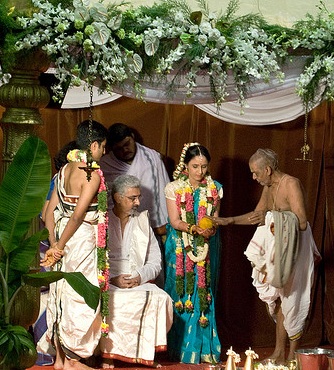
[image: 8 Types of Hindu Wedding as per
Manusmriti]<http://mymarriagewebsite.com/wp-content/uploads/2011/11/Part-5-Thirumangalya-Dharanam-Tying-of-the-sacred-thread.jpg>
8 Types of Hindu Marriages as per Manusmriti


1. Brahma Vivah

Brahma vivah is considered the best marriage. In this the boy and girl
belonging to good families and the same varna get married. The boy should
have completed his Brahmacharya Ashram (studenthood). There is no dowry
involved and the girl enters the boy’s house with two sets of clothes and
some ornaments. In this marriage, the boy’s family approaches the girl’s
family. “Kanyadaan”, which is the handing of the bride by her father to the
groom, is an important ritual of the Brahma Vivah.
2. Daiva Vivah

In this type of Hindu marriage, the girl’s family looks for a groom. If a
girl has not been able to get a suitable husband for a period of time, her
family look to marry her to a priest who officiates over sacrifices.


3. Arsha Vivah

Here the groom gives a gift (a cow and a pair of bulls) to the girl’s
family. This usually takes place when the girl’s parents can not afford to
meet the expense of the marriage. This is not considered an ideal marriage
because there is a monetary consideration involved in this wedding.


4. Prajapatya Vivah

Somewhat similar to the Brahma Vivah, except in this case the girl’s family
looks for a groom and the ritual of Kanyadaan is not followed. Instead of
“Kanyadaan”, the bride’s father hands over protection of his daughter to
the groom during the “Panigrahan” ritual. The actual wedding takes place
after “Panigrahan”.
5. Gandharva Vivah

This is a love marriage, where the bride and groom marry of their own free
will. Usually the consent of the parents is not taken or is not available
because either or both parents are against the marriage.


6. Asura Vivah

Somewhat similar to the “Arsha Vivah” where the groom gives presents to the
bride’s family in order to get their approval for the marrige. Usually the
groom is not of the same stature as the bride.


7. Rakshasa Vivah

In this Hindu wedding, the bride is ready to marry groom, but the bride’s
family is against the marriage. In such cases, if the groom’s family
forcibly takes away the bride, it is a “Rakshasa Vivah”.


8. Paishacha Vivah

This type of marriage is not allowed. In this marriage, a girl, who is not
in her senses (she may not be of sound mind or intoxicated or drugged, etc)
is forcibly married off. The girl has not consented to this marriage.


Based on the bride and groom’s caste, some of the above Hindu marriages are
allowed and some are disallowed.


--

*
*
*
*
**
*
*  <http://sig.graphicsfactory.com/>*

நல்லதுசெய் நல்லதே நடக்கும்
*जन सेवा ईश्वर  सेवा *
*cnu.pne*

--
You received this message because you are subscribed to the Google Groups
"Thatha_Patty" group.
To unsubscribe from this group and stop receiving emails from it, send an email
to [email protected].
For more options, visit https://groups.google.com/groups/opt_out.