TidBITS#886/02-Jul-07
=====================
  Issue link: <http://db.tidbits.com/issue/886>
  The iPhone is now available - did you buy one? Glenn Fleishman
  braved the lines at his nearest Apple Store and reports on opening
  day hysteria (the controlled, efficient kind) and gives his first
  impressions of the new device. We also detail the iPhone's voice and
  data plans, and the TidBITS staff chimes in on whether to buy or
  wait. And although it seems unlikely, there was plenty of non-iPhone
  news last week, as we note the releases of PDFpen 3.2, MacBook Pro
  Software Update 1.0, updates to the Final Cut Studio 2 applications,
  a SuperDrive firmware update, the rest of Adobe Creative Suite 3,
  and iTunes 7.3 (which does in fact revolve around the iPhone, but
  throws in an Apple TV feature, too). Lastly, Adam looks at the
  latest brouhaha in the music world, with Universal Music Group
  refusing to sign a long-term contract with the iTunes Store.

Articles
    MacBook Pro Software Update 1.0 Released
    Adobe Ships Rest of Creative Suite 3
    Universal Rejects Long-Term Apple iTunes Contract
    PDFpen 3.2 Adds Editing Marks
    Final Cut Studio 2 Applications, SuperDrive Firmware Updated
    DealBITS Discount: 4 GB iPod nano from Small Dog
    iTunes 7.3 Adds iPhone, Apple TV Features
    iPhone Voice, Data Plans Reasonably Priced, but Missing Wi-Fi
    Staff Roundtable: Who's Buying an iPhone?
    My First Days with the iPhone
    Hot Topics in TidBITS Talk/02-Jul-07


------------ This issue of TidBITS sponsored in part by: --------------

* READERS LIKE YOU! Support TidBITS with a contribution today!
  <http://www.tidbits.com/about/support/contributors.html>
  Special thanks this week to Andy Enzminger, Leon Menzer,
  George Hall, and William Hern for their generous support!

* SMALL DOG ELECTRONICS: TidBITS Exclusive for July 2 - July 16:
  BLACK 2.0 GHz Core 2 Duo MacBook, 2 GB RAM / 120 GB hard
  drive, SuperDrive/AP/BT, brand new, one-year warranty. Only
  $1379! Order yours today at <http://www.smalldog.com/tb/>

* FETCH SOFTWORKS: With Fetch 5.2, FTP and SFTP are simpler
  than ever. Use it on Mac OS X to upload, download, mirror,
  and manage your Web site, eBay images, and data sets.
  Download your free trial version! <http://fetchsoftworks.com/>

* WebCrossing Neighbors Creates Private Social Networks
  Create a complete social network with your company or group's
  own look. Scalable, extensible and extremely customizable.
  Take a guided tour today <http://www.webcrossing.com/tour>

* MARK/SPACE, INC: New, from the makers of The Missing Sync, comes
  SyncTogether, a brand new app for syncing contacts, calendars,
  notes and more between multiple Macs and one or more user
  accounts. $49.95 for 3 Macs. <http://www.markspace.com/bits>

* Microsoft's MacBU: Supporting Mac users with Office 2004.
  Supporting the Mac community through tech support newsgroups,
  user group appearances, our new team blog, and more!
  Check out our team blog at <http://blogs.msdn.com/macmojo/>

* DealBITS: Get the word out about your product AND generate sales!
  It's easy: give away a few copies and offer a discount to entrants.
  A DealBITS drawing is quick to set up and can easily pay for itself.
  For more info and rates, visit <http://www.tidbits.com/dealbits/>.

---------- Help support TidBITS by supporting our sponsors ------------


MacBook Pro Software Update 1.0 Released
----------------------------------------
  by Jeff Carlson <[EMAIL PROTECTED]>
  article link: <http://db.tidbits.com/article/9061>

  Apple has released MacBook Pro Software Update 1.0, which fixes a
  number of unspecified problems with 2.2 GHz and 2.4 GHz MacBook Pro
  models. According to a post at MacFixIt, the update appears to patch
  several issues with the Nvidia graphics cards and may solve an issue
  with "shimmering" display issues. The update is available via
  Software Update on the affected machines, or as a 14.7 MB download.

<http://www.apple.com/support/downloads/macbookprosoftwareupdate10.html>
<http://www.macfixit.com/article.php?story=20070629084320249>


Adobe Ships Rest of Creative Suite 3
------------------------------------
  by Glenn Fleishman <[EMAIL PROTECTED]>
  article link: <http://db.tidbits.com/article/9064>

  Adobe Systems has broken with tradition by releasing products
  promised for third quarter of 2007 on the second day of that
  quarter. A quarter-based release typically means "as close to the
  last day of the quarter as possible so we can book the revenue in
  that quarter."

  In April, Adobe released 9 of the 13 main applications that form
  Creative Suite 3 (CS3) as both individual programs and 6 editions
  (see "Adobe Announces Creative Suite 3 Plans, Pricing, Dates,"
  2007-04-02, and "Adobe Ships Creative Suite 3, Offers Video Betas,"
  2007-04-16). The released programs spanned their entire print and
  online range, including Photoshop (in two versions, no less),
  InDesign, and Dreamweaver. The company then promised four video and
  audio tools and support applications by the third quarter of this
  year.

<http://www.adobe.com/products/creativesuite/>
<http://db.tidbits.com/article/8930>
<http://db.tidbits.com/article/8951>

  Today, Adobe shipped After Effects, Premiere Pro, Soundbooth, and
  Encore for Intel-based Macs and Windows XP and Vista, along with two
  Windows-only applications, OnLocation and Ultra. OnLocation, a
  direct-to-disk recording tool, works with Boot Camp, Adobe says. The
  two delayed editions are now shipping, too: Production Premium
  ($1,700) and Master Suite ($2,500). Master Suite contains the entire
  CS3 line of products.

<http://www.adobe.com/aboutadobe/pressroom/pressreleases/200706/070207MPShipping.html>


Universal Rejects Long-Term Apple iTunes Contract
-------------------------------------------------
  by Adam C. Engst <[EMAIL PROTECTED]>
  article link: <http://db.tidbits.com/article/9066>

  The New York Times is reporting that Universal Music Group (owned by
  the French media giant Vivendi), the largest of the record
  companies, has refused to renew its two-year contract to sell
  downloadable music through Apple's iTunes Store. Instead, Universal
  is opting for a month-by-month option that would enable it to jump
  ship with minimal notice to Apple, possibly signing an exclusive
  deal with another online music retailer.

<http://www.nytimes.com/2007/07/02/business/media/02universal.html/partner/rssnyt>

  The move is clearly a game of corporate chicken. Since tracks from
  Universal account for a third of all music sold in the United
  States, for the iTunes Store to lose access to such a massive
  library of music would be disastrous. However, nearly 15 percent of
  Universal's worldwide revenue in the first quarter of 2007 came from
  online sources, and with the iTunes Store controlling over 75
  percent of the online market, Universal stands to anger a retailer
  responsible for over 10 percent of its revenue.

<http://en.wikipedia.org/wiki/Chicken_%28game%29>

  Universal undoubtedly hopes to negotiate a more favorable contract
  with Apple, likely one that gives Universal more control over
  setting per-track pricing based on popularity or that involves Apple
  paying Universal a per-iPod royalty, much as Universal strong-armed
  Microsoft into doing with the Zune (see "Of the Zune, DRM, and
  Universal Music," 2006-11-13).

<http://db.tidbits.com/article/8751>

  I can't see Universal pulling its tracks from the iTunes Store at
  this point for three reasons. Apple is now the third-largest music
  retailer behind only Wal-Mart and Best Buy, and the iTunes Store
  continues to grow. It makes no sense to endanger a relationship with
  a large retailer that stands to become even more powerful.

  The popularity of iTunes stems in large part from the iPod, which
  has now sold over 100 million units and - bolstered by the release
  of the music-playing iPhone - shows no signs of losing momentum.
  Since nearly all other online music retailers employ Windows-based
  digital rights management that is incompatible with the iPod and the
  iPhone, no other online retailer stands much of a chance of
  competing with the iTunes Store in the near-term.

  The final reason? Steve Jobs. The iPod, the iTunes Store, and the
  ethos of a flat-rate pricing scheme are near and dear to his heart,
  and any significant changes must be accompanied by some sort of
  gain, as with the EMI deal that resulted in more-expensive iTunes
  Plus tracks that lack DRM and are encoded at a higher quality (see
  "Apple and EMI Offer DRM-Free Music via iTunes," 2007-04-02). Jobs
  simply wouldn't let anything else happen.

<http://db.tidbits.com/article/8937>


PDFpen 3.2 Adds Editing Marks
-----------------------------
  by Adam C. Engst <[EMAIL PROTECTED]>
  article link: <http://db.tidbits.com/article/9057>

  For many of us, editing on paper seems like something that went out
  with the arrival of the word processor. And it's true - the need to
  edit on paper has been drastically reduced by the ease of creating
  and sharing digital documents. But sometimes you don't want an
  editor or proofreader to be able to change text, even with Microsoft
  Word's change tracking capabilities, since numerous errant changes
  would require significant effort to reconcile. Plus, a fair amount
  of proofing work takes place after a document has already been laid
  out in InDesign or QuarkXPress, and many publishers don't want
  proofreaders working in a master copy of the document.

  The modern solution to non-destructive editing is PDF - you can send
  a low-resolution PDF of a book to a proofreader, who can then use
  Adobe Acrobat to indicate changes. However, Adobe chose to provide a
  limited set of editing tools that are relatively easy to use, but
  entirely non-specific. You can add sticky notes; indicate text to be
  inserted, deleted, or replaced; highlight text; draw on the page;
  insert callouts; and a bit more. But what those tools replace is the
  collection of standard proofreading and editing marks used, at least
  historically, by professional editors and proofreaders used to
  working on paper. The marks may seem arcane at first glance, but
  they're essentially a quick and concise instruction set that's
  efficient to enter and interpret.

<http://www.colorado.edu/Publications/styleguide/symbols.html>

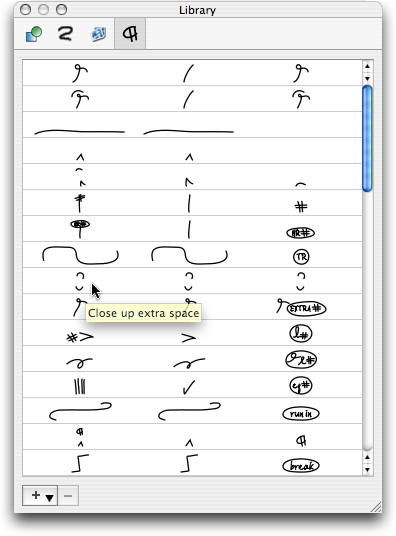
  Now there's an alternative method of editing in PDF for
  professionals or those who would prefer a more-structured approach.
  SmileOnMyMac has released version 3.2 of their PDFpen and PDFpen Pro
  PDF manipulation programs with a new Library panel that provides
  resizable graphics of standardized proofreading marks, making it
  easy for editors to mark up a PDF. Usage involves merely dragging a
  mark out of the Library panel to the document and positioning it;
  some may require resizing to make the edit completely clear.
  Tooltips provide explanations of what each symbol means, if you're
  unclear on some of them. The update also improves PDFpen's
  capability to save markup to scanned documents and fixes some minor
  bugs. It's free to registered users; new copies cost $50 for PDFpen
  or $95 for PDFpen Pro (which can create cross-platform fillable
  forms).

<http://www.smileonmymac.com/PDFpen/>
<http://www.tidbits.com/resources/2007-06/PDFpen-Library-Panel.png>


Final Cut Studio 2 Applications, SuperDrive Firmware Updated
------------------------------------------------------------
  by Jeff Carlson <[EMAIL PROTECTED]>
  article link: <http://db.tidbits.com/article/9058>

  Apple has released updates for the Final Cut Studio 2 suite of video
  production applications via Software Update and as stand-alone
  installers; the latter require that you sign in using your Apple ID
  and your Final Cut Studio 2 serial number. Most of the updates cover
  bug fixes and improve stability, but a few items are notable. Pro
  Applications Update 2007-01 (an 8.1 MB download) patches the
  underlying frameworks and shared components of Final Cut Studio 2
  (the package also seems to be specific to those applications).

<http://www.apple.com/finalcutstudio/>
<http://docs.info.apple.com/article.html?artnum=305524>
<http://www.apple.com/support/downloads/proapplicationsupdate200701.html>

  Final Cut Pro 6.0.1 (a 37.5 MB download) adds support for importing
  AVCHD (Advanced Video Codec High Definition) footage, a video format
  introduced last year that is designed to be saved to random-access
  storage devices such as hard disks, solid-state memory, and MiniDVD
  discs (versus MiniDV tapes, the media of choice for many consumer
  camcorders as well as cameras that record to the high-definition HDV
  format). Although a few AVCHD camcorders are currently available,
  editing the footage has been limited under Windows and nonexistent
  on the Mac. Apple's release notes indicate a few caveats with AVCHD
  footage, namely that as it's imported, the video is transcoded into
  either Apple ProRes 422 or Apple Intermediate Codec; that could
  require up to 10 times the size of the native AVCHD file of
  available hard disk space. (The inclusion of AVCHD also potentially
  means the format could be supported in the next version of iMovie
  HD.)

<http://www.apple.com/support/releasenotes/en/Final_Cut_Pro_6.0_rn/>
<http://www.apple.com/support/downloads/finalcutpro601.html>
<http://en.wikipedia.org/wiki/AVCHD>

  Motion 3.0.1 (a 19.4 MB download) fixes a number of known issues
  with 32-bit float projects and rendering of intersecting 3D groups,
  and improves performance. Soundtrack Pro 2.0.1 (a 74.5 MB download)
  improves stability and performance and updates the Delay Designer
  surround effect plug-in. Compressor 3.0.1 (a 93.3 MB download) adds
  the capability to export music in the 256 Kbps AAC format used by
  iTunes Plus, can now set poster frames, and applies other fixes.
  Color 1.0.1 (an 8.3 MB download) improves stability, metadata
  support from Final Cut Pro, and single-display mode, as well as
  floating-point processing on Macs with Nvidia graphics cards.

<http://www.apple.com/support/releasenotes/en/Motion_3.0_rn/>
<http://www.apple.com/support/downloads/motion301.html>
<http://www.apple.com/support/releasenotes/en/Soundtrack_Pro_2.0_rn/>
<http://www.apple.com/support/downloads/soundtrackpro201.html>
<http://www.apple.com/support/releasenotes/en/Compressor_3.0_rn/>
<http://www.apple.com/support/downloads/compressor301.html>
<http://www.apple.com/support/releasenotes/en/Color_1.0_rn/>
<http://www.apple.com/support/downloads/color101.html>

  Lastly, unrelated to Final Cut Studio 2, Apple released SuperDrive
  Firmware Update 2.1 (a 12 MB download), which provides unspecified
  fixes but notes improved readability of certain CD media. The
  installer puts an application called SuperDrive Update 2.1 into your
  Utilities folder that must be run separately, which is unusual. Note
  that the application starts the update process at launch, which is
  bad form; it should behave like most updaters, where the user
  initiates the process (for example, to make sure the drive isn't in
  use, I would imagine). The updater also requires a restart of the
  Mac to take effect.

<http://www.apple.com/support/downloads/superdrivefirmwareupdate21.html>


DealBITS Discount: 4 GB iPod nano from Small Dog
------------------------------------------------
  by Adam C. Engst <[EMAIL PROTECTED]>
  article link: <http://db.tidbits.com/article/9053>

  Congratulations to Barbara LHeureux of charter.net, whose entry was
  chosen randomly in last week's DealBITS drawing and who received a
  blue 4 GB iPod nano (refurbished) along with a Mophie case, worth a
  total of $136.99. For those who didn't win, Small Dog is offering an
  identical blue 4 GB iPod nano (refurbished) with Mophie case through
  11-Jul-07 for the discounted price of $119.99. Remember that the
  only way Small Dog can continue to give away cool prizes and offer
  discounts is if enough TidBITS readers use Small Dog for their
  Mac-related purchases. Be sure to mention TidBITS when you check out
  so they know that their sponsorship of TidBITS is useful.
  Thanks to the 1,841 people who entered this DealBITS drawing, and we
  hope you'll continue to participate in the future!

<http://db.tidbits.com/article/9052>
<http://www.smalldog.com/wag17521/>


iTunes 7.3 Adds iPhone, Apple TV Features
-----------------------------------------
  by Jeff Carlson <[EMAIL PROTECTED]>
  article link: <http://db.tidbits.com/article/9060>

  Apple has released iTunes 7.3, which enables support for the iPhone.
  iTunes acts as the hub between the computer and the iPhone (much as
  it does with the iPod), handling synchronization of contacts,
  calendars, music, and movies. iTunes is also the interface for
  activating the iPhone's phone and data service plans; a video at
  Apple's site demonstrates the activation process. iTunes 7.3 is
  available via Software Update or as stand-alone downloads for Mac (a
  33.8 MB download) and Windows (a 47.4 MB download). Note that iTunes
  7.3 updates your iTunes library, so it's a good idea to have a
  current backup before you apply the update.

<http://www.apple.com/iphone/usingiphone/activation.html>
<http://www.apple.com/support/downloads/itunes73formac.html>
<http://www.apple.com/support/downloads/itunes73forwindows.html>

  iTunes 7.3 also adds a requested feature to the Apple TV: photo
  streaming. Previously, photos could only be synchronized (copied to)
  the Apple TV.

<http://www.apple.com/appletv/>


iPhone Voice, Data Plans Reasonably Priced, but Missing Wi-Fi
-------------------------------------------------------------
  by Glenn Fleishman <[EMAIL PROTECTED]>
  article link: <http://db.tidbits.com/article/9056>

  A few days before the iPhone went on sale, Apple and AT&T announced
  service plans, with offerings for individual accounts costing $60,
  $80, and $100 per month for 450, 900, and 1,350 peak voice minutes;
  unlimited cellular data; and 200 SMS text messages. These plans also
  include rollover minutes, allowing unused minutes to be banked for
  up to 12 months, and unmetered calling within AT&T's cellular
  network, as well as visual voicemail.

<http://www.apple.com/iphone/easysetup/rateplans.html>

  The cheapest plan includes 5,000 night and weekend minutes; the two
  higher-priced plans have no limit on night and weekend calling.
  (5000 minutes is over 83 hours, so only teenagers and insomniacs
  calling each other at 2:00 AM will exceed that number.)

  Family plans for two or more lines cost $80, $100, and $120 for 700,
  1,400, and 2,100 peak minutes, while the second and subsequent
  iPhones cost $30 per month each. AT&T charges $10 per month for
  regular phones in their family plans, a fact that's not generally
  noted in iPhone coverage. Family plans all include the same features
  as the two higher-priced single-line services.

  Higher numbers of minutes (2,000, 4,000 and 6,000 for individuals,
  and 3,000, 4,000, and 5,000 for family plans) are also available.

  Existing AT&T customers can add iPhone service for $20 per month for
  the same package of SMS messages and unlimited data; 1,500 SMS
  messages will run $30 additional per month, while unlimited text
  messages adds $40 per month.

  SMS messages may be of great interest for iPhone users, as Apple -
  at least initially - has included no iChat or other instant
  messaging support. SMS would be the likely replacement, and text
  message counts climb quickly when used for even short back-and-forth
  conversations.

  Unlike other cellular phones, the iPhone doesn't need to be
  activated at an Apple Store or AT&T Store. Instead, you walk out
  with a box, and then use iTunes to enable the phone using Mac OS X
  10.4.10, Windows XP SP2 (Home or Professional), or Vista (all but
  Basic). Existing AT&T customers can transfer current phone numbers
  to the iPhone. Portability of other carriers' numbers is possible
  (it's a federal requirement), but specifics of doing so are not
  available online. That may require a return visit to an AT&T Store.
  Gizmodo asked AT&T that question and got no reply.

<http://www.apple.com/iphone/pr/20070626activate.html>
<http://gizmodo.com/gadgets/apple/will-switching-from-another-carrier-for-iphone-be-easy-as-pie-272348.php>

  These prices are in parity with similar offerings from AT&T for
  other slow cell data handsets that use the EDGE standard, and with
  T-Mobile, which provides unlimited EDGE for $20 a month on top of
  voice plans. (AT&T and T-Mobile are the two U.S. carriers that
  employ the worldwide GSM standard, which includes EDGE for data in
  the United States, and UMTS and HSDPA for faster data elsewhere in
  the world.)

  What's interesting, and so far unclear, is whether AT&T plans to
  leverage its own Wi-Fi hot spot network of 10,000 locations between
  its own contracted venues and roaming partners. This network costs
  either nothing or $2 per month for AT&T's DSL customers;
  higher-speed subscribers get the service for free starting today.

<http://www.att.com/gen/general?pid=5949>
<http://money.cnn.com/news/newsfeeds/articles/prnewswire/AQM030A02072007-1.htm>

  Because the iPhone has a real browser built in, it should be
  possible for the phone's users to connect to a Wi-Fi hot spot
  network and view the gateway page from which they can agree to terms
  of usage (for free networks that require this), pay for service, or
  log into an existing account.

  But that's a far cry from seamless roaming from EDGE to Wi-Fi. That
  will obviously work for open, free networks and for home and office
  networks that can be pre-configured. I was expecting (and still
  expect) more from AT&T on this front. Why build a huge national
  network and not use it for a flagship product?


Staff Roundtable: Who's Buying an iPhone?
-----------------------------------------
  by TidBITS Staff <[EMAIL PROTECTED]>
  article link: <http://db.tidbits.com/article/9063>

  As nearly everyone within range of the Reality Distortion Field now
  knows, Apple on Friday released the iPhone, selling untold numbers -
  one analyst estimates 500,000, while another is claiming 700,000 -
  in the first few days, including one to our very own Glenn
  Fleishman. There's no question that the iPhone is unparalleled as an
  object of techno-lust, but does that mean you should buy one right
  away? We'll be writing more on that topic as Glenn explores the
  features and limitations of his iPhone, but for now, in the
  interests of full disclosure, we wanted to share with you our own
  iPhone purchasing plans, or lack thereof.

<http://news.com.com/8301-10784_3-9738446-7.html>
<http://blog.seattletimes.nwsource.com/brierdudley/2007/07/the_iphone_a_good_thing_and_a_1.html>

  [Glenn Fleishman] When my previous cell phone heard about the iPhone
  - it was in the keynote hall with me when Steve Jobs announced the
  iPhone - something deep inside gave up the ghost. It has been flaky
  ever since, crashing, turning itself off, putting a call on hold
  when answered. It knew its days were numbered.

  Even before the iPhone announcement, I was in the market for a
  better communicator, and was giving a Windows Mobile smartphone
  serious consideration, perish the thought. So the iPhone, even with
  its hefty price tag, seemed like the right migration path for me.

  As the release got closer, and more of the limitations appeared, I
  grew more reluctant. I know that a 3G iPhone is no more than six to
  nine months away: AT&T will have its high-speed network much more
  fleshed out by then, and newer 3G chips will give Apple the size and
  battery life they want. I also knew that, no matter how good the
  initial iPhone was, there would still be some first-generation
  wonkiness to work out.

  But I'm a reporter, darn it, and it's hard to write about the
  biggest news since sliced bread if you're working from second-hand
  information or a loaner phone from Apple. Apple's review program was
  very small for the iPhone, with only four reviewers given iPhones in
  advance of the launch, and a larger number provided with phones on
  the Friday night of the launch. (The larger number did not include
  me, Jeff, nor other writers at The Seattle Times, for which we write
  a regular Mac column.)

<http://seattletimes.nwsource.com/html/practicalmac/>

  So I bought one (see "My First Days with the iPhone" in this issue).
  I don't regret it. It's clearly the best handheld organizer I've
  ever owned or used, and it's the best cell phone - despite its
  limitations - that I've ever owned.

<http://db.tidbits.com/article/9062>

  [Jeff Carlson] I'll admit, I really _want_ an iPhone. I'm the target
  audience: a Mac-focused, highly mobile geek. And yet, I wasn't out
  there on the first day, and probably won't be seriously considering
  an iPhone for a while. Mostly this is due to price: Although I don't
  believe it's overpriced for what it is, $500 is too much for me to
  part with right now (it goes against the desire to pay down my one
  remaining credit card). I would also need to pay $20 more per month
  to use AT&T's iPhone plan. I could swing it, but it's not an added
  expense that I _need_ right now, no matter how attractive the iPhone
  is. My current phone is a Treo 650, which offers many of the same
  features as the iPhone (though not nearly as well), and I don't use
  its Internet service. Like Glenn, I'm convinced that my Treo knows
  the iPhone is now available, because it flakes out on me more often
  than it used to (for example, putting one call on hold to answer
  another makes it impossible for me to get back to the original
  caller).

  And, quite simply, Palm is now Old News. They've had a few years to
  make the Treo a breakthrough, but instead kept with the status quo.
  Although the company has now restructured itself, recent comments
  from CEO Ed Colligan don't inspire confidence. During a conference
  call with investors, he expressed hope that iPhone users might be
  returning their new devices within 30 days. (And no, I don't see the
  Palm Foleo gaining any traction at all). The release of the iPhone
  should put aggressive innovation at the top of Palm's to-do list, or
  else they'll need to sell Treos at a huge discount to compete.

<http://news.com.com/Palm+reports+profit+drop,+expects+iPhone+effect/2100-1041_3-6194279.html>
<http://www.palm.com/foleo/>

  The iPhone definitely has a gravitational pull on me. People are
  responding to the iPhone not because of its features, but because
  Apple seems to have done it right - they looked at what people hate
  about the other phones out there and started from scratch. If I were
  to buy one tomorrow, it would be because the iPhone has been
  designed from top to bottom with Apple's focus on making something
  excellent as opposed to leveraging third-rate components and
  fourth-rate software that would maximize some profit ratio. I know
  Apple looks as hard at the bottom line as any company, but with the
  iPhone I get the sense that they've designed the product for _me_,
  not them. And that's a huge difference.

  [Adam Engst] As much as I'm sure I lose geek cred for saying this, I
  can't see myself or Tonya buying an iPhone any time soon. The
  problems are threefold: price, location, and lifestyle. Put bluntly,
  $500 or $600 plus $60 per month is way more than we'd be comfortable
  spending on such a device, given that we already have $30 cell
  phones from Virgin Mobile that cost us about $60 per year in
  pay-as-you-go airtime, along with a variety of iPods that more than
  meet our mobile music and podcast needs.

  The cost becomes especially steep here in upstate New York, where
  cell service is fairly spotty. I'm sure the iPhone would get fine
  reception in downtown Ithaca and at Cornell, but all bets are off
  once you go more than a few miles out of town. Poor reception
  promotes a feedback cycle - if you can't rely on having access
  wherever you are, you stop thinking about using the cell phone
  unless it's absolutely necessary.

  And lastly, we simply don't have the sort of lifestyle for which an
  iPhone makes sense. We work in home offices, so we have no commute,
  and we seldom leave home for work-related events or meetings. When
  we're at home, we have perfectly functional landlines, multiple
  high-speed Internet connections, laptop Macs, and large quantities
  of screen real estate. If we lived in a metropolitan area with long
  commutes and a fully mobile lifestyle, the iPhone would be
  significantly more compelling. To listen to me play devil's
  advocate, check out this MacNotables podcast.

<http://www.macnotables.com/wordpress/macnotables-745-countdown-to-the-iphone-with-the-macnotables/>

  All that said, I still want one, and if one arrived on my doorstep,
  I can guarantee that I'd figure out some way to work it into my
  lifestyle, even if most of the usage was via Wi-Fi in the house.

  [Matt Neuburg] Matt Neuburg thinks the iPhone is stupid. He also
  thought iPods were stupid. Before that he thought Mac OS X was
  stupid, and previous to that he thought those colorful original
  iMacs were stupid. He also thought the World Wide Web was stupid;
  we've got email and FTP, what do we need a bunch of hyperlinks and
  pictures for? In short, Matt Neuburg has never been right about
  anything, and suggests that everyone should probably do the opposite
  of what he thinks and get an iPhone immediately. Also Matt Neuburg
  thinks that people who speak of themselves in the third person are
  delusional.

  [Mark Anbinder] One of the oft-reported glitches that affected
  iPhone purchasers this weekend is related to one key reason I
  probably won't have an iPhone for a while. My employer, Cornell
  University, has been trying to get iPhones for a few IT staff
  members, me included - but no one at AT&T can figure out how to do
  this.

  The fact that the iPhone is officially only for individual
  consumers, and not for corporate accounts, was a stumbling block
  this weekend when iPhone purchasers tried to transfer existing phone
  numbers that were previously on AT&T corporate accounts. AT&T's
  automated system couldn't transfer a number from a corporate account
  to an individual account, and AT&T customer service reps could only
  do so with permission from that corporate account's contact person -
  who was probably not available after 6:00 PM on Friday.

  Believe it or not, while I was definitely impressed with what I saw
  of the iPhone presented at WWDC, I didn't feel an overwhelming urge
  to buy an iPhone right away. (If I'd wanted to, I could have gotten
  one easily on Friday at our local AT&T Store; the line didn't get
  long until mid-afternoon.) But if I want to let Cornell buy one for
  me, they have to figure out how to do it first, and that's proving
  to be a challenge.

  Apple has insisted that AT&T offer the iPhone only as a consumer
  product for now, so not only is it not eligible for corporate
  discount plans, there's simply no way to put it on a corporate
  account. Corporate purchasers could use a company credit card, but
  the activation process still starts with a credit check that
  requires an individual's social security number. One of my
  colleagues has expressed some concern that signing up with his own
  social security number puts him personally on the hook for the
  two-year commitment, even if he's signing up for work.

  I actually got to touch someone's iPhone (still in its
  shrink-wrapped box) on Friday evening, as they left the AT&T Store,
  so even if I haven't had a chance to play with one yet, I think I
  can keep my gizmo envy at bay for a bit. I'll wait until the
  bean-counters can figure out how to do corporate purchases, even if
  it requires some fiscal sleight-of-hand.

  [Joe Kissell] I'm in the market for a new cell phone, and the iPhone
  looks like it would meet my needs nicely. The one teensy catch is
  that I've just this week moved to Paris, France, and paying AT&T
  roaming charges for all my calls for the next two years doesn't seem
  cost-effective. So I'll have to wait until the European release
  later this year, and if the rate plans and contract terms are
  reasonable, I'll more than likely pick up one then.


My First Days with the iPhone
-----------------------------
  by Glenn Fleishman <[EMAIL PROTECTED]>
  article link: <http://db.tidbits.com/article/9062>

  While stopped at a traffic light north of Seattle yesterday, the
  driver in the car to the right of us gestures through the window.
  Did we leave our gas tank door open when we left the station a
  moment ago? No. "Hey," he says to my wife Lynn after she and he have
  rolled down their respective windows, "Is that an iPhone?"

  The day before - the day after the iPhone went on sale - walking
  through a festival at a nearby community park and museum, I pull out
  my iPhone to take a picture of my son Ben standing next to an
  historic bell. An older Japanese woman says to me, "4 gigabytes or 8
  gigabytes?"

  Those two experiences sum up the intense interest that Apple managed
  to generate around the iPhone through a combination of indifference,
  secrecy, and strategic information release.

  I bought an iPhone Friday night, and the experience was both fun and
  instructive. After two days of use, I'm very pleased with the
  combination phone, iPod, and Internet device. It has proven
  invaluable in a couple of cases, and it has already failed me, too.

<http://www.apple.com/iphone/>

  Astute readers may know that last week I wrote a column for The New
  York Post in which I presented the reasons why people who didn't fit
  into the early adopter or business traveler categories should wait
  to buy the next-generation model. My suggestions from that article
  still stand: there's good reason to wait until the next release, but
  likely less reason to wait beyond that one. (The article was labeled
  by Post editors as a "first review" and the version that appeared
  implied that I had recent experience with an iPhone. However, I
  hadn't touched one since January; see "iTouched an iPhone,"
  2007-01-15. For my account of writing the Post article, see my blog
  entry "Glenn Stabbed in Nude iPhone Review!")

<http://www.nypost.com/seven/06262007/news/columnists/dont_get_hung_up_on_buying_an_iphone_columnists_glenn_fleishman.htm>
<http://db.tidbits.com/article/8811>
<http://blog.glennf.com/mtarchives/007732.html>


**The Worst Part Was (Not) the Waiting** -- Purchasing a new iPhone
  wasn't the ordeal I expected. While the line was long at the
  University Village Apple Store, it moved quickly and there were
  plenty - and I mean plenty - of iPhones left in view by the time I
  reached the door.

<http://www.apple.com/retail/universityvillage/>

  I had arrived after 5:00 PM to check out the scene, and take a bunch
  of photographs. This particular Apple Store, the first of Apple's
  stores to open in the Northwest, had a line with at least 300 people
  waiting. Only a few had been there more than a day, and many just a
  few hours. A nearby AT&T Store had a line of perhaps 60 people.
  (TidBITS Contributing Editor Mark Anbinder and various TidBITS
  readers also contributed photos to the Flickr pool.)

<http://flickr.com/groups/tidbits_iphone_launch/pool/>

  I waited near the entrance until 6:00 PM to watch the Apple Store
  open, and dozens of people were allowed in initially. I left to get
  into the shorter AT&T Store line, figuring that I'd do better there.
  After 20 minutes of waiting, however, only a few people had left
  with iPhones.

  Another person in line popped up front and discovered that AT&T was
  forcing everyone to buy accessories. This was confirmed by Brier
  Dudley, a reporter for The Seattle Times, who bought his model at a
  different AT&T Store, as well as by reports from across the country.
  It wasn't a corporate-directed mandate, because apparently signs
  were hand-lettered, and the deal was different everywhere. Most
  stores didn't seem to have this requirement.

<http://blog.seattletimes.nwsource.com/brierdudley/2007/06/would_you_like_fries_with_that_1.html>

  Customers at AT&T Stores that did were told that they had to buy an
  accessory package, comprising a car charger and some other item,
  typically running $50 or more, and that they could return items for
  a full refund either the next day or within 14 days.

  This was a punk move by AT&T, and I imagine it will involve
  CEO-to-CEO conversations between AT&T head Randall Stephenson and
  Steve Jobs. These were all company-owned stores, so there's no one
  to blame but upper or middle management. I expect that the firm just
  engaged in commonplace upsell tactics with an exclusive phone. But
  they lost a lot of individual good will, and the stories that spread
  will keep people out of AT&T Stores in the future to avoid that kind
  of nonsense.

  I left the AT&T Store line, and returned to the Apple Store, where
  half the line had already been served by 6:30 PM. I was in the store
  within 20 minutes and out of the store 2 minutes later. Anyone
  arriving at 7:00 PM would have waited no more than five minutes.
  There was clearly a large supply on display, and store employees
  brought out large bins of iPhones from the back.

  The sleazy tactics at the AT&T Store near me weren't universal,
  thank goodness. TidBITS friend and Take Control editor Karen
  Anderson spent a chunk of Friday waiting at another nearby mall at
  an AT&T Store, and had a quick and pleasant experience in purchasing
  her iPhone. (Karen is a former Apple employee.)

<http://themysterioustraveler.blogspot.com/2007/06/iphone-report.html>

  While waiting, I and a few people around me discussed the arbitrage
  of the iPhone availability. When we were far from the store, we all
  thought we'd buy two, and immediately sell one for a higher price on
  Craigslist. As we got closer, we realized that initial demand might
  not outstrip supply. In the end, we all bought only one each.

  One bit of wisdom acquired in the Apple Store is that while the
  iPhone is covered by Apple's warranty today - AT&T doesn't offer its
  usual terrible cell phone damage/loss insurance - Apple will be
  offering some AppleCare deal in July. Two store employees described
  this separately; I haven't been able to find details on either
  company's site yet.

  iPhone availability apparently is fluctuating, with AT&T Stores
  reporting mostly being out of iPhones on Saturday, but Apple Stores
  receiving what sounds like a regular wave of shipments. Apple
  created an iPhone retail store availability page that indicates
  whether iPhones are available at area retail stores.

<http://www.apple.com/retail/iphone/>


**Pleasant, Like a Cool Bath on a Sultry Day** -- Activating the
  iPhone was as simple for me as Apple and AT&T claimed it would be.
  It was a few steps and a few minutes to upgrade my existing AT&T
  cell phone account, transfer my phone number, and be up and running.

  Two Macworld editors had worse luck: one had a problem with a
  business account that had been converted to a personal account last
  week in preparation, while the other got a dud iPhone. Both had
  their situations resolved within a day or so. Reports indicate that
  many people had hang ups (figurative and literal) in getting their
  iPhones activated. It's hard to know what percentage of all
  activations were so affected, however.

<http://www.macworld.com/weblogs/editors/2007/06/iphone_act/index.php>
<http://iphone.macworld.com/2007/06/things_to_do_with_an_iphone_wh.php>

  My reaction so far is that the iPhone is the most remarkable cell
  phone I've ever used, and that Apple made a lot of good design
  decisions. It works more or less as advertised, and nothing is
  actually broken in my testing. Missing features or a lack of certain
  controls doesn't equate to broken, and it leaves room for
  improvement in small ways that will make a big difference in future
  software or hardware versions.

  It's wonderful to pull the iPhone out of my pocket, hit the unlock
  button and slide my finger, and then have access to a pile of my
  personal information, the Web, email, a camera, and a phone. Within
  a day, I found myself reflexively pulling it out or grabbing it even
  when a laptop was nearby.

  My wife and I were at a park, and we couldn't remember the name of
  some actor, and I said, hey, I could look it up! We both laughed,
  but if we were about 10 percent more geeky, I would have done it.

  The resolution, brightness, and clarity are just extraordinary. It's
  not just that rendered and photographic images snap, but that even
  the smallest type is still somewhat legible. When I saw early shots
  of the iPhone, I assumed that rendered text had been inserted into
  screen displays. In fact, even when I'm looking at the iPhone
  screen, I have the sense that I'm seeing something not quite real,
  because of the quality of the anti-aliased type. That brightness
  makes it work well even in bright outdoor light.

  I hate to say it, but a 10-inch handheld version of this thing would
  be an incredibly useful item for many homes, even though I've never
  before thought stripped-down computers without keyboards were
  useful. Add Apple TV features for local network streaming with
  802.11n, and I could see a future for such a device in a way the
  ultra-mobile PCs, tablet PCs, and other similar devices never had.


**Some Shortfalls** -- The most talked-about feature of the iPhone was
  the decision to not include a physical keyboard, offering a "glass"
  one for greater flexibility. What was less clear at that time is
  that the onscreen keyboard shows just letters in a typewriter
  arrangement; numbers and punctuation marks are reached by tapping
  another button. (This is oddly similar to how Baudot code, one of
  the earliest data encoding schemes, used an average of
  five-and-a-half bits to carry text.)

<http://en.wikipedia.org/wiki/Baudot_code>

  After two days, I'm still finding it awkward and frustrating to use
  the keyboard. I've been a touch typist for 27 years, since I was 11,
  and can learn most keyboard layouts in minutes. I type well over 100
  words per minute on a QWERTY keyboard. And I may be too old to
  convert well to the iPhone. I'll report as my brain retrains.

  The auto-correction and auto-prediction does work reasonably well;
  I'm not sure if it has heuristics to learn what I normally type or
  not, but it seems to know my name already.

  The keyboard method comes into play most irritatingly, however, when
  entering passwords. Passwords are almost universally case-sensitive,
  meaning "TidBITS" is different than "tidbits" which is different
  than "TiDbItS". When entering a password on a Web site or in
  settings fields throughout the system, the iPhone keyboard hides
  characters after you type each one. But the keyboard shows only
  uppercase letters as you type regardless of whether Shift or Caps
  Lock is engaged. This approach causes cognitive dissonance when you
  type an "e", the keyboard shows an "E", and then the letter appears
  as a bullet in the password field.

  The Safari browser works quite well, producing stunningly rendered
  pages that can be zoomed in and out with a finger gesture or set of
  taps. Double tapping any part of a Web page zooms to the width of
  that particular CSS or table column - a neat trick. But even when
  you rotate the iPhone into landscape orientation, it can still be
  difficult to achieve the right combination of magnification to read
  lengthy text.

  I hope Apple considers adding accessibility features that typically
  abled people might use, too, such as a tap command that would
  extract the text in the current column to display in larger type or
  without much formatting, while still allowing a toggle back to the
  normal view.

  On the communications side, the most frustrating part of the iPhone
  is the reliance on the old and slow EDGE network for data access
  outside of Wi-Fi networks; the related part is AT&T's failure to
  offer a Wi-Fi hotspot subscription plan to ease that task. (I have a
  rundown on Wi-Fi options for the iPhone at Macworld.)

<http://www.macworld.com/2007/06/firstlooks/iphone_wifi/>

  Every time I switched to the EDGE network when roaming around the
  last couple of days, I groaned. The network was sometimes not
  available - a tiny E next to the AT&T network text would disappear -
  or speeds were only slightly faster than a dial-up modem. I did
  occasionally see something like the average 100 to 200 Kbps that
  AT&T has said its subscribers should expect.

  An entirely new iPhone model will be needed when AT&T completes its
  third-generation (3G) cell data network. That network will be done
  this year, and the chips Jobs said he needed will certainly be
  available by year's end, too. That could put a 3G iPhone in the
  January Macworld Expo announcement time frame.

  Changes to all the software, of course, are much simpler, and can be
  rolled out at will by Apple and AT&T as they continue development. I
  expect there's a laundry list of features that didn't make the cut
  for launch, and I predict that before the end of July, a minor
  update will add a lot of bits and pieces. For instance, when using
  Google Maps, you can't point to a location and make that a bookmark
  - a rather insane missing feature for a map application.

  But it's also worth noting, as Salon's Fahrad Manjoo pointed out,
  that we're completely reliant on Apple and AT&T here - they must
  have the same priorities as us to change and enhance the phone's
  software. He wrote that he knew that his critique of missing
  software features would result in fanboy email claiming the software
  was malleable and updatable. Sure, he said, but "that I have to
  depend on Apple - rather than on a wide world of software developers
  - to fix what's wrong doesn't entirely comfort me."

<http://machinist.salon.com/blog/2007/06/30/iphone_review/>

  And that's exactly it. We at TidBITS are fervent supporters of
  application developers; the Mac is what it is because of the
  dedication for personal joy or financial gain or both that
  programmers and software firms have brought to the platform. And
  that has to come to the iPhone, too. After Apple's Worldwide
  Developers Conference, Jobs has made more broadly worded statements
  that third-party development will be possible, and some kind of
  certification program will be in place. Let's hope we see it sooner
  rather than later.


Hot Topics in TidBITS Talk/02-Jul-07
------------------------------------
  by TidBITS Staff <[EMAIL PROTECTED]>
  article link: <http://db.tidbits.com/article/9065>

**Initial iPhone impressions** -- What are your initial impressions of
  the iPhone? (1 message)

<http://emperor.tidbits.com/TidBITS/Talk/1353/>


**Mac-friendly alternatives to Exchange?** Microsoft's Exchange isn't
  the only game in town. What other mail and calendar servers are
  available? (5 messages)

<http://emperor.tidbits.com/TidBITS/Talk/1347/>


**iPhone Hypesteria** -- Has the iPhone been over-hyped? The coverage
  of the device can be even more annoying outside the United States,
  where it's not likely to be available for some time. (8 messages)

<http://emperor.tidbits.com/TidBITS/Talk/1348/>


**Snapz Pro X 2.1 Goes Universal** -- Ambrosia Software's highly
  regarded screen capture utility now runs natively on Intel-based
  Macs. Readers discuss how they use it to create professional
  screencasts. (4 messages)

<http://emperor.tidbits.com/TidBITS/Talk/1349/>


**iPhone confusion at AT&T** -- A reader details confusion on the part
  of AT&T prior to the iPhone's release, and wonders how difficult it
  will be for people to get activated and transfer numbers from other
  carriers. (4 messages)

<http://emperor.tidbits.com/TidBITS/Talk/1350/>


**Odd AirPort Issue** -- Here's an odd problem. Why would a MacBook
  connected via AirPort refuse to connect to Google's servers? (3
  messages)

<http://emperor.tidbits.com/TidBITS/Talk/1351/>


**iPhone Language Capabilities** -- What scripts can the iPhone
  display properly? (1 message)

<http://emperor.tidbits.com/TidBITS/Talk/1352/>


**iPhone and DUNS?** Can an iPhone act as a modem for a laptop? (1
  message)

<http://emperor.tidbits.com/TidBITS/Talk/1354/>


$$

This is TidBITS, a free weekly technology newsletter providing timely
news, insightful analysis, and in-depth reviews to the Macintosh and
Internet communities. Feel free to forward to friends; better still,
please ask them to subscribe!

Non-profit, non-commercial publications and Web sites may reprint or
link to articles if full credit is given. Others please contact us. We
do not guarantee accuracy of articles. Caveat lector. Publication,
product, and company names may be registered trademarks of their
companies. TidBITS ISSN 1090-7017.

Copyright 2007 TidBITS: Reuse governed by Creative Commons license.

Contact us at:    <[EMAIL PROTECTED]>
TidBITS Web site: <http://www.tidbits.com/>
License terms:    <http://www.tidbits.com/terms/>
Full text search: <http://www.tidbits.com/search/>
Subscriptions:    <http://www.tidbits.com/about/list.html>
Account help:     <http://www.tidbits.com/about/account-help.html>


--
If you want to unsubscribe or change your address, use this link
http://emperor.tidbits.com/webx?unsub@@.3c557dc4!u=306a67f9