TidBITS#952/03-Nov-08
=====================
  Issue link: <http://db.tidbits.com/issue/952>
  The big news this week is that TidBITS publisher Adam Engst survived
  the New York City Marathon on Sunday, ensuring that there will be
  future issues. Turning to the stuff we really cover, AT&T is now
  offering free Wi-Fi to iPhone users, Apple has opened iPhone
  developer forums, and LogMeIn is testing a tool that lets you
  control remote computers via an iPhone or iPod touch. Returning to
  the world of the Mac, Adam relates at how it's possible to put 6 GB
  of RAM in a MacBook or MacBook Pro, and Doug McLean reports on the
  unveiling of Netflix's Mac-compatible Watch Instantly player. Also
  this week, Glenn Fleishman examines the ground-breaking legal
  settlement that will keep Google Book Search going. In the TidBITS
  Watchlist, we cover the releases of Microsoft Office 2008 for Mac
  12.1.4 Update, iKey 2.3.1, TextExpander 2.5, SpamSieve 2.7.2, and
  Fission 1.6.

Articles
    AT&T Offers Free Wi-Fi for iPhone, for Real This Time
    Adam Beats His New York City Marathon Goal
    Apple Launches iPhone Developer Forums
    6 GB of RAM in a MacBook or MacBook Pro
    LogMeIn Tests Remote Screen Sharing via iPhone, iPod touch
    Netflix Starts Deploying Mac-Compatible Media Player
    Take Control News: Create Better AirPort Wireless Networks
    Authors and Publishers Settle with Google Book Search
    TidBITS Watchlist: Notable Software Updates for 03-Nov-08
    Hot Topics in TidBITS Talk/03-Nov-08


------------ This issue of TidBITS sponsored in part by: --------------

* READERS LIKE YOU! Support TidBITS with a contribution today!
  <http://www.tidbits.com/about/support/contributors.html>
  Special thanks this week to Ryoichi Morita, Clark K. Williams,
  Lawrence M. Kelly, and John Busteed for their generous support!

* Fetch Softworks: Fetch 5.3 has a new look for Leopard,
  and new support for Leopard technologies. And you can
  upload with the oldest technology of all, Copy and Paste!
  Download your free trial version! <http://fetchsoftworks.com/>

* WebCrossing Neighbors Creates Private Social Networks
  Create a complete social network with your company or group's
  own look. Scalable, extensible and extremely customizable.
  Take a guided tour today <http://www.webcrossing.com/tour>

* Bare Bones Software's BBEdit 9.0 -- A burly upgrade introducing new
  capabilities like Projects, non-modal Find and Multi-File Search,
  editing in browsers, text completion, Scratchpad, new Ruby module,
  better JavaScript, ObjC, Obj-C++, YAML <http://www.barebones.com/>

* MARK/SPACE, INC: If you have a smartphone, we can sync it!
  Sync your address book, calendar, notes, music, pictures, and
  more from your BlackBerry, Windows Mobile or Palm OS mobile
  phone to your Mac. <http://www.markspace.com/bits>

* VMware Fusion. The most seamless way to run Windows on your Mac.
  Backed by nearly a decade of proven virtualization technology.
  Try VMware Fusion today for free, or order online for only $79.
  Visit: <http://www.tidbits.com/about/support/vmware-fusion.html>

* Microsoft's MacBU: Supporting Mac users with Office 2008.
  Straighten up your Office with the latest updates to Word,
  Excel, PowerPoint, and Entourage. Update today at Mactopia!
  <http://www.microsoft.com/mac/downloads.mspx>

* ConceptDraw Office adds real business power to Microsoft Office
  and Apple's iWork. Whether you need project management, business
  graphics, or mind mapping, it's all easily created on your Mac!
  Buy today for only $499! <http://www.conceptdraw.com/tb>

* Circus Ponies NoteBook: The easy way to get organized
  on the Mac. Control your notes. Track your tasks. Manage
  your projects. Organize your life. Try NoteBook right now,
  free for 30 days! <http://www.circusponies.com/tidbits>

---------- Help support TidBITS by supporting our sponsors ------------


AT&T Offers Free Wi-Fi for iPhone, for Real This Time
-----------------------------------------------------
  by Jeff Carlson <[EMAIL PROTECTED]>
  article link: <http://db.tidbits.com/article/9836>

  AT&T is now providing free wireless Internet access to its
  iPhone-owning customers at the company's hotspot locations, which
  include thousands of Starbucks cafes, McDonald's restaurants,
  hotels, airports, and more. News of this service appeared briefly
  earlier in the year on AT&T's Web site and was then taken down (see
  "iPhone Roundup: AT&T Wi-Fi, Out of Stock, International Carriers,"
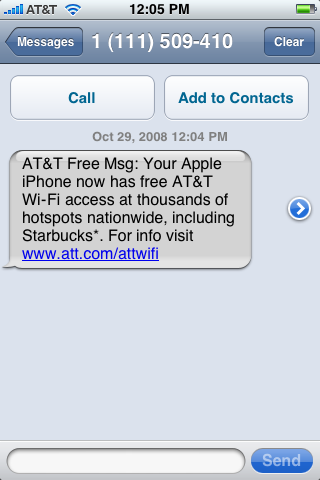
  2008-05-10). iPhone owners are also being notified by text message,
  so it's not likely an inadvertent posting error this time.

<http://www.wireless.att.com/learn/internet/wifi.jsp>
<http://www.starbucks.com/retail/find/default.aspx>
<http://db.tidbits.com/article/9609>
<http://www.tidbits.com/resources/2008-10/attwifi.png>

  AT&T's Wi-Fi service typically costs $20 per month, but access is
  free for many business, DSL, and fiber customers. In participating
  Starbucks stores, connecting to the in-store Wi-Fi network makes a
  special Starbucks category appear in the iPhone's iTunes Store app
  for purchasing music (which requires a Wi-Fi connection).

  To use the service from an iPhone, go to the Settings app, select
  "attwifi" from the list of available networks, and enter your
  10-digit mobile number. After agreeing to the Acceptable Use Policy,
  AT&T will send a free text message containing a secure link that's
  valid for 24 hours at that location.

<http://www.wireless.att.com/learn/internet/accessing-wifi.jsp>


Adam Beats His New York City Marathon Goal
------------------------------------------
  by Adam C. Engst <[EMAIL PROTECTED]>
  article link: <http://db.tidbits.com/article/9842>

  It's good to have goals, like breaking 3 hours in the marathon, but
  it's even better to crush them underfoot, as I did Sunday while
  racing to a 2 hour and 48 minute finish in the New York City
  Marathon, good for about 317th place out of 37,899 finishers. It was
  perhaps the hardest thing I've ever done - not so much the actual
  running, but the 4 months of hard training, capped by weeks of
  meticulous preparations. I was relatively sure I could break 3
  hours, but I had no idea I could run so fast for so long. (Tristan
  apparently did, though, since his contribution to Tonya's email from
  the night before the race was "Have a great marathon and get as
  close as you can to 2 hours and 50 minutes. Or less.")

  My sincere apologies to those of you who were either disappointed or
  worried when you couldn't follow my progress on the New York City
  Marathon Web site, but there was a snafu regarding my timing chip at
  registration (see "Adam Running the New York City Marathon,"
  2008-10-27). So I don't have an official time or place yet, but I
  alerted the marathon organizers and hope they can resolve the
  problem soon.

<http://db.tidbits.com/article/9829>

  Wonderful as this experience was, I don't think I'll be racing
  another marathon any time soon. I simply don't have the time in my
  life for the necessary level of training, and I'm not certain my
  body can handle the strain over a long period of time. I'd rather be
  running comfortably at age 70 than have a few more marathons under
  my belt. And of course, it might be disappointing if my next
  marathon was a lot slower.

  Big thanks to Tonya and Tristan for their support during the months
  of training, to my many friends in the Ithaca running community for
  their much-appreciated advice and camaraderie, and to everyone who
  sent an email or tweet of encouragement. Our neighbor and TidBITS
  reader Kathie Hodge even left an envelope in our mailbox with a good
  luck card and a four-leafed clover, and long-time TidBITS friend
  Chris Pepper and his wife Amy and daughter Julia cheered me on at
  the 7 mile mark (I'm the guy in the red shorts in Chris's photo). As
  much as I had to retreat inside myself to maintain my pace after
  mile 20, all the public support up to that point was instrumental.

<http://www.flickr.com/photos/chrispepper/2995030013/>

  The combination of elation and pain after the race took me by
  surprise, and although I'm used to talking with fellow runners after
  races, I was also pleasantly surprised at just how New Yorkers in
  general opened up and became downright chatty as soon as they saw my
  race number on the walk, subway ride, and ferry trip back to my aunt
  and uncle's house on Staten Island. It's nice to see such an event
  make the big city feel more like a small town.

  Now it's time to focus on healing the damage I did to my body -
  pretty much every muscle below my rib cage hurts when I move. I'll
  be downing lots of water and nutritious food, stretching to the
  extent I can, and massaging out all the trigger points that are
  causing much of the pain. I hope to be back on the roads and trails
  soon for some easy runs.

  To leave you with something of general utility, I'll note that one
  side benefit of all this training is that I've developed a
  significantly deeper understanding of muscular anatomy and have
  found that trigger point therapy (a form of massage you can do to
  yourself) is tremendously useful at addressing all sorts of pain.
  Trigger point therapy is certainly no panacea, and is itself
  uncomfortable, but I've had great success with it addressing plantar
  fasciitis pain in my right foot, knee pain due to IT band syndrome,
  and even back pain due to working at the Mac for too many hours in a
  row. If you want to learn more, I highly recommend "The Trigger
  Point Therapy Workbook: Your Self-Treatment Guide for Pain Relief,
  Second Edition," by Clair Davies and Amber Davies, thanks to its
  real-world advice and easily followed directions. Also useful is
  "Trigger Point Therapy for Myofascial Pain: The Practice of Informed
  Touch," by Donna Finando and Steven Finando, which has better
  diagnostic pictures but far more technical text aimed at massage
  therapists.

<http://www.amazon.com/dp/1572243759/?tag=tidbitselectro00>
<http://www.amazon.com/dp/1594770549/?tag=tidbitselectro00>


Apple Launches iPhone Developer Forums
--------------------------------------
  by Glenn Fleishman <[EMAIL PROTECTED]>
  article link: <http://db.tidbits.com/article/9835>

  Apple has opened up the Apple Developer Forums for talking about
  iPhone software development. The free forums, currently in beta
  testing, are available to anyone signed up for iPhone development
  via its three programs: standard, enterprise, and university.
  Standard developers pay a $99 fee, which includes the right to
  submit software for release through the App Store, while businesses
  pay $299 for the right to develop software that's distributed within
  a company. Those signed up just to access the iPhone Software
  Development Kit (SDK), which requires no payment, are not allowed
  access.

<http://developer.apple.com/devforums/>

  Apple was widely criticized by programmers for keeping a
  non-disclosure agreement (NDA) in place following the release of the
  iPhone 2.0 software. This NDA prevented any public discussion of
  development issues, restricted the distribution among companies of
  software code, and put a damper even on private interactions, many
  developers said.

  The NDA was dropped informally a few weeks ago (see "Apple Allows
  Developers to Talk about iPhone Software," 2008-10-01) and the legal
  agreement was updated last week. The removal of the NDA covers only
  software and features that have been publicly announced and
  discussed, such as the current release of the iPhone operating
  system.

<http://db.tidbits.com/article/9793>


6 GB of RAM in a MacBook or MacBook Pro
---------------------------------------
  by Adam C. Engst <[EMAIL PROTECTED]>
  article link: <http://db.tidbits.com/article/9839>

  After a few weeks of Internet conversation and testing, it turns out
  that recent MacBook and MacBook Pro models - both the
  just-introduced aluminum-and-glass models and the two previous minor
  updates - can address not just 4 GB of RAM, as Apple's technical
  specifications pages state, but 6 GB of RAM.

<http://forums.macrumors.com/showthread.php?t=573906>

  (To identify if your MacBook or MacBook Pro is new enough, run
  System Profiler and in the Hardware Overview screen, check the Model
  Identifier line. After the model name are two numbers, separated by
  a comma, as in "3,1". If the first number is 3, 4, or 5, the Mac
  should be able to handle 6 GB of RAM.)

  The laptops both have a pair of DIMM slots. The current MacBook and
  MacBook Pro models require a new form of high-speed memory called
  DDR3, running at 1066 MHz. The previous models use DDR2 RAM running
  at 667 MHz. Standard configurations have either 2 GB or 4 GB of RAM,
  achieved by installing a pair of either 1 GB or 2 GB DIMMs.

  So what if you replaced one 2 GB DIMM with a 4 GB DIMM? The answer
  seems to be that the MacBook and MacBook Pro both operate reliably
  with 6 GB of RAM, as long as it's the same type and speed of RAM.
  However, reports indicate that the next logical step - installing a
  pair of 4 GB DIMMs for a total of 8 GB of RAM - does not work
  properly. As yet, it's unclear if the problem could be resolved in
  software (such as by Snow Leopard, the next major update to Mac OS
  X), or if there are hardware issues.

  There are some downsides to jumping to 6 GB. First, you must install
  mismatched DIMM sizes (one 2 GB DIMM and one 4 GB DIMM). When
  working with a pair of identical DIMMs, the Mac can take advantage
  of its dual-channel architecture to increase the speed with which
  data can move from RAM to the CPU. However, for most usage patterns,
  a dual-channel architecture provides only a slight speed
  improvement, and losing that is probably outweighed by the benefit
  of reduced virtual memory disk swapping.

<http://en.wikipedia.org/wiki/Dual_channel>

  At the moment, there is another problem: price. Ramjet just
  announced the first 4 GB DDR3-1066 DIMM for the recently released
  MacBook and MacBook Pro models, and it's not cheap, at $599. In
  comparison, a 2 GB DDR3-1066 DIMM costs only $75 from Ramjet. For
  the previous generations of the laptops, a 4 GB DDR2-667 DIMM is a
  lot cheaper, at $159.99 from Newegg. Personally, I'd wait for the
  price to come down on the 4 GB DDR3-1066 DIMM.

<http://www.ramjet.com/ItemDescription.asp?Item=MBALX4G>
<http://www.ramjet.com/ItemDescription.asp?Item=MBPX4G>
<http://www.newegg.com/Product/Product.aspx?Item=N82E16820231202>

  And lastly, I must stress that this is an unsupported configuration,
  and I have not tried it personally. If you have problems and call
  Apple for help, they will be entirely justified in giggling at you.
  Don't say you weren't warned!


LogMeIn Tests Remote Screen Sharing via iPhone, iPod touch
----------------------------------------------------------
  by Glenn Fleishman <[EMAIL PROTECTED]>
  article link: <http://db.tidbits.com/article/9834>

  I'm constantly beset by the need to reach a computer that's not
  within reach: a server located 15 miles to the south, a laptop at
  home, or a "headless" system (no monitor attached). LogMeIn is one
  of the tools I rely on to complement Timbuktu Pro and Back to My
  Mac's screen sharing. LogMeIn's Mac OS X version, a free
  screen-sharing utility, lets me manipulate my computers remotely,
  even those inside my ostensibly locked-away home network.

  The company has now announced a limited beta test of LogMeIn
  Ignition, an extension of their system, which relies on client
  software and centrally coordinating servers that they run, to the
  iPod touch and iPhone.

<https://secure.logmein.com/welcome/IgnitionPreview/>

  The App Store currently offers some remote-access packages, although
  these rely on VNC. VNC is built into Tiger and Leopard, but it
  requires directly reachable IP addresses, whether you use port
  mapping or have a public IP address on the computer you want to
  connect to. LogMeIn can traverse NAT and other obstacles to
  end-to-end connectivity.


Netflix Starts Deploying Mac-Compatible Media Player
----------------------------------------------------
  by Doug McLean <[EMAIL PROTECTED]>
  article link: <http://db.tidbits.com/article/9832>

  [Updated 03-Nov-08 to account for the opening of Netflix's public
  beta. -Adam]

  A few weeks ago I reported on Netflix's blog announcement that the
  company hoped to make its Watch Instantly feature accessible to Mac
  users by the end of 2008 (see "Netflix Mac Support News and More,"
  2008-10-08). Netflix has now backed up their claim by unveiling
  their new media player - based on Microsoft's Silverlight
  technology. While it may seem surprising that the long-awaited
  solution to this Mac-access problem comes by way of Microsoft, you
  probably won't be surprised to learn that the root of the problem
  lies in digital rights management (DRM) technology requirements from
  the studios. According to Netflix:

<http://db.tidbits.com/article/9803>
<http://netflix.mediaroom.com/index.php?s=43&item=288>
<http://silverlight.net/>

    "Apple does not license their DRM solution to third parties, which has made
this more difficult, but we are working with the studios and content owners to
gain approval for other solutions. As soon as a studio-approved DRM for the Mac
is available to us, whether from Apple or another source, we will move quickly
to provide a movie viewer that enables you to watch movies from Netflix
instantly on your Mac."

  The new Netflix player will use Microsoft's PlayReady DRM - new in
  Silverlight 2.0 - to prevent users from doing anything but watching
  the content. Netflix's current player relies on a Windows-only DRM
  system.

  For those hearing about Microsoft Silverlight for the first time,
  it's a technology akin to Adobe Flash in that it's embodied in a Web
  browser plug-in and can display animations, audio and video, and
  interactive applications. Silverlight was first put to the test this
  past summer in streaming the Beijing Olympics for NBC. The player
  streamed thousands of hours of live coverage with generally
  successful results.

<http://en.wikipedia.org/wiki/Silverlight>
<http://www.nbcolympics.com/video/>

  Unfortunately, as Mac users attempting to watch Olympic video
  discovered, the new Netflix player works only on Intel-based Macs,
  leaving older PowerPC-based Macs in the lurch. Netflix claims that
  Intel-based Macs account for about three quarters of the company's
  current Mac-based subscribers. So while a fix for the majority of
  Mac users is certainly better than nothing, it's a shame for that
  remaining 25 percent to be denied access. It's hard to imagine that
  Microsoft will extend Silverlight back to PowerPC-based Macs in the
  future.

  Although Netflix initially limited access to the beta of the new
  player to new subscribers, the company has since opened the beta
  program to anyone who wants to sign up. Have at it, but remember,
  since it's a beta, you shouldn't expect perfect performance out of
  the gate.

<http://www.netflix.com/WiMessage?msg=58>


Take Control News: Create Better AirPort Wireless Networks
----------------------------------------------------------
  by Adam C. Engst <[EMAIL PROTECTED]>
  article link: <http://db.tidbits.com/article/9838>

  We are pleased to announce the release of the significantly
  rewritten "Take Control of Your 802.11n AirPort Network," the latest
  in our line of Glenn Fleishman's Take Control titles about AirPort
  wireless networking. With his usual good-natured enthusiasm, Glenn
  has created a fully updated ebook about AirPort networking, covering
  not only the practical details and real-world steps that you need to
  set up a fast, reliable, and secure wireless network, but also lots
  of details of interest for everyone from the beginner (basic
  terminology and concepts) to the experienced user (tricky IP
  addressing scenarios, IPv6, and software base stations). The
  242-page ebook (perhaps our most comprehensive yet!) is available
  for $15, although those of you who already have one of Glenn's
  AirPort books should have already received email about free or
  discounted upgrades. Topics covered include:

<http://www.takecontrolbooks.com/airport-n.html?14@@!pt=TB952>

* Real-world advice - with diagrams - about setting up the 802.11n
  models of the AirPort Express, AirPort Extreme, and Time Capsule

* Advice on whether the 2.4 GHz or 5 GHz band is best for your network

* Tricks for including older 802.11b and 802.11g Wi-Fi gear without
  damaging performance

* Step-by-step instructions on connecting from Macintosh and Windows
  clients

* Details about handling complex Internet addressing configurations

* The ins and outs of sharing USB disks, including a Time Capsule

* Help with connecting shared printers to Leopard, Tiger, and Windows

* A discussion of networking with and configuring an Apple TV

* How to set up a multi-base-station network to extend the area of
  wireless coverage

* The scoop on the up-and-coming IPv6 standard for handling IP
  addresses

  Although the ebook focuses on Mac OS X 10.5 Leopard, it also covers
  Mac OS X 10.4 Tiger, Windows XP, and Windows Vista.


Authors and Publishers Settle with Google Book Search
-----------------------------------------------------
  by Glenn Fleishman <[EMAIL PROTECTED]>
  article link: <http://db.tidbits.com/article/9837>

  Google wants to index all knowledge, and it thought that scanning a
  few tens of millions of books might be a good addition to the
  compendium of billions of Web pages, PDFs, and Word documents they
  already offer. The only trouble? Most of the books they wanted to
  scan are still under copyright protection. This caused the
  Association of American Publishers (AAP), the Authors Guild, and
  other organizations to gnash their teeth - and file lawsuits.

  Last week, Google and a host of these complainants agreed to a
  settlement that a court must still approve. Google will contribute
  piles of cash - $125 million - to settle outstanding issues and fund
  a new copyright clearinghouse that will enable authors and
  publishers to receive funds for online viewing of works.

<http://books.google.com/booksrightsholders/>

  The settlement also clears the way for far greater access to
  _orphaned works_: books (and other material) that remain protected
  by copyright, but which are out of print or out of production, and
  largely unavailable even through lending libraries.

  Unlike the outcome of many lawsuits about copyright and access, this
  settlement could be a big win for authors, publishers, readers, and
  libraries. Could such a thing be possible?

  (Full disclosure: I am a member of the Authors Guild. Although I did
  not support the particular form of the Authors Guild lawsuit,
  neither did I cancel my membership as a result of the legal action.)

  [Editors' disclosure: With our Take Control hats on, we've worked
  with Google Book Search for years, and it pains me to say that the
  experience has been nothing but frustrating, with literally months
  of delay between uploading a fully searchable PDF - no need to scan
  anything - and having it posted. Plus, although Google's support
  people responded quickly to our queries, they were universally
  useless at addressing any complaints, such as posting delays or the
  existence of guaranteed broken links to Amazon.com for our titles,
  given the fact that Amazon doesn't resell our ebooks. I certainly
  hope that the settlement will mean increased exposure for Google
  Book Search and our content, and additional sales. -Adam]


**The Backstory** -- After a couple years of prep work, Google
  announced in 2004 its Google Print program, later renamed Google
  Book Search, as well as its Library Project, the controversial part.

<http://books.google.com/googlebooks/newsviews/history.html>

  Google started partnering with major publishers first, followed by
  smaller houses - a total of 20,000 so far - to make their books
  available in some form online.

  Google's bigger objective was to partner with major academic
  libraries around the world, scan books using high-speed techniques
  it had invented, and use optical character recognition (OCR)
  technology to turn the scans into searchable text.

  Google Book Search made it possible for anyone to search the
  contents of any scanned book and, depending on the copyright status
  of the book and other factors, view or even download some or all
  pages. (Microsoft started two similar programs which avoided many
  copyright issues, but the company shut those projects down in May
  2008.)

<http://www.libraryjournal.com/article/CA6564275.html>

  This behavior rankled many because Google claimed the right to scan
  copyright-protected books because the company wasn't per se
  distributing the books, even though it had full digital copies.
  Google maintained - in a rough approximation - that because it was
  working under contract with libraries that owned physical copies of
  the books, that making archival digital copies was perfectly
  legitimate, as was turning the copyrighted works into text and
  images that weren't revealed in whole on the Web.

  The various parties aligned against Google disagreed, and filed suit
  in 2005.


**The Variety of Works under Discussion** -- Part of what publishers
  and the Authors Guild found problematic, and part of how the
  settlement on which parties agreed was designed, centers around
  separating works into three categories: public domain, in
  copyright/out of print, and in copyright/in print.

* Public domain works are no longer covered by copyright, and may be
  used in essentially any form and any fashion. Many publishers,
  notably Dover, reprint public-domain works in various forms and
  compendiums. Copyright holders can also release all rights on works
  they control, placing a creation in the public domain. Google Book
  Search makes the full text available, including for download.

<http://store.doverpublications.com/by-subject-literature-dover-thrift-editions.html>

* Books that are in copyright, but out of print, are often called
  _orphan works_. This category covers books that are no longer
  stocked or available from the commercial book trade, but which
  remain under copyright. The copyright may be owned by a living
  person or his or her estate, by a trust, by a publisher, or by a
  company. Orphaned works make writers cry, because their hard-wrung
  prose - fiction or non-fiction or reference - is unavailable, even
  if the market desires it, because the economics of print publishing
  have until recently put their children in the gutter. Google Book
  Search makes the full text searchable, with snippets of context
  presented.

* Active books are in copyright and in print. Books that are actively
  sold by publishers through booksellers or directly, even if they're
  30, 40, or 70 years old, fit in this category. Publishers often
  refer to their frontlist, books that are relatively new and actively
  promoted, and their backlist, titles still in stock and available,
  and which may even sell well, but which aren't promoted. The same
  searching and results are allowed as with out of print titles. (By
  the way, Amazon's special-order books program, launched at the same
  time as the bookseller's overall store in 1995, was the first simple
  way to obtain in-print books that weren't routinely stocked by
  either bookstores or book distributors. Prior to Amazon, special
  order books required time and effort on the part of a bookseller,
  and were often regarded as a giant pain to fulfill.)

  These three categories raise the question: what's covered under
  copyright, anyway? I'm glad you asked.


**Copyright's Increasing Longevity** -- Copyright law in the United
  States has been tweaked quite a bit since the right was granted in
  the Constitution, and because of this, there's quite a bit of
  complexity involved. The U.S. Copyright Office has a brief
  explanation, as well as a more extended discussion of terms.

<http://www.copyright.gov/help/faq/faq-duration.html#duration>
<http://www.copyright.gov/circs/circ15a.html#works>

  If I can try to boil the discussion down for published works
  copyrighted in the United States:

* Everything copyrighted - registered with the Copyright Office -
  before 1922 is in the public domain.

* Nearly everything registered as under copyright starting in 1922 was
  under copyright initially for a term of 28 years, which could be
  renewed on the 28th anniversary through the Copyright Office for
  another 28 years.

* Works registered starting 01-Jan-50 are grandfathered through a
  variety of rules to extend their copyright with no renewal being
  required. There are a lot of niceties involved, but this is the
  general rule.

* Any work copyrighted from 01-Jan-78 on is under copyright protection
  the moment it's created for the author's life plus 70 years, or for
  95 years from publication for works owned by a company - so-called
  "work for hire," in which a work was created by a statutorily
  defined employee of a firm or institutions, or for which copyright
  has been transferred by the individual or people involved to a
  company. No registration is required, but it ensures both a proof of
  ownership along with the maximum statutory damages (treble!) for
  successful proof of violation. (Before the Sonny Bono Copyright Term
  Extension Act of 1998, the duration was 50 years following death or
  75 years for works for hire. This was also pejoratively known as the
  Mickey Mouse Protection Act, because Mickey's appearance in
  Steamboat Willie would have entered the public domain in 2000.)

<http://en.wikipedia.org/wiki/Sonny_Bono_Copyright_Term_Extension_Act>

  A lot more explanation, which I'll avoid here, is necessary for
  rules surrounding other countries' copyright regulations prior to
  general international agreement in the 1970s about copyright terms,
  and rules in the United States for anonymous, pseudonymous, and
  unpublished works.

  If you read this carefully, you'll notice a gap. If a work was
  registered starting in 1922 and before 1950, it would wind up in the
  public domain if a renewal notice were not filed. It's unclear how
  many hundreds of thousands or millions of works may have fallen into
  that gap.

  But you can see that there's a giant divide. Before 1922,
  essentially everything. After 1922, nothing that anyone paid
  attention to.


**Fair Use** -- Copyright law contains a giant set of exemptions that
  are supposed to balance the U.S. Constitution's language against the
  public good. Article 1, Section 8, states that Congress shall have
  power "To promote the Progress of Science and useful Arts, by
  securing for limited Times to Authors and Inventors the exclusive
  Right to their respective Writings and Discoveries."

  Many arguments have been made about what limited times means -
  Stanford law professor Larry Lessig argued the Sonny Bono Act all
  the way to the Supreme Court - but the idea that copyright is
  intended not solely for the benefit of "authors and inventors" but
  for society as a whole should be undisputed. (If you've followed the
  actions of the movie and recording industries, and legislative
  efforts to support their actions, you might believe that copyright
  is all about ownership, not public good.)

<http://www.lessig.org/blog/eldredcc/>
<http://wiki.lessig.org/index.php/Against_perpetual_copyright>

  In that spirit, Congress defined exceptions to copyright, including
  fair use, which have further been refined by practice and the
  courts. There's a quadripartite test when a claimed fair use is
  examined: the commercial nature or lack thereof; the kind of work
  involved; the quantity of work used in relation to the original; the
  effect on the market of the original work. The test doesn't require
  every element to be met, but each part to be evaluated against the
  whole. (You can read about this in more depth at the Copyright
  Office.)

<http://www.copyright.gov/fls/fl102.html>

  Google has argued that its efforts at scanning copyrighted books and
  making them available for search with only snippets of results meet
  the smell test: Google was making no specific commercial return on
  its book search (in fact, investing tens of millions into its
  library-scanning efforts with libraries), that the works were
  intended for public distribution, that snippets were infinitesimal
  parts of books, and that the search giant was stimulating demand for
  the books it provided results against. Google provided links to
  purchase the books, and could thus track sales, too.

  The Authors Guild, among others, stated that simply the act of
  creating electronic editions that were stored and distributed,
  required permission from copyright holders, much less displaying the
  results. With a little programming work, an interested party could
  extract passages or entire books, too.

  Without being a lawyer specializing in this area, I believe it was
  and remains impossible to determine whether Google or its one-time
  opponents would have prevailed. They clearly would have created a
  new sub-area of law, either affirming, denying, or making far more
  complicated the notion of whether creating and owning copies of
  copyrighted works were de facto violations of the law.

  But these one-time opponents are now at least somewhat supportive of
  Google's efforts. What changed? Quite a lot, and in ways that all
  parties, and we readers, stand to benefit.


**Out-of-Print Books and Book Rights Registry** -- The settlement
  opens the way to allowing vastly improved availability of
  in-copyright books by separating out-of-print and in-print books
  into their respective categories, and collecting fees for all
  snippet displays, page reading, and page printing.

  Publishers, authors, and other copyright holders will be able to
  opt-out of having out-of-print books included; by default, all
  out-of-print books will be available, but parties can opt out. For
  in-print books, those who own the rights will opt in. This allows
  all of Google's existing partners to continue what they're doing,
  and publishers to experiment by adding specific titles or simply
  adding their entire catalogs.

  If I read the settlement right, publishers who do not opt in to
  allow in-print titles to be included by Google will simply have
  their works removed if available or not added in the future. (A
  complete set of links to resources can be found at the Authors Guild
  site.)

<http://authorsguild.org/advocacy/articles/settlement-resources.html>

  Where this agreement goes far beyond Google's current program,
  making it a win for Google, is that Google will now be able to
  provide not just snippet results, but entire pages or books (for
  viewing and printing).

  Google would collect the fees and pass them on to the Book Rights
  Registry, which will be run by a board of authors and publishers,
  and be founded with $34.5 million of a $125 million settlement that
  Google has agreed to pay - without admitting that any of Google's
  claims are invalid.

  Authors and publishers win by suddenly having a mechanism to
  disseminate electronic editions while collecting for per-snippet,
  per-page viewing, and per-page printing. Google has agreed to a
  63-37 split in favor of the copyright holder.

  The public wins because the settlement calls for a free subscription
  license for "designated" computers at all U.S. public and academic
  libraries - a miserly 1 per public library building or either 1 per
  4,000 or 1 per 10,000 students, depending on the institution type.
  Google has also agreed to pay all printing royalty fees for 5 years
  or up to $3 million, whichever comes first, for these qualifying
  locations.

  Other institutions can pay for overarching printing and reading
  licenses, and public libraries can upgrade to fuller licenses, too.
  Without knowing what these more extensive subscriptions cost, it's
  hard to know whether public libraries will be able to afford them.
  Wade Roush of Xconomy, from whose writing I learned about the limits
  on free library access, is down on the whole deal, partly due to the
  scale of free access and partly due to the default pricing that
  Google will set on out-of-print, in-copyright books.

<http://www.xconomy.com/boston/2008/10/31/in-google-book-search-settlement-readers-lose/>

  Anyone who researches a topic should benefit from the availability
  of out-of-print works, as they comprise many millions of titles that
  are rarely available in wide circulation. Ten libraries around the
  world might have a particular book you need, but that doesn't mean
  you can gain access to it.

  Google has also agreed to pay legal fees, and at least $45 million
  to copyright holders whose works were scanned before a certain date
  connected to the lawsuit.

  Now, of course, not all publishers or copyright holders are
  represented by the parties involved, and some may choose to sue
  separately in the future. The court might also require the parties
  to appear in court, although courts prefer settlements.

  The only fly in the ointment is that copyright holders of
  out-of-print but in-copyright works are being de facto opted in to
  having their works available by virtue of this settlement, even if
  they're not party to it. That should fly, because most of these
  creators or owners can get no value out of their works at present,
  and few people complain about receiving additional compensation.
  Further, the creation of a clearinghouse gives a kind of imprimatur,
  allowing a party that represents authors and publishers to make sure
  out-of-print works see life again.

  There was the notable case in the music world of James Carter, a
  former convict whose voice was recorded on a chain gang in 1959 by
  pioneering folk music collector Alan Lomax. In 2002, the song he
  sang, "Po' Lazarus," was used in the opening of the movie "O
  Brother, Where Art Thou?" The soundtrack sold 4 million copies.

  Carter, who left prison in 1967 and had led a quiet life since, was
  tracked down after months of research by the Lomax archives, and
  presented with a $20,000 check; he received $100,000 by his death in
  2003.

<http://articles.latimes.com/2003/dec/08/local/me-carter8>


**Avoiding Collision with the Future** -- I'm a writer. I make my
  living by sitting down and typing, as I am now. The notion of Google
  appropriating my words without my permission or acknowledgment
  always bothered me, even though I also accepted that there was a
  fine chance that the company was operating within the legal
  constraints of copyright law.

  I similarly was troubled by the Authors Guild partnering with what
  is often its natural enemy, the AAP, in trying to prevent Google
  from related activities, some of which seemed to benefit me and
  authors, and others of which did not. (For instance, the AAP at
  times has suggested that public libraries should pay fees to
  publishers when they lend works. While this is the case in EU
  nations, authors generally don't believe that publishers would pass
  along these fees to authors; that's separate from the seemingly
  un-American idea that public libraries pay royalties!)

<http://en.wikipedia.org/wiki/Directive_92/100/EEC>

  This reconciliation doesn't solve all issues, but it makes it much
  more likely that independent authors and publishers survive and even
  thrive by providing a broader marketplace, while also providing
  greater availability of human knowledge. While the ease of access to
  publicly promulgated information, like Web pages, has increased,
  trends seemed to suggest that books would go down the path that
  movies are still taking and music is slowly escaping from: being
  available only in highly restricted ways that interfere with
  technological progress.

  With this new agreement in place, it's possible that you could
  publish a book, distribute it entirely through Google Book Search,
  and earn some money - maybe even a lot of money if the book goes
  viral - and bypass publishers entirely. That was the promise of the
  Internet music, blog, and podcast revolutions, too. While it hasn't
  come true for everyone, it's certain that many more voices are being
  heard by many more people around the world. And that's a good thing.


TidBITS Watchlist: Notable Software Updates for 03-Nov-08
---------------------------------------------------------
  by Doug McLean <[EMAIL PROTECTED]>
  article link: <http://db.tidbits.com/article/9833>

* Microsoft Office 2008 for Mac 12.1.4 Update fixes a problem in
  Entourage introduced in the recent 12.1.3 update where Exchange
  accounts could not send or receive meeting invitations and
  responses. Microsoft Office 2008 for Mac 12.1.3 is required for the
  update to work. It's available as a standalone download or by
  choosing Check for Updates from the Help menu in any Office 2008
  application. (Free update, 16 MB)

<http://www.microsoft.com/mac/downloads.mspx?pid=Mactopia_Office2008&fid=910BDFBE-8575-4F3A-AF07-8E61FD153650#viewer>

* iKey 2.3.1r2 from Script Software is the first major update to the
  popular keyboard macro tool in a long time, after a new programmer
  took over the code. Version 2.3 fixes a number of user interface
  problems that cropped up when running in Mac OS X 10.5 Leopard,
  along with a Leopard-specific problem related to shortcuts that type
  text. The subsequent 2.3.1 and 2.3.1r2 updates fix new issues that
  caused problems in Mac OS X 10.4 Tiger. ($30 new, free update, 5.2
  MB)

<http://www.scriptsoftware.com/ikey/>

* TextExpander 2.5 from SmileOnMyMac updates the typing shortcut
  utility with several new features and some minor bug fixes. Added
  features include customizable date and time math snippets - enabling
  users to add or subtract years, months, days, hours, minutes, and
  seconds from the current date and time. A new Internet productivity
  snippet group includes AppleScript scripts that automatically
  shorten URLs by utilizing online services such as TinyURL. And
  finally, a Symbol snippet group adds the capability to enter
  commonly used symbols such as copyright, trademark, euro, Command,
  Option, and Control. Bug fixes are unspecified other than one that,
  according to SmileOnMyMac's Web site, enables, "%- and %+ to abandon
  or keep delimiter on a per-snippet basis." ($29.95 new, free update,
  5.6 MB)

<http://www.smileonmymac.com/TextExpander/>
<http://tinyurl.com/>

* SpamSieve 2.7.2 from C-Command Software is the latest update to the
  powerful Bayesian spam filtering software. Changes include improved
  filter accuracy, enhanced performance, refined error reporting, a
  training program bug fix that prevents the possibility of
  interruption, and a break into two separate plug-ins for Apple Mail
  - one for Mac OS X 10.4 and one for Mac OS X 10.5 and later - that
  auto-install based on your version of Mac OS X. ($30 new, free
  update, 5.6 MB)

<http://c-command.com/spamsieve/>

* Fission 1.6 from Rogue Amoeba updates the audio editor with several
  new features and bug fixes. The most significant addition is the
  MakeiPhoneRingtone feature that enables users to save any file, in
  any format, as an iPhone ringtone. According to Rogue Amoeba's Web
  site, other changes include "...the ability to Insert Silence into a
  file, a command to set the exact location of the playhead, software
  updates via Sparkle, and almost two dozen additional improvements
  and bug fixes." To find the full list of changes in version 1.6,
  from within the program go to Help > Fission Manual > Version
  History. ($32 new, free update, 3.2 MB)

<http://www.rogueamoeba.com/fission/>


Hot Topics in TidBITS Talk/03-Nov-08
------------------------------------
  by Jeff Carlson <[EMAIL PROTECTED]>
  article link: <http://db.tidbits.com/article/9841>

**syslogd CPU Hog** -- A reader notices syslogd is burning up his CPU
  cycles, and others notice the same thing happening with other system
  processes. Is Safari somehow the cause? (6 messages)

<http://emperor.tidbits.com/TidBITS/Talk/2271>


**Python shells with Windows?** After a MacBook fails, a spare Dell
  takes its place. But the reader can't figure out how to write Python
  programs under Windows. 7 messages)

<http://emperor.tidbits.com/TidBITS/Talk/2273>


**Adeona -- Lojack-Like Application** -- Trying a recommended
  application for tracking a laptop thief ends in frustration due to
  the lack of meaningful documentation. 1 message)

<http://emperor.tidbits.com/TidBITS/Talk/2274>


**Take Control of Your 802.11n AirPort Extreme Network** -- Adam
  clears some confusion regarding the title of the latest version of
  Glenn Fleishman's AirPort ebook. 2 messages)

<http://emperor.tidbits.com/TidBITS/Talk/2275>


**Authors and Publishers Settle with Google Book Search** -- Readers
  discuss the implications of Google's settlement, both in terms of
  practical upsides for authors and also serving the greater good. 2
  messages)

<http://emperor.tidbits.com/TidBITS/Talk/2277>


$$

This is TidBITS, a free weekly technology newsletter providing timely
news, insightful analysis, and in-depth reviews to the Macintosh and
Internet communities. Feel free to forward to friends; better still,
please ask them to subscribe!

Non-profit, non-commercial publications and Web sites may reprint or
link to articles if full credit is given. Others please contact us. We
do not guarantee accuracy of articles. Caveat lector. Publication,
product, and company names may be registered trademarks of their
companies. TidBITS ISSN 1090-7017.

Copyright 2008 TidBITS: Reuse governed by Creative Commons license.

Contact us at:    <[EMAIL PROTECTED]>
TidBITS Web site: <http://www.tidbits.com/>
License terms:    <http://www.tidbits.com/terms/>
Full text search: <http://www.tidbits.com/search/>
Subscriptions:    <http://www.tidbits.com/about/list.html>
Account help:     <http://www.tidbits.com/about/account-help.html>


--
If you want to unsubscribe or change your address, use this link
http://emperor.tidbits.com/webx?unsub@@.3c557dc4!u=306a67f9