Hi Mike:

Nice to see you here.  This is my take on it, but there are others on this list
that are much more knowledgeable.
The key to the performance of a GPSDO has to do with the Allan plots for the
oscillator, GPS receiver and it's antenna  and . . . .  Also the Time Interval
counter used in the GPSDO that compares the oscillator and the GPS 1 PPS is
important.

The key idea is that when you overlay the GPS receiver's plot with the
oscillator plot there will be only one point where they intersect.  That's what
the loop time constant should be for the PLL.  That way for time intervals that
are shorter you get the good performance of the xtal oscillator and for longer
time intervals you get the long term stability of GPS.

Inside the GPSDO it somehow compares the oscillator output with the 1 PPS from
GPS.  It's very important how that's done.  Suppose that it's done by dividing
the oscillator's output down to 1 PPS and then measuring the time interval
between the two pulses.  The one shot resolution of that TI counter is a point
on the Allan plot at 1 second (because we're using 1 pulse/second).  You can
draw a line through this point slopping down at 45 degrees to indicate what
stability you will get if you average for longer times or if you make
measurements at a faster pace.

If that line is below the GPS - Oscillator intersection point then all is well.
  But it the TI line is above the intersection point then the TI counter is
limiting the performance of the GPSDO.

Of all the GPSDOs kits out there It's my understanding that the Brooks Shera is
the best.  But it was designed back when the 8 channel Motorola GPS receivers
were the standard.  But now with the M12+T (or other newer 12 channel)
receivers that have much better performance it's limited by the TI counter.

It's difficult to answer your questions in a general way.  One of the problems
has to do with the sensitivity and range of the EFC input to the oscillator.
On one hand you want to use a D/A converter that has very small steps in order
to allow tuning the oscillator with steps of E-12 or smaller.  And if you know
the direction of drift and set the manual adjustment so the EFC is very near
one end of it's range you then have almost the full range available until the
next manual adjustment is needed.  When you combine both of these it turns out
that you can't buy a DAC with that many bits.  So you can see that it's hard to
generalize about what the stability will be at 24 hours for different designs
of GPSDO.

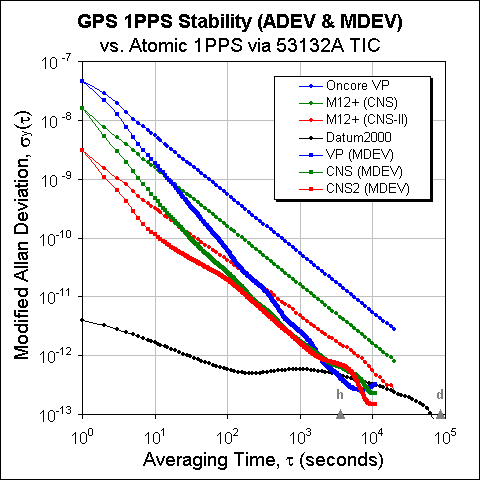
A well designed GPSDO would have long term performance that was about the same
as the GPS receiver.  Tom has a number of plots on his web page, but this one
compares a number of GPS receivers.
http://www.leapsecond.com/pages/3gps/gps-adev-mdev.gif
The Datum2000 is a GPSDO, not just a receiver.
It would be interesting to see what happens to these receivers if the test was
extended.  I expect that they all would bottom out and go horizontal in after a
few days.  But at different stability values.  Seeing that would answer your
question in a better way.

I have some T&F info at:
http://www.pacificsites.com/~brooke/timefreq.shtml

Have Fun,

Brooke Clarke, N6GCE
http://www.PRC68.com
http://www.pacificsites.com/~brooke/PRC68COM.shtml
http://www.precisionclock.com


Mike Feher wrote:
> I have to show my ignorance here, because this has been bothering me for a
> while, and, I wonder if there is a relatively simple answer. This question
> has to do with frequency accuracy and stability only. Also, let's talk of
> long term like 24 hours or more, so let's ignore phase noise and just
> concern ourselves with long term accuracy/stability. If I have three
> separate oscillators, let's say a Rubidium, an OCXO and a TCXO all with
> EFC's capable of closing the loop to lock to GPS, what kind of absolute
> frequency difference should I see amongst the three at any given time,
> random times, or, over the entire test period. Let's also make it simple and
> say all three are at 10 MHz nominal, unlocked to GPS. When locked, and
> properly designed with a narrow loop filter, I would expect the long term
> accuracy to be very close amongst all 3 oscillators. Certainly better than a
> few parts in 10^-11. First, am I wrong in this assumption? In either case,
> crystals, and even Rubidium cells do age, while at different rates, so, it
> is possible, that if lock with GPS is lost for some reason, because the
> oscillator may have drifted/aged out of loop range, it cannot be disciplined
> again. I, for the time being, also assume that the EFC on all 3 oscillators
> has a range wide enough to keep the oscillator locked even as it ages. Are
> the narrow loop bandwidths and wide EFC ranges contradictory? So, to
> reiterate the question, if I was clear enough, what kind of frequency
> excursions should I anticipate to see amongst my three disciplined
> oscillators in lets say 24 hours, or in a month. Assume GPS disciplining was
> working all of that time (can I even assume that with aging?). BTW, how is
> my assumption regarding the oscillators aging? If the oscillator basic
> frequency determining element drifts out of lock range, during lock, will it
> stay in lock? - Thanks in advance for any enlightenment - Mike
>
>
>
> Mike B. Feher, N4FS
> 89 Arnold Blvd.
> Howell, NJ, 07731
> 732-886-5960
>
>
>
>
> _______________________________________________
> time-nuts mailing list
> [email protected]
> https://www.febo.com/cgi-bin/mailman/listinfo/time-nuts
>

_______________________________________________
time-nuts mailing list
[email protected]
https://www.febo.com/cgi-bin/mailman/listinfo/time-nuts