Thanks so much, your description of collecting the raw timing data is
really clear.  I like the technique of doing timing interval
measurements from a slower known reference on one channel to a DUT on a
second channel.  This definitely gets me started.
jeff


Didier Juges wrote:
> Jeff,
>
> I have a practical step by step example using the HP 5370, a reference
> oscillator (in  my case, a Thunderbolt GPSDO, but you could use the
> counter's time base if you know it to be better than your UUT), a test
> oscillator (in my case an HP 10811) and the free Plotter software from
> Ulrich Bangert on mu web page:
>
> http://www.ko4bb.com/Timing/FAQ-1.html
>
> Look for "Practical Example" near the bottom.
>
> Didier KO4BB
>
>> -----Original Message-----
>> From: [EMAIL PROTECTED]
>> [mailto:[EMAIL PROTECTED] On Behalf Of Jeff Mock
>> Sent: Monday, November 26, 2007 1:13 PM
>> To: [email protected]
>> Subject: [time-nuts] Collecting raw timing data
>>
>> This is mostly a question for tvb.
>>
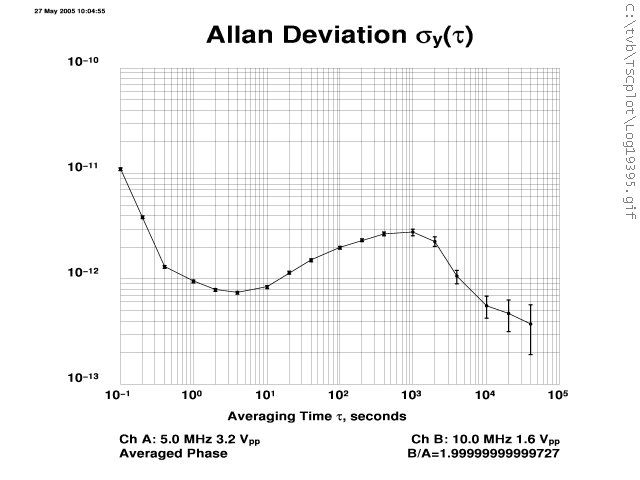
>> How are you collecting raw timing timing data to calculate a
>> typical Allan deviation plot?  Something like:
>>
>>     http://www.leapsecond.com/museum/hp58503b/log19395v.gif
>>
>> I've been fiddling with my HP53132A to get the right
>> combination of settings to collect useful timing data for
>> making Allan deviation plots.
>>   Any information on your general workflow from collecting
>> the raw data to making a plot is appreciated.
>>
>> thanks,
>> jeff
>
>
> _______________________________________________
> time-nuts mailing list -- [email protected]
> To unsubscribe, go to https://www.febo.com/cgi-bin/mailman/listinfo/time-nuts
> and follow the instructions there.
>


_______________________________________________
time-nuts mailing list -- [email protected]
To unsubscribe, go to https://www.febo.com/cgi-bin/mailman/listinfo/time-nuts
and follow the instructions there.