Hi all,

  Many thanks to everyone who responded so far.  I am taking notes and will be
trying
all of the ideas as soon as possible.  I'll report results to the group.
Jim Robbins,
N1JR


-----Original Message-----
>From: [EMAIL PROTECTED]
>Sent: Jun 6, 2008 11:41 PM
>To: [email protected]
>Subject: time-nuts Digest, Vol 47, Issue 16
>
>Send time-nuts mailing list submissions to
>       [email protected]
>
>To subscribe or unsubscribe via the World Wide Web, visit
>       https://www.febo.com/cgi-bin/mailman/listinfo/time-nuts
>or, via email, send a message with subject or body 'help' to
>       [EMAIL PROTECTED]
>
>You can reach the person managing the list at
>       [EMAIL PROTECTED]
>
>When replying, please edit your Subject line so it is more specific
>than "Re: Contents of time-nuts digest..."
>
>
>Today's Topics:
>
>   1. Re: Measuring Rubidium frequencies (Magnus Danielson)
>   2. Re: Measuring Rubidium frequencies (David C. Partridge)
>   3. Re: Measuring Rubidium frequencies (Adrian)
>   4. Re: Measuring Rubidium frequencies (David C. Partridge)
>   5. Re: Measuring Rubidium frequencies (Bill Hawkins)
>   6. Re: Measuring Rubidium frequencies (David C. Partridge)
>   7. pcb question ([EMAIL PROTECTED])
>
>
>----------------------------------------------------------------------
>
>Message: 1
>Date: Fri, 06 Jun 2008 18:30:16 +0200 (CEST)
>From: Magnus Danielson <[EMAIL PROTECTED]>
>Subject: Re: [time-nuts] Measuring Rubidium frequencies
>To: [email protected], [EMAIL PROTECTED]
>Message-ID: <[EMAIL PROTECTED]>
>Content-Type: Text/Plain; charset=us-ascii
>
>From: "Jim Robbins" <[EMAIL PROTECTED]>
>Subject: [time-nuts] Measuring Rubidium frequencies
>Date: Fri, 6 Jun 2008 09:01:48 -0400
>Message-ID: <[EMAIL PROTECTED]>
>
>Jim,
>
>> I have a problem which I am unable to understand and need some help.  I have
>> two M100 Rubidiums, a Racal 1992 counter, a factory standard T'Bolt and a
>> Symmetricom Starloc II.  When I set up either GPSDO as the External Timebase
>> for the 1992 and measure either Rubidium, I get the same reading of
>> 9.99998278.  When I use the 1992's Internal Timebase, I get 9.99999995.  All
>> equipment has warmed up.  The antenna is a Symmetricom HP 58532A on the
>> roof.     On a few occasions I have seen the frequency drift up to
>> 0.00001722.  I would have expected that both Rubies would have read
>> 0.00000000.  Any ideas would be much appreciated.
>
>Do you have propper levels at the reference input?
>If you have a too weak signal you may miss a cycle every now and then.
>
>The same can happend if your measurement input has the trigger point in the
>wrong spot. However, I suspect the reference input is much sparser in design
>than the measurement input. This put more requirements on the signal and
>"should not be a problem".
>
>This would however make your counter show larger numbers.
>
>The best thing you can do is to take a RF generator, dial it to 10 MHz and
>dial the amplitude to different levels while feeding the reference input.
>Watch for the same kind of anomalies.
>
>Another thing which may kill you is interference. Additive interference can add
>additional cycles. Now, for a frequency counter and its reference input
>it produces the interesting feature of showing lower numbers than it should,
>since your actual reference runs at a higher frequency than you think.
>
>So, given that it is the external references which produces lower numbers, I'd
>bet that you have additive interference on the 10 MHz signal. I'd suspect a
>lower frequency than 10 MHz. Putting an RF-choke on the cable may help.
>If you have a spectrum analyzer at hand, use that, but for the signal to have
>impact it needs to be fairly strong, so scoping it may do the trick. However,
>you must scope it with the counter connected to recreate the same environment.
>
>It may very well be a switching supply that upsets you. One trick would be to
>isolate the parts so that they are not part of a larger interfering
>environment. Another trick is to just turn off everything not needed for the
>measurement. Regardless, it seems like additive interference.
>
>One counter-action you can take is to convert your 10 MHz to a squarewave.
>The slewrate of the square leaves less time for the interference to interact
>with the signal. RF chokes in addition may help.
>
>Cheers,
>Magnus
>
>
>
>------------------------------
>
>Message: 2
>Date: Fri, 6 Jun 2008 17:45:23 +0100
>From: "David C. Partridge" <[EMAIL PROTECTED]>
>Subject: Re: [time-nuts] Measuring Rubidium frequencies
>To: "'Discussion of precise time and frequency measurement'"
>       <[email protected]>
>Message-ID: <[EMAIL PROTECTED]>
>Content-Type: text/plain;      charset="US-ASCII"
>
>Curious also that 9.99998278 +.00001722 = 10.000000000
>
>-----Original Message-----
>From: [EMAIL PROTECTED] [mailto:[EMAIL PROTECTED] On
>Behalf Of Jim Robbins
>Sent: 06 June 2008 14:02
>To: [email protected]
>Subject: [time-nuts] Measuring Rubidium frequencies
>
>Hi all,
>
>I have a problem which I am unable to understand and need some help.  I have
>two M100 Rubidiums, a Racal 1992 counter, a factory standard T'Bolt and a
>Symmetricom Starloc II.  When I set up either GPSDO as the External Timebase
>for the 1992 and measure either Rubidium, I get the same reading of
>9.99998278.  When I use the 1992's Internal Timebase, I get 9.99999995.  All
>equipment has warmed up.  The antenna is a Symmetricom HP 58532A on the
>roof.     On a few occasions I have seen the frequency drift up to
>0.00001722.  I would have expected that both Rubies would have read
>0.00000000.  Any ideas would be much appreciated.
>
>many thanks,
>Jim Robbins
>_______________________________________________
>time-nuts mailing list -- [email protected] To unsubscribe, go to
>https://www.febo.com/cgi-bin/mailman/listinfo/time-nuts
>and follow the instructions there.
>
>
>
>
>------------------------------
>
>Message: 3
>Date: Fri, 06 Jun 2008 19:10:18 +0200
>From: Adrian <[EMAIL PROTECTED]>
>Subject: Re: [time-nuts] Measuring Rubidium frequencies
>To: Discussion of precise time and frequency measurement
>       <[email protected]>
>Message-ID: <[EMAIL PROTECTED]>
>Content-Type: text/plain; charset=ISO-8859-1; format=flowed
>
>Jim,
>
>it might be much easier than you're thinking...
>
>Are you sure the GPDSO's are locked?
>Are you sure the rubidium oscillators are locked?
>What is the reading of your GPDSO's when you measure them with the
>internal counter time base?
>
>I would say that neither 0.00001722 nor 0.00000000 can be correct for a
>10.000,000 MHz signal.
>Something with your figures appears to be dead wrong, IMO.
>
>Adrian
>
>
>Jim Robbins schrieb:
>> Hi all,
>>
>> I have a problem which I am unable to understand and need some help.  I have
>> two M100 Rubidiums, a Racal 1992 counter, a factory standard T'Bolt and a
>> Symmetricom Starloc II.  When I set up either GPSDO as the External Timebase
>> for the 1992 and measure either Rubidium, I get the same reading of
>> 9.99998278.  When I use the 1992's Internal Timebase, I get 9.99999995.  All
>> equipment has warmed up.  The antenna is a Symmetricom HP 58532A on the
>> roof.     On a few occasions I have seen the frequency drift up to
>> 0.00001722.  I would have expected that both Rubies would have read
>> 0.00000000.  Any ideas would be much appreciated.
>>
>> many thanks,
>> Jim Robbins
>> _______________________________________________
>> time-nuts mailing list -- [email protected]
>> To unsubscribe, go to https://www.febo.com/cgi-bin/mailman/listinfo/time-nuts
>> and follow the instructions there.
>>
>>
>
>
>
>
>------------------------------
>
>Message: 4
>Date: Fri, 6 Jun 2008 20:41:07 +0100
>From: "David C. Partridge" <[EMAIL PROTECTED]>
>Subject: Re: [time-nuts] Measuring Rubidium frequencies
>To: "'Discussion of precise time and frequency measurement'"
>       <[email protected]>
>Message-ID: <[EMAIL PROTECTED]>
>Content-Type: text/plain;      charset="US-ASCII"
>
>The 1992 doesn't display the leading 1 when its in when in maximum accuracy
>mode. So for 0.0000 read 10.0000 and of course apply the 10**6 multiplier.
>
>Dave
>
>-----Original Message-----
>From: [EMAIL PROTECTED] [mailto:[EMAIL PROTECTED] On
>Behalf Of Adrian
>Sent: 06 June 2008 18:10
>To: Discussion of precise time and frequency measurement
>Subject: Re: [time-nuts] Measuring Rubidium frequencies
>
>Jim,
>
>it might be much easier than you're thinking...
>
>Are you sure the GPDSO's are locked?
>Are you sure the rubidium oscillators are locked?
>What is the reading of your GPDSO's when you measure them with the internal
>counter time base?
>
>I would say that neither 0.00001722 nor 0.00000000 can be correct for a
>10.000,000 MHz signal.
>Something with your figures appears to be dead wrong, IMO.
>
>Adrian
>
>
>Jim Robbins schrieb:
>> Hi all,
>>
>> I have a problem which I am unable to understand and need some help.  I
>have two M100 Rubidiums, a Racal 1992 counter, a factory standard T'Bolt and
>a Symmetricom Starloc II.  When I set up either GPSDO as the External
>Timebase for the 1992 and measure either Rubidium, I get the same reading of
>9.99998278.  When I use the 1992's Internal Timebase, I get 9.99999995.  All
>equipment has warmed up.  The antenna is a Symmetricom HP 58532A on the
>roof.     On a few occasions I have seen the frequency drift up to
>0.00001722.  I would have expected that both Rubies would have read
>0.00000000.  Any ideas would be much appreciated.
>>
>> many thanks,
>> Jim Robbins
>> _______________________________________________
>> time-nuts mailing list -- [email protected] To unsubscribe, go to
>> https://www.febo.com/cgi-bin/mailman/listinfo/time-nuts
>> and follow the instructions there.
>>
>>
>
>
>_______________________________________________
>time-nuts mailing list -- [email protected] To unsubscribe, go to
>https://www.febo.com/cgi-bin/mailman/listinfo/time-nuts
>and follow the instructions there.
>
>
>
>
>------------------------------
>
>Message: 5
>Date: Fri, 6 Jun 2008 14:44:26 -0500
>From: "Bill Hawkins" <[EMAIL PROTECTED]>
>Subject: Re: [time-nuts] Measuring Rubidium frequencies
>To: "'Discussion of precise time and frequency measurement'"
>       <[email protected]>
>Message-ID: <[EMAIL PROTECTED]>
>Content-Type: text/plain;      charset="us-ascii"
>
>It might be even easier than that.
>
>As a long-time user of the 1992, I know I'll get weird results
>if I fail to turn on the 50 ohm terminator for the input(s).
>
>Your 1992 will also do phase A-B measurements. This is a great
>way to compare standards if you don't have the expensive stuff.
>Don't know about the terminator for the external standard since
>I don't use it, using phase instead.
>
>Bill Hawkins
>
>
>-----Original Message-----
>From: [EMAIL PROTECTED] [mailto:[EMAIL PROTECTED] On
>Behalf Of Adrian
>Sent: Friday, June 06, 2008 12:10 PM
>To: Discussion of precise time and frequency measurement
>Subject: Re: [time-nuts] Measuring Rubidium frequencies
>
>Jim,
>
>it might be much easier than you're thinking...
>
>Are you sure the GPDSO's are locked?
>Are you sure the rubidium oscillators are locked?
>What is the reading of your GPDSO's when you measure them with the
>internal counter time base?
>
>I would say that neither 0.00001722 nor 0.00000000 can be correct for a
>10.000,000 MHz signal.
>Something with your figures appears to be dead wrong, IMO.
>
>Adrian
>
>
>Jim Robbins schrieb:
>> Hi all,
>>
>> I have a problem which I am unable to understand and need some help.
>I have two M100 Rubidiums, a Racal 1992 counter, a factory standard
>T'Bolt and a Symmetricom Starloc II.  When I set up either GPSDO as the
>External Timebase for the 1992 and measure either Rubidium, I get the
>same reading of 9.99998278.  When I use the 1992's Internal Timebase, I
>get 9.99999995.  All equipment has warmed up.  The antenna is a
>Symmetricom HP 58532A on the roof.     On a few occasions I have seen
>the frequency drift up to 0.00001722.  I would have expected that both
>Rubies would have read 0.00000000.  Any ideas would be much appreciated.
>>
>> many thanks,
>> Jim Robbins
>
>
>
>
>
>------------------------------
>
>Message: 6
>Date: Fri, 6 Jun 2008 21:34:05 +0100
>From: "David C. Partridge" <[EMAIL PROTECTED]>
>Subject: Re: [time-nuts] Measuring Rubidium frequencies
>To: "'Discussion of precise time and frequency measurement'"
>       <[email protected]>
>Message-ID: <[EMAIL PROTECTED]>
>Content-Type: text/plain;      charset="US-ASCII"
>
>>As a long-time user of the 1992, I know I'll get weird results if I fail to
>turn on the 50 ohm terminator for the input(s).
>
>Oh yes indeed!
>
>Dave
>
>
>
>
>------------------------------
>
>Message: 7
>Date: Fri, 6 Jun 2008 23:41:20 EDT
>From: [EMAIL PROTECTED]
>Subject: [time-nuts] pcb question
>To: [EMAIL PROTECTED], [email protected]
>Message-ID: <[EMAIL PROTECTED]>
>Content-Type: text/plain; charset="us-ascii"
>
>Hello Norm,
>
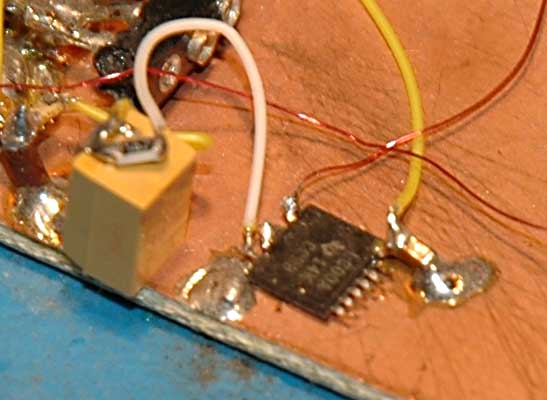
>yes, you are right, that's the way I do it. You can see that on the two
>attached pics. You can also see that I sometimes cut small islands into the
>Copper with an Exacto knife to solder down through hole parts and Tantalum
>caps
>for example.
>
>For SMD IC's I solder down the GND pins, then use small caps from the board
>to the power pins, and wire the VCC with rework wire.
>
>Excuse the poor picture/board quality, these are the only two boards I had
>able to be photographed - I usually use thermal glue to seal the  finished
>boards.
>
>This is a very quick and dirty, and surprisingly good electrical way to
>build something. I've done circuits with over 1GHz like this!
>
>Hope that helps,
>bye,
>Said
>
>
>In a message dated 6/6/2008 15:50:40 Pacific Daylight Time, SAIDJACK  writes:
>
>
>
>____________________________________
> From: [EMAIL PROTECTED]
>To: [EMAIL PROTECTED]
>Sent: 6/6/2008  14:15:10 Pacific Daylight Time
>Subj: pcb question
>
>
>Said,
>I subscribe to the timenuts reflector. A few  days ago(June 2), you
>described a method of dead bug construction using  SMT IC's and discrete
>components. Do you have any pics of the details?  How exactly do you
>attach the bypass caps to the power pins?
>My  assumption is you're using single sided fr4 and the copper is ground,
>with vcc wired as needed.
>
>This will be my first try at SMT. I've  played a bit with wire wrap and
>plugboard.
>
>This will be used for  a pulse shaper/divider network.
>Thank you for any help!
>Norm  n3ykf
>
>
>
>
>
>
>**************Get trade secrets for amazing burgers. Watch "Cooking with
>Tyler Florence" on AOL Food.
>(http://food.aol.com/tyler-florence?video=4?&NCID=aolfod00030000000002)
>-------------- next part --------------
>A non-text attachment was scrubbed...
>Name: SMD.jpg
>Type: image/jpeg
>Size: 43646 bytes
>Desc: not available
>Url :
>http://www.febo.com/pipermail/time-nuts/attachments/20080606/d5b8e86c/attachment.jpg
>
>-------------- next part --------------
>A non-text attachment was scrubbed...
>Name: smd2.jpg
>Type: image/jpeg
>Size: 47615 bytes
>Desc: not available
>Url :
>http://www.febo.com/pipermail/time-nuts/attachments/20080606/d5b8e86c/attachment-0001.jpg
>
>
>------------------------------
>
>_______________________________________________
>time-nuts mailing list
>[email protected]
>https://www.febo.com/cgi-bin/mailman/listinfo/time-nuts
>
>End of time-nuts Digest, Vol 47, Issue 16
>*****************************************


_______________________________________________
time-nuts mailing list -- [email protected]
To unsubscribe, go to https://www.febo.com/cgi-bin/mailman/listinfo/time-nuts
and follow the instructions there.