Based on my experience with the HP 8660C (detailed below) I suspect fan
noise could have an effect on HP 5370 performance.
I was project manager for the HP8660C synthesizer. During the project we
discovered the fan in the 8660C was adding significant "close-in" noise
sidebands to the synthesizer output by vibrating the internal 10811
reference oscillator. For that reason we devised a foam damped mounting
system for the 10811 and added a narrow band crystal filter in series with
it's output. With these two countermeasures the internal 10811 oscillator
yielded noise performance comparable to that obtained with an external
reference. This was in 1975 and unfortunately I no longer remember details
as to the sideband frequencies or magnitudes generated by the fan/10811
combination.
Jim Hall W4TVI


--------------------------------------------------
From: "Didier" <[email protected]>
Sent: Saturday, July 11, 2009 1:54 PM
To: "'Discussion of precise time and frequency measurement'"
<[email protected]>
Subject: Re: [time-nuts] 10811 crystal orientation
That is interestng and brings a question that I should be able to answer
but
have been too busy (or lazy...) to try...

The HP 5370 has a noisy fan, and an HP 10811 in the same box. Has anyone
been curious enough to measure the effect of fan vibration on the
oscillator
and p-p noise on TI measurements?

Didier
-----Original Message-----
From: [email protected]
[mailto:[email protected]] On Behalf Of Tom Van Baak
Sent: Friday, July 10, 2009 5:51 PM
To: Discussion of precise time and frequency measurement
Subject: Re: [time-nuts] 10811 crystal orientation

> One is do crystal oscillators change frequency when they
are turned.
> The answer to that is yes. This gravitational acceleration
effect is
> rather huge, parts in ten to the 9th or so, and anyone can
see this.
> This is why you never touch, bump, or move, or rotate a laboratory
> frequency standard (this includes GPSDO and cesium standards).

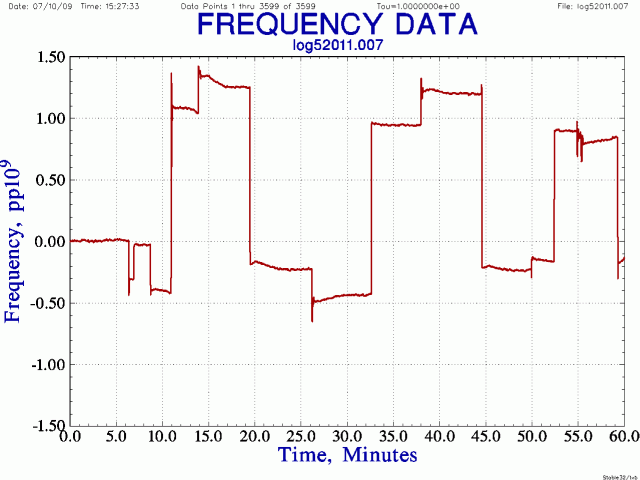
And to give you a *picture* instead of just numbers... Here
is a plot showing frequency changes in an OCXO (this from a
free-running Thunderbolt GPSDO) over the span of one hour.
Every 5 minutes or so I rotated the rectangular box on some
axis by 90 degrees.

<http://www.leapsecond.com/pages/ocxo-2g/TBolt-2g-6axis.gif>

You can see that the sudden frequency jumps due to change in
g-force on the crystal are about -0.5e-9 to +1.5 e-9, which
is 100x the normal frequency noise for this oscillator (about
2e-11 pk-pk or about 2e-12 adev).

Hopefully this result won't come as a big surprise to anyone;
the so-called "2g turn-over" spec is common for quality oscillators.
Again, this is why when you enter the world of precision
timing at 1e-10 and below you tend not to ever touch your standards.

Now if one of you happened to have a fully-programmable
3-axis turntable and a couple of hours you could slowly
create a most beautiful high-resolution 3D color plot showing
the precise shift in frequency as a function of axis.

/tvb


_______________________________________________
time-nuts mailing list -- [email protected] To unsubscribe,
go to https://www.febo.com/cgi-bin/mailman/listinfo/time-nuts
and follow the instructions there.
_______________________________________________
time-nuts mailing list -- [email protected]
To unsubscribe, go to
https://www.febo.com/cgi-bin/mailman/listinfo/time-nuts
and follow the instructions there.
_______________________________________________
time-nuts mailing list -- [email protected]
To unsubscribe, go to https://www.febo.com/cgi-bin/mailman/listinfo/time-nuts
and follow the instructions there.