"John Miles" <[email protected]> wrote:

  [...]
  > Thanks -  this stuff is all pretty cheap if you wait  by  the eBay
  > river long  enough. It is more important to have  an understanding
  > S.O. than  a large equipment budget (the 3048A occupies a  6' rack
  > in what amounts to my living room).

  My GF passed away some time ago so I have no problems in that area.

  But I'd word it a bit different - my bed happens to be in my lab:)

  [...]

  > The reference was a surplus 5 MHz Wenzel ULN. It is rated  at -115
  > dBc/Hz at 1 Hz, so was sufficient for these tests. The 11848A's 10
  > MHz sources  have a good broadband floor but are  not  very stable
  > close-in due to their wide tuning range.

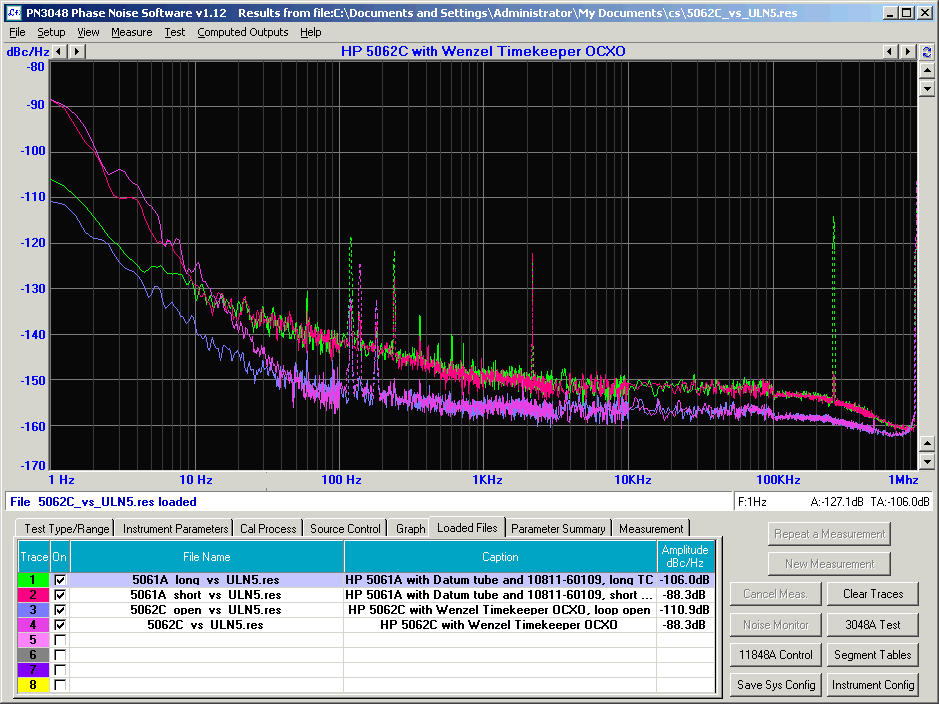
  >The actual measurement is here fwiw: http://www.thegleam.com/ke5fx/cs.gif

  Very interesting.  Thanks.  It is amazing to  see  how  good crystal
  oscillators were in the 1980's.

  [...]

  > did you  ever find out what was causing the ~10dB excess  noise in
  > the regenerative divider...?

  > I'm waiting   until   I   have   faster   digital   noise analysis
  > capabilities before  tinkering with the  regenerative  divider any
  > further. They  need  a lot of tweaking to perform  at  their best,
  > rather than  being  the plug-and-play  devices  that  I originally
  > expected. The  results   on   that   page   should  be  treated as
  > provisional.

  > john, KE5FX

  That's an  interesting  answer.  Can you explain  what  you  mean by
  "faster digital noise analysis capabilities"?

  The reason  this interest me is I'd like to get the low  phase noise
  of a  Wenzel 100MHz ULN, but I understand the price is  $1,500 which
  is a bit too high.

  Some guys  at  NIST got very good noise performance  with  a  DRO at
  10GHz. This  is  interesting, since  MiniCircuits  sells inexpensive
  low-noise microwave  amplifier  ic's  and  mixers.  So  it  might be
  possible to get a low noise cavity DRO at 8GHz and  use regenerative
  dividers to  get down to 1GHz (8 / 2^3), then use  injection locking
  to get  down  to 10MHz. This could be an inexpensive  solution  to a
  difficult problem. And you have shown you can put 10GHz on FR4, so a
  Rogers pcb may not be needed:

  http://www.thegleam.com/ke5fx/hpll.htm

  So the  question is what kind of tweaking is needed to get  the best
  performance in a regenerative divider, and what kind of equipment is
  needed to do it? Then, is perfection really needed in order  to beat
  the Wenzel  ULN?  Maybe  put   up   with  lower  performance  in the
  beginning, then upgrade later.

  BTW, I love your construction techniques. Everything on ground plane
  in shielded boxes, such as

  http://www.thegleam.com/ke5fx/equinox/equinox.html

  One trick  I have found that really helps isolate circuit  blocks is
  to put them on their own small island pcb, which is then soldered to
  the main ground plane to hold it in place. Then find the location of
  ground connections  that   give   the   lowest   crosstalk.  A brief
  description is here.

  http://pstca.com/spice/pstpp/pstpp.htm

  I need  to  post  some  pictures to show how  easy  it  is  to mount
  descrete components like caps, transistors and ics. Hopefully  I may
  find the  time to do that soon. But this is now my  preferred method
  of construction, both for convenience and very low crosstalk.

  Regards,

  Mike

_______________________________________________
time-nuts mailing list -- [email protected]
To unsubscribe, go to https://www.febo.com/cgi-bin/mailman/listinfo/time-nuts
and follow the instructions there.