Send time-nuts mailing list submissions to
[email protected]

To subscribe or unsubscribe via the World Wide Web, visit
https://www.febo.com/cgi-bin/mailman/listinfo/time-nuts
or, via email, send a message with subject or body 'help' to
[email protected]

You can reach the person managing the list at
[email protected]

When replying, please edit your Subject line so it is more specific
than "Re: Contents of time-nuts digest..."


Today's Topics:

  1. Fwd:  CS reservoir depletion ([email protected])


----------------------------------------------------------------------

Message: 1
Date: Sun, 16 Jan 2011 15:27:23 EST
From: [email protected]
Subject: [time-nuts] Fwd:  CS reservoir depletion
To: [email protected]
Message-ID: <[email protected]>
Content-Type: text/plain; charset="us-ascii"


Hello Bob,

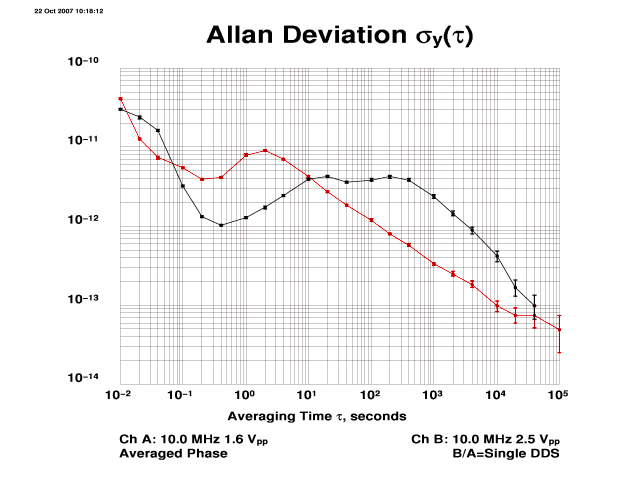
very nice summary. Here is a plot to support your list:

In terms of ADEV performance, a good GPSDO can come very close to and in
some areas exceed the performance of a good Cs significantly.

See the attached plot, this was created by super-imposing two typical
plots available on a prominent Time-Nuts members' website, and shows a
5071A
compared to one of our Fury GPSDO units. Both compared against an even
better
standard I believe.

The red plot is the 5071A, the black plot is the Fury GPSDO.

We can see that the Fury actually out-performs the 5071A between 0.1s to
10s with quite a bit of margin. Then it is less than one order of
magnitude
difference between the two from 10s to about 40Ks, at which time the Fury
seems  to "catch up" to the 5071A. The GPSDO likely also out-performs the
5071A in  terms of phase noise performance.

There is about a 33x price difference between the two units new,  and as
you mentioned the GPSDO is maintenance-free, whereas the 5071A requires
care
from time to time. There is also a massive difference in power-consumption
and thus operating costs.

bye,
Said


From: Bob Camp <[email protected]_ (mailto:[email protected]) >
Date: January 16,  2011 12:00:50 PST
To: Discussion of precise time and frequency  measurement
<[email protected]_ (mailto:[email protected]) >
Subject:  Re: [time-nuts] CS reservoir depletion
Reply-To: Discussion  of precise time and frequency measurement
<[email protected]_ (mailto:[email protected]) >


Hi

While I agree with the idea of  a "super GPS" as being a good standard,
there are some reasons for needing  something else:

1) You need something to  compare *your* GPS gizmo to in your setting.
Knowing that it might be working  ok is not as good as knowing that it is
working  ok.

2) Without some fancy corrections, GPS  can indeed drift. The period might
be hours, it could be days. The net effects will cancel over a long
enough
time, but that time may be longer than your loop can suppress.
3) Anything that creates a "fast" change in your local fly wheel
standards
will still show up on the output. It will walk out with time. Things in
this category are stuff like a step change in the supply voltage creating
a
change in your OCXO  output.

All of that can be worked on. Much  of it applies equally to having a
single Cs in the basement.

There are a couple of things the GPS gives  you that the Cs will not:

1) It will tell you  what time it is to within a few ns. Most of us
"frequency guys" don't realize  quite how hard that is to do without GPS.

2)  The long term stability (because it's steered) of the GPS is going to
eventually beat anything else out there. If you do really long data runs
(months, years) the GPS will always win.
3) Low cost to run. Even if you have a working Cs, how long until the
tube
goes?  The GPS has essentially no wear out mechanisms. The Cs is full of
strange  stuff. The parts in the GPS are pretty cheap / easy to find.

4) Easy to duplicate. Everything you are  likely to use in a fancy GPS
setup is commonly available in quantity. The components are "known good"
and
cheap. No gamble on a tube or other hard to replace stuff.
5) Easy to run. There's not much mystery about what's going on. Nothing
is
hidden in a vacuum bottle. No hidden numbers in a rom. Everything is
pretty much right in front of you. The only exception would be the
disciplining
software in the GPSDO if you choose  to use it.

I admit that the GPS makes a  *lot* of sense. I sure wouldn't turn down a
nice shinny new HP cesium if one  showed up on my doorstep.

Bob


On  Jan 16, 2011, at 7:01 AM, [email protected]_ (mailto:[email protected])
wrote:
Having two HP CBT's minus enclosure sitting on my window sill, allow me
to
ad my two cents worth. Looking at the  assemblies I see more art than


science and duplicating something like that  would most likely end in
failure.


Comparing that to the previous H Maser  discussions the collective know
how


and resources of the list could maybe result  in a  Maser.


As to refurbishing tubes some of us have  discussed that off line and  in


my opinion with proper tools and equipment  cleaning and replacing  cesium
is
doable. Cynics say the manufacturers of tubes could do it but rather
sell
only new ones since they are the only source  of the much more expensive
new


tube. I think that is only half the  story.


The reason in my opinion why refurbishing the  tube is commercially not
viable is you have to ask: when done what do you really have? You have
not
eliminated some of the failure modes, in the  case of the 5071 the data in
the
EPROM does not necessarily reflect the tube and who could say how long
the
tube  would last? A crap  shoot.


I have a HP 5061 B and a HP 5062 C but  eventually want to replace them


totally with a Tbolt-Rb-HP 10811 combination  using two digital loops that
are
tailored to the devices. I am now focusing on the thermal management
in
order to get maximum performance. There is  work going on by some members
of


the list to develop more sophisticated digital  loops. Lets face it, with
GPS


properly  used, having a Cesium Standard  will give you the warm feeling


that you have a primary  standard.


By the way that is why I repeatedly have asked  the list if there is any


long term Tbolt data out there comparing the 1  PPS or the 10 MHz with a
Maser.


I hope this is worth two  cents.


Bert Kehren


_______________________________________________


time-nuts mailing list -- [email protected]_ (mailto:[email protected])


To unsubscribe, go to
_https://www.febo.com/cgi-bin/mailman/listinfo/time-nuts_
(https://www.febo.com/cgi-bin/mailman/listinfo/time-nuts)
and follow the instructions  there.


_______________________________________________
time-nuts mailing list -- [email protected]_
(mailto:[email protected])
To unsubscribe, go to
_https://www.febo.com/cgi-bin/mailman/listinfo/time-nuts_
(https://www.febo.com/cgi-bin/mailman/listinfo/time-nuts)
and  follow the instructions  there.


=
-------------- next part --------------
A non-text attachment was scrubbed...
Name: not available
Type: image/gif
Size: 60277 bytes
Desc: not available
URL:
<http://www.febo.com/pipermail/time-nuts/attachments/20110116/4c008baf/attachment.gif>
------------------------------

_______________________________________________
time-nuts mailing list
[email protected]
https://www.febo.com/cgi-bin/mailman/listinfo/time-nuts

End of time-nuts Digest, Vol 78, Issue 67
*****************************************