Thanks Tom that makes sense.    (In this case I'm fairly sure that the FTS 1050
is at least meeting it's 100 sec ADEV spec of 1E-12 I have had results in the
13's on occasion when looking at other oscilators, and I leave it running in a
fairly stable enviornment.)
I appriceate the insight.

Regards
Mark Spencer

--- On Tue, 8/30/11, Tom Van Baak <[email protected]> wrote:

> From: Tom Van Baak <[email protected]>
> Subject: Re: [time-nuts] Question for any HP105 owners
> To: "Discussion of precise time and frequency measurement"
> <[email protected]>
> Received: Tuesday, August 30, 2011, 2:25 PM
> Mark,
>
> Let me explain the sqrt(2) thing.
>
> Since you have a number of oscillators you have probably
> already
> compared them to each other to see which one is best, or
> which
> pair is best.
>
> When you compare the FTS1050 against the HP105 remember
> that the ADEV numbers you obtain are always the rms sum of
> the instabilities of the DUT, the REF, and the 5370B. At
> first you
> can't quite know how much of the measured instability at
> each
> tau is due to each of the three parts.
>
> So the trick -- if you are comparing two of your best
> oscillators
> at tau 100 s and get something like 1e-12 you can assume
> that
> worst-case they are sqrt(2)*1e-12, or 7e-13 each.
>
> Why? Because your 1e-12 measurement is the rms sum of DUT
> and REF and comparator noise. At 100 s the 5370B noise is
> down
> to, say, 2e-13. The rms of 2e-13 plus 7e-13 plus 7e-13 =
> 10e-13,
> or 1e-12.
>
> In other words, when you get a DUT that approaches to how
> good
> your REF is, your ADEV measurements may *understate* how
> good the DUT really is.
>
> Once you've played with this you can try the next trick
> which is the
> so-called 3-cornered hat. The goal in the end is to better
> determine
> the real ADEV (not relative ADEV) of your measurement
> system
> and each of your oscillators.
>
> /tvb
>
>
> ----- Original Message -----
> From: "Mark Spencer" <[email protected]>
> To: "Discussion of precise time and frequency measurement"
> <[email protected]>;
> "Tom Van Baak" <[email protected]>
> Sent: Tuesday, August 30, 2011 8:00 AM
> Subject: Re: [time-nuts] Question for any HP105 owners
>
>
> Thanks Tom, the reference oscilator is a Datum FTS
> 1050.  I've used both a HP 5370B and my Tek 2252 scope
> as time
> interval counter and looked at the data files with Plotter
> and Time Lab.  The results are all more or less the
> same for
> ADEV at 100 seconds.
>
> With regards to the sqrt(2) removal I'm not familiar with
> that phrase but the measurements I was making were for ADEV.
>
> Using Plotter I also removed the small ammount of drift but
> the ADEV values didn't change much.
>
>
> My HP105B has the older style (non 10811)
> oscilator.   It does out perform all the
> 10811's that I own (especially with
> regards to longer term stability.)
>
> Regards
> Mark Spencer
>
>
> --- On Tue, 8/30/11, Tom Van Baak <[email protected]>
> wrote:
>
> > From: Tom Van Baak <[email protected]>
> > Subject: Re: [time-nuts] Question for any HP105
> owners
> > To: "Discussion of precise time and frequency
> measurement" <[email protected]>
> > Received: Tuesday, August 30, 2011, 2:09 AM
> > Hi Mark,
> >
> > What reference oscillator and measurement system did
> you
> > use?
> > Is that with or without a sqrt(2) removed? Is your
> HP105
> > the older
> > style with the 00105 brick oscillator or a newer one?
> >
> > The modern HP105 is essentially a well engineered
> wrapper
> > around
> > a 10811 oscillator so the performance you see will be
> that
> > of the
> > 10811. Your 3e-12 measurement beats the spec for a
> 10811
> > (1e-11
> > at tau 100 s) by a wide margin.
> >
> > It is possible that the 10811 used in HP105 met some
> higher
> > spec
> > or were hand selected. I don't know. Perhaps someone
> from
> > HP
> > (Rick?) could clarify this for us. We do know there
> are a
> > number
> > of different grades of 10811.
> >
> > One lesson you learn if you test many 10811 is that
> they
> > can vary
> > by quite a lot (an order of magnitude or more), even
> those
> > with the
> > same part number in the same instrument model.
> >
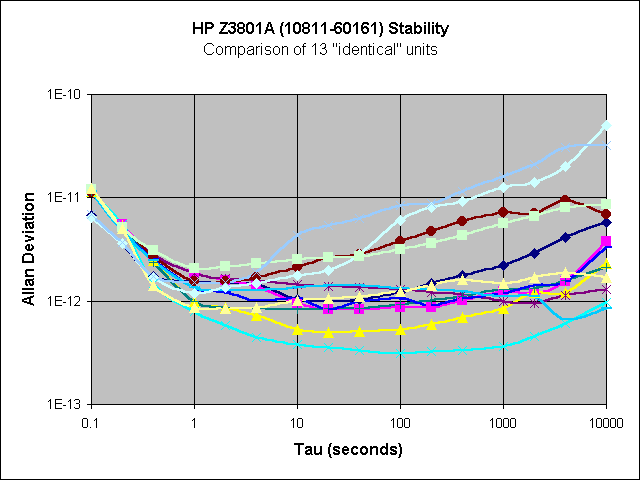
> > For example, see the tau 100 second point of a dozen
> > 10811's:
> > http://leapsecond.com/pages/z3801a-osc/z3801a-13-adev-m.gif
> > Notice they all are under the 1e-11@100s spec, but
> some
> > are
> > much better than others. It's the luck of the draw.
> And one
> > reason
> > why some of us troll eBay for old or cheap 10811
> hoping to
> > find
> > one that's better than the previous best.
> >
> > /tvb
> >
> > ----- Original Message ----- From: "Mark Spencer"
> <[email protected]>
> > To: <[email protected]>
> > Sent: Saturday, August 27, 2011 4:53 PM
> > Subject: [time-nuts] Question for any HP105 owners
> >
> >
> > > Just curious what a typical ADEV figure is for
> the
> > HP105 ? Mine seems to be approx 3X10-12 at 100
> > seconds. Just curious what results any other HP105
> > owners have seen in practice.
> > >
> > > Thanks in advance
> > > Mark VE7AFZ
> >
> >
> > _______________________________________________
> > time-nuts mailing list -- [email protected]
> > To unsubscribe, go to
> > https://www.febo.com/cgi-bin/mailman/listinfo/time-nuts
> > and follow the instructions there.
> >
>
>
> _______________________________________________
> time-nuts mailing list -- [email protected]
> To unsubscribe, go to https://www.febo.com/cgi-bin/mailman/listinfo/time-nuts
> and follow the instructions there.
>

_______________________________________________
time-nuts mailing list -- [email protected]
To unsubscribe, go to https://www.febo.com/cgi-bin/mailman/listinfo/time-nuts
and follow the instructions there.