Thank you for sharing your filter implementation. I'll study it.

On Sun, Apr 1, 2012 at 1:42 PM, Ulrich Bangert <[email protected]>wrote:
> Hello Ernie,
>
> please allow me to correct your use of my first name. It is "Ulrich" and
> not
> "Ulbrich". I attach great importance to this difference because a certain
> Walter Ulbricht was one of the leading politicians in the communist terror
> regime of the former so called "German Democratic Republic" and I do not
> want my name to sound even similar to his one.
>
> > Understand that the key point is the PLL or the phase
> > comparator circuit.........if you want to build you own GPS-DO.....
>
> As far as I remember I had understood this when I started my DIY GPSDO
> project. If you have not read about it yet take it as an indication that I
> did not want to publish it. Nevertheless you can see some pictures of it in
> the photo gallery
>
> http://www.ulrich-bangert.de/html/photo_gallery_1.html
>
> of my homepage.
>
> > can you please be a more specific.... namely to show
> > us the pre filter and other circuit....if you do not mind.
>
> The Pll as well as the pre filter is SOFTWARE and not hardware as your
> question may imply. Again I have to use the P-word because the software was
> written in PASCAL. The pre filter and the PLL part reads like:
>
> procedure ComputePreFilter;
> begin;
>  PrefilterValue:=PrefilterValue*PreFilterTimeconstant
>                 +PhaseDelay*(1-PrefilterTimeConstant);
>  Str(PreFilterValue,PreFilterValue_S);
> end;
>
> procedure DoPll;
> var count:integer;
>    flag:boolean;
>    sum:Extended;
> begin;
>  if DoPrefilter then PllPhaseValue:=PrefilterValue else
> PllPhaseValue:=PhaseDelay;
>  TimeConstant:=Sqr(NaturalTimeConstant)*(KDet*KVco);
>  If NeueZeitKonstante then
>  begin;
>    NeueZeitKonstante:=False;
>    Sum:=PropValue+IntegralValue;
>    PropFactor:=2.0*StabilityFactor/Sqrt(KDet*KVco*TimeConstant);
>    PropValue:=PropFactor*PLLPhaseValue*1.0E-9*KDet;
>    IntegralValue:=Sum-PropValue;
>  end;
>  PropFactor:=2.0*StabilityFactor/Sqrt(KDet*KVco*TimeConstant);
>  PropValue:=PropFactor*PLLPhaseValue*1.0E-9*KDet;
>  IntegralValue:=IntegralValue+PllPhaseValue*1.0E-9/TimeConstant*KDet;
>  begin;
>    TuningWord:=SollTuningWord-(PropValue+Integralvalue)*KVco/PllFactor;
>    FiltTuningWord:=(1-0.2)*FiltTuningWord+0.2*TuningWord;
>    TuningWord:=FiltTuningWord;
>    StoreTuningword:=TuningWord;
>    MakeTuningBinary(TuningWord);
>    count:=0;
>    repeat
>      SetFrequency_9852;
>      flag:=GetFrequency_9852;
>      if flag=false then Inc(DDSRWError);
>      inc(count);
>    until flag or (count>9);
>    str(DDSRWError,DDSRWError_S);
>    Strip(DDSRWError_S);
>    if count>1    then MessageLog('DDS Read/Write Error');
>    if flag=false then ErrorLog('Unable to set DDS frequency');
>    StoreM41T56_TW;
>  end;
> end;
>
> The initialization is:
>
> PreFilterTimeConstant:=1-6/NaturalTimeConstant;
>
> Both procedures are executed once per second. Read "If NeueZeitKonstante
> then" as "If the user has set a new PLL time constant then do". If you can
> gain a certain understanding for the source then terms like
> "SetFrequency_9852;" or "flag:=GetFrequency_9852;" will indicate you that
> instead of an analogue steering of the OCXO my project used a AD9852 DDS
> circuit to steer the output frequency the digital way. For that reason it
> could steer anything from simple xtals to rubidiums and cesiums without the
> slightest interaction with the circuitry of the oscillator itself which
> made
> me call the device AOS (Arbitrary Oscillator Synchronizer).
>
> The "microcontroller" used was a BECK SC12 and you can read more about it
> here:
>
> http://www.beck-ipc.com/en/products/index.asp
>
> For a lot of people this may seem a strange choice but beware: If you want
> to handle 48 bit tuning words you should take care that your micro/compiler
> combination is able to handle 64 bit entities. Before I gained access to
> the
> IAR C compiler for the AVR range of microcontrollers the Turbo Pascal that
> I
> could run on the Beck was the only environment available for me which
> featured 64 bit "extended" floating point entities and 64 bit "cardinal"
> integer entities.
>
> The phase comparator was a simple TIC with a delay line interpolation to 56
> ps resolution in an ALTERA EPF10K10 cpld. This cpld (although specified
> with
> some ns pin to pin delay) had a very fast internal "carry chain" logic
> (neccessary for multi byte adders for example) and the carry chain elements
> could be used as a fast delay line for the time interpolator.
>
> > Understand that the key point is the PLL or the phase
> > comparator circuit.........if you want to build you own GPS-DO.....
>
> Among the key points for a good GPSDO are some things that have never been
> discussed here, for example how to detect and reject outliers in the phase
> measurements. Outliers are anything else then extraordinary and a single
> outlier may  push the pll's integrator value into outer space so we MUST
> detect them before the can fire up a desaster. Unfortunately detecting
> outliers is anything else than trivial and a science of it's own called
> "robust statistics" tells us how to do. For that reason be prepared to
> learn
> more than you really want.
>
> Best regards
> Ulrich
>
> > -----Ursprungliche Nachricht-----
> > Von: [email protected]
> > [mailto:[email protected]] Im Auftrag von Erno Peres
> > Gesendet: Samstag, 31. Marz 2012 15:10
> > An: [email protected]
> > Betreff: Re: [time-nuts] CW12-TIM vs M12M and the world
> >
> >
> >
> > Hi Ulbrich,
> >
> > Sorry but not everybody a digital and/or a  professional
> > guru... can you please be a more specific.... namely to show
> > us the pre filter and other circuit....if you do not mind.
> > Understand that the key point is the PLL or the phase
> > comparator circuit.........if you want to build you own GPS-DO.....
> >
> > Many thanks and best regards,
> >
> > Ernie.
> >
> >
> >
> >
> > -----Original Message-----
> > From: Ulrich Bangert <[email protected]>
> > To: 'Discussion of precise time and frequency measurement'
> > <[email protected]>
> > Sent: Sat, Mar 31, 2012 2:53 pm
> > Subject: Re: [time-nuts] CW12-TIM vs M12M and the world
> >
> >
> > Bert,
> > sometimes a manual can be a true treasure chest! Just
> > download the PRS-10 anual at
> > http://www.thinksrs.com/downloads/PDFs/Manuals/PRS10m.pdf
> > and find starting on page 13 the complete instructions on how
> > to build your wn GPSDO. A basic knowledge of math,
> > programming and control theory is eeded to understand the
> > manual but then: It works. I have constructed my own DIY
> > GPSDO on the base of the information that I have found there,
> > ncluding the pre-filter. Best regards lrich
> > > -----Ursprungliche Nachricht-----
> >  Von: [email protected]
> >  [mailto:[email protected]] Im Auftrag von [email protected]
> >  Gesendet: Samstag, 31. Marz 2012 13:46
> >  An: [email protected]
> >  Betreff: Re: [time-nuts] CW12-TIM vs M12M and the world
> >
> >
> >  Ulrich
> >  can you tell us more about your pre filter?
> >  Thank you
> >  Bert Kehren
> >
> >
> >  In a message dated 3/31/2012 6:23:49 A.M. Eastern Daylight Time,
> >  [email protected] writes:
> >
> >  Thomas,
> >
> >  > Has anyone compared the M12M to the  M12+?
> >
> >  I have done some measurements on the M12+ with typical
> >  results as  shown in
> >
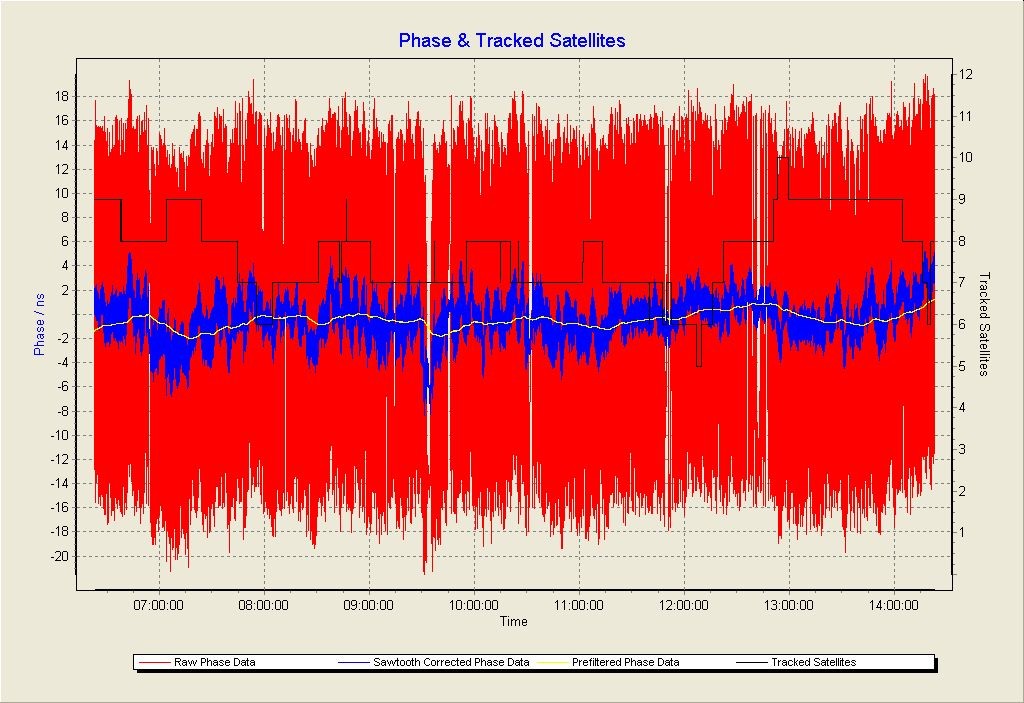
> >  http://www.ulrich-bangert.de/M12Performance.jpg
> >
> >  The red  line is the raw phase data of the M12's PPS against
> >  a PPS derived from a  local FRK-L rubidium. Note that you do
> >  not observe an overall difference  frequency (and a resulting
> >  drift in phase) because the FRK-L is disciplined  by the GPS.
> >  The blue line is the sawtooth corrected phase data and it
> >  becomes immediatly clear HOW IMPORTANT applying the
> >  correction is. The  yellow line show you what happens if the
> >  sawtooth corrected phase data is  sent through a pre-filter
> >  (lowpass with 1/3 the time constant of the
> >  main
> >  pll loop) before entering the loop itself. That is something
> >  that I  learned from the PRS-10 manual. You may decide on
> >  your own which data you  would
> >  like
> >  to work on in a GPSDO.
> >
> >  Best regards
> >  Ulrich Bangert
> >
> >  > -----Ursprungliche Nachricht-----
> >  > Von:  [email protected]
> >  > [mailto:[email protected]] Im  Auftrag von Tom
> > Knox  > Gesendet: Freitag, 30. Marz 2012 22:19  >  An:
> > Time-Nuts  > Betreff: Re: [time-nuts] CW12-TIM vs M12M and
> > the  world  >
> >  >
> >  >
> >  > Has anyone compared the M12M to the  M12+?
> >  > Thanks for all the input, it is really appreciated.
> >  > best  wishes;
> >  > Thomas Knox
> >  >
> >  >
> >  >
> >  > > CC:  [email protected]
> >  > > From: [email protected]
> >  > > Date: Fri,  30 Mar 2012 09:53:17 -0700
> >  > > To: [email protected]
> >  > >  Subject: Re: [time-nuts] CW12-TIM vs M12M and the world
> >  > >
> >  >  > Hello Ed, Azelio,
> >  > >
> >  > > We should also compare the  same parameters. Sawtooth
> > error  > of the m12+  > > of +/-25ns  is not its standard
> > deviation, it's max/min.  > Compare that  >  > number to your
> > 30ns max/min measurement on the 5372a.  > >
> >  > > Standard deviation of the m12+ is around 2ns with
> >  correction.  That
> >  > > needs to be compared to the 5ns you measure on the 5372a
> >  as  that is
> >  > > the best performance you will get from the CW12. Yes the
> >  > uncorrected
> >  > > 1pps of the m12 is worse, but it is  designed to be used
> > with  > > correction. So in the end the m12m  still performs better
> >  than the
> >  > > CW12.
> >  > >
> >  > >  Bye,
> >  > > Said
> >  > >
> >  > > Sent From iPhone
> >  >  >
> >  > > On Mar 29, 2012, at 1:56, Azelio Boriani
> >  <[email protected]>
> >  > > wrote:
> >  > >
> >  >  > > We (that is my company) use the CW12-TIM (NMEA
> > version)  > and  its PPS
> >  > > > wonders as usual, nothing different from a uBlox
> > LEA-5T  > or the M12M.  > > >
> >  > > > On Thu, Mar  29, 2012 at 9:32 AM, Hal Murray
> >  > > >  <[email protected]> wrote:
> >  > > >
> >  > >  >>
> >  > > >>>> The sawtooth error on the Motorola  M12+ is about
> > +/-  > 25ns, while  > > >>>> the  CW12-TIM has a sawtooth
> > error of +/- 2 ns, so  > correcting for  >  > >>>> the
> > sawtooth error is not as critical with the  CW12-TIM.  > > >>
> >  > > >>> The first  claim
> >  > > >>>> The sawtooth error on the Motorola M12+ is  about
> > +/- 25ns  > > >>> is correct but are you absolutely  sure that the
> >  second claim is
> >  > > >>> correct  too?????
> >  > > >>
> >  > > >>> It would mean a  factor >10 improvement of the
> > CW12-TIM  > against the  > >  >>> M12  > > >> which  > > >>>
> > is  hardly believeable.  > > >>
> >  > > >> The 25 ns  probably comes from period of the the free
> >  > running clock
> >  >  > >> they are using.  It doesn't seem unreasonable to me
> >  to get  10x
> >  > > >> better if they use a GPSDO for the local clock so
> > they  > can get the  > > >> PPS edge right where they  want
> > it.  > > >>
> >  > > >>
> >  > > >>
> >  > > >> --
> >  > > >> These are my opinions, not  necessarily my
> > employer's.  I  > hate spam.  > > >>
> >  > > >>
> >  > > >>
> >  > > >>
> >  >  > >> _______________________________________________
> >  > >  >> time-nuts mailing list -- [email protected]
> >  > > >> To  unsubscribe, go to
> >  > > >>  https://www.febo.com/cgi-bin/mailman/listinfo/time-nuts
> >  > > >>  and follow the instructions there.
> >  > > >>
> >  > > >  _______________________________________________
> >  > > > time-nuts  mailing list -- [email protected]
> >  > > > To unsubscribe, go to
> >  > > >  https://www.febo.com/cgi-bin/mailman/listinfo/time-nuts
> >  > > > and  follow the instructions there.
> >  > >
> >  > >  _______________________________________________
> >  > > time-nuts mailing  list -- [email protected]
> >  > > To unsubscribe, go to
> >  > >  https://www.febo.com/cgi-bin/mailman/listinfo/time-nuts
> >  > > and  follow the instructions there.
> >  >
> >  >  _______________________________________________
> >  > time-nuts mailing list  -- [email protected]
> >  > To unsubscribe, go to
> >  >  https://www.febo.com/cgi-bin/mailman/listinfo/time-nuts
> >  > and follow the  instructions  there.
> >
> >
> >  _______________________________________________
> >  time-nuts  mailing list -- [email protected]
> >  To unsubscribe, go to
> >  https://www.febo.com/cgi-bin/mailman/listinfo/time-nuts
> >  and follow the  instructions there.
> >
> >  _______________________________________________
> >  time-nuts mailing list -- [email protected]
> >  To unsubscribe, go to
> >  https://www.febo.com/cgi-bin/mailman/listinfo/time-nuts
> >  and follow the instructions there.
> >
> > ______________________________________________
> > ime-nuts mailing list -- [email protected]
> > o unsubscribe, go to
> > https://www.febo.com/cgi-bin/mailman/listinfo/time-nuts
> > nd follow the instructions there.
> >
> > _______________________________________________
> > time-nuts mailing list -- [email protected]
> > To unsubscribe, go to
> > https://www.febo.com/cgi-bin/mailman/listinfo/time-nuts
> > and follow the instructions there.
>
>
> _______________________________________________
> time-nuts mailing list -- [email protected]
> To unsubscribe, go to
> https://www.febo.com/cgi-bin/mailman/listinfo/time-nuts
> and follow the instructions there.
>
_______________________________________________
time-nuts mailing list -- [email protected]
To unsubscribe, go to https://www.febo.com/cgi-bin/mailman/listinfo/time-nuts
and follow the instructions there.