> I see that from one way or the other, we always end up in a TimePod. OK,
> then the TimePod has no comparator, no trigger but has A to D conversions.
> Is the A/D conversion process supposed to be threshold-free?
Hey, everybody needs at least one or two TimePods. :)  You can use a TimePod
or TSC 512xA to measure additive jitter, or for that matter a mixer and a
delay line.  But these instruments will all do the job by making a phase
noise measurement, then integrating the plot to find the equivalent RMS time
jitter.  This means that you'll have to decide what limits of integration
you want to use.  A counter, on the other hand, will give you the total
jitter seen across its entire front-end bandwidth, so there is less thinking
involved.

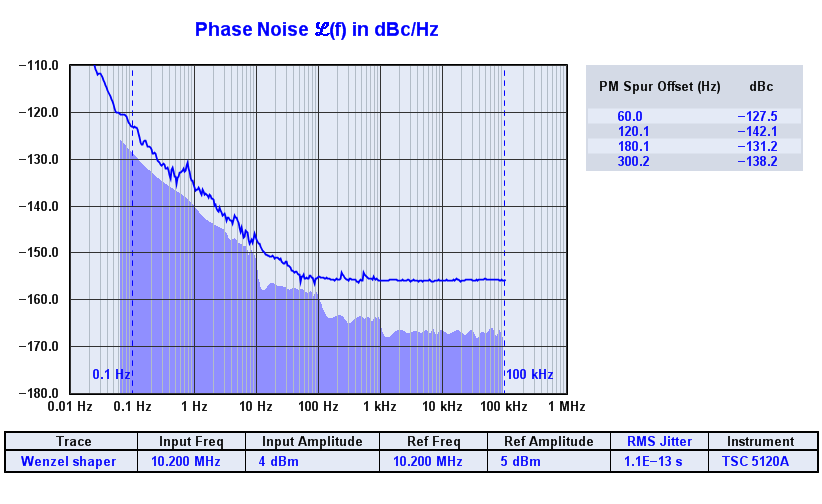
The trouble is, any good shaper or ZCD will have very low jitter, perhaps
too low for even a Wavecrest-class TIC to measure.  This is what Wenzel's
quick-and-dirty differential amp with a pair of 2N3906s looks like, when the
splitter test mentioned by Bob is performed with a TimePod, TSC or other
phase noise analyzer:

http://www.wenzel.com/documents/waveform.html
http://www.ke5fx.com/wenzel_shaper_resid_jitter.png

That's about 100 fs of additive jitter, measured between 0.1 Hz and 100 kHz.
Because the broadband floor is relatively high, a great deal of the total
jitter comes from the higher decades.   (The circuit's jitter contribution
between 0.1 Hz and 100 Hz is only about 10 fs.)

A counter will not be limited by the 100 kHz or 1 MHz integration range of a
TimePod or TSC 5120, so you might see enough jitter to be noticeable on a
Wavecrest in the 1 to 10-ps neighborhood.  But maybe you only care about
jitter at lower offsets... in which case the counter will make your shaper
look a lot worse than it really is.

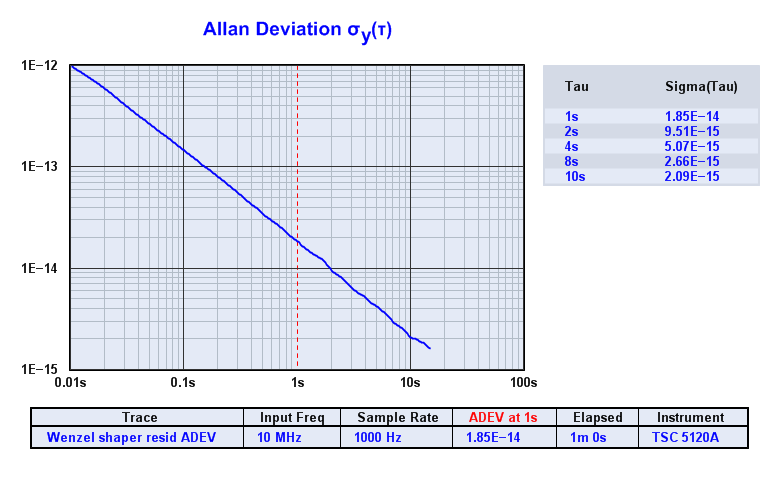
For instance, if the reason you're investigating ZCDs is because you want to
build a DMTD, then you may be more interested in a residual ADEV plot
instead.  The pair of bipolars contributes white and flicker PM noise, so
its residual ADEV at t=1s isn't too different from the residual jitter in
the ADEV measurement bandwidth, which was 500 Hz in this case:

http://www.ke5fx.com/wenzel_shaper_resid_ADEV.png

It's worth noting that I made these measurements on a TSC 5120A.  The phase
noise measurement could have been made on a TimePod, but the residual ADEV
plot could not, as it's below the TimePod's ADEV floor.

To me, this says that there are better ways to spend one's time than
designing a fancy multistage ZCD.  The important thing is to consider how
much bandwidth is really required in your application, and whether/how it
should be limited.

-- john, KE5FX
Miles Design LLC


_______________________________________________
time-nuts mailing list -- [email protected]
To unsubscribe, go to https://www.febo.com/cgi-bin/mailman/listinfo/time-nuts
and follow the instructions there.