John,

If the math works out, then I guess it must work.. If one has the time to wait..
Bye,
Said

Sent From iPhone

On Dec 30, 2012, at 16:23, "John Miles" <[email protected]> wrote:

>> Bruce,
>>
>> The Tsc5125A and miles Timepod show a phase noise floor 3dB above the
>> noise floor of the two oscillators (if two are used with identical noise
> floors).
>
> Bruce is actually talking about a semi-undocumented trick with the TimePod
> that allows it to act like an E5052 or TSC 5120A-01 with two internal
> references.  Basically, you remove the SMA jumpers from the TimePod's input
> jack panel and feed two independent reference sources that are very close to
> the same frequency to the Ch0 IN and Ch2 IN jacks.  Then you connect your
> DUT to the REF IN jack, and flip the channel equations from "0-1" and "2-3"
> to "1-0" and "3-2" to reverse the roles of the input and reference sources.
>
> That allows the cross-correlation algorithm that normally removes the ADC
> noise from a PN measurement to remove the uncorrelated noise from your two
> references as well.  It's a nifty technique, but it is important that the
> two references be close to the same frequency for various reasons, some of
> which I haven't adequately investigated.   So it falls into the "Unsupported
> technique/Use at your own risk" category.
>
>> It would be nice if that worked, then we all could use $10 TCXOs instead
> of
>> $1000 Wenzel references.
>
> That's basically how the E5052A/B and TSC 5120A-01 work -- if you look at
> their phase noise floor specs, they are much better than what can be
> obtained from any one reference source.  The E5052A/B instruments actually
> use the technique to remove the noise from two VHF-microwave downconverters.
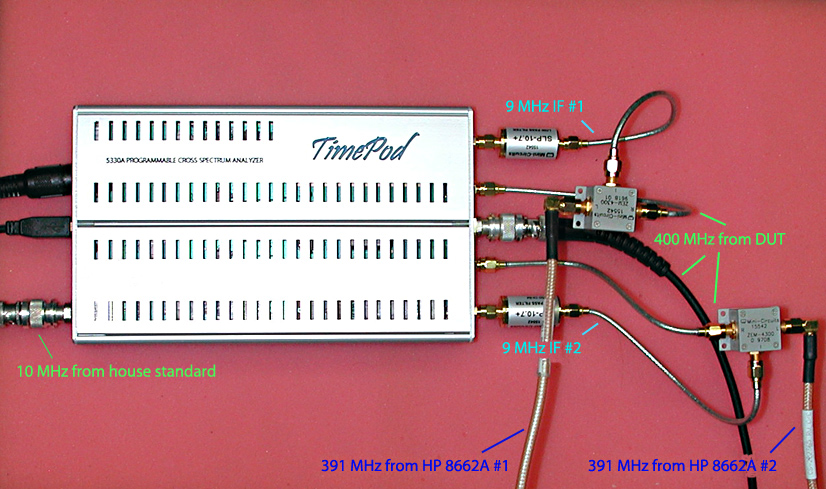
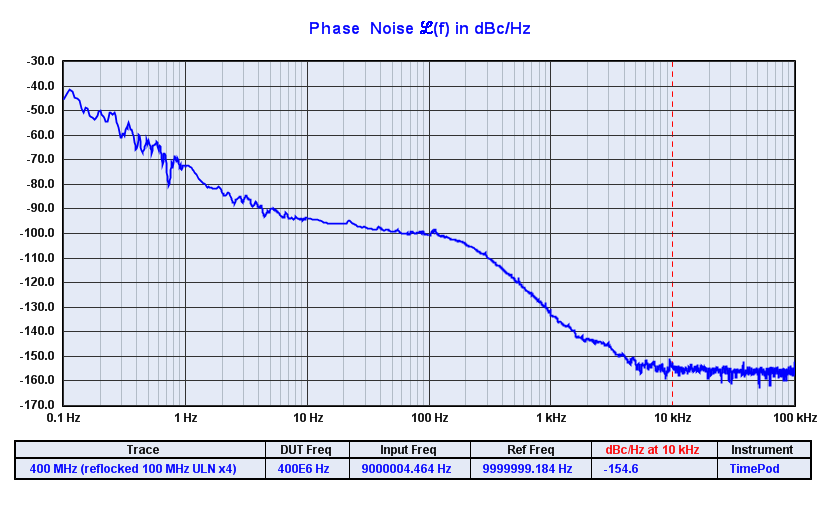
> That was my original intent in adding those SMA jacks -- see
> http://www.miles.io/timepod/VHF_test_jig.jpg and
> http://www.miles.io/timepod/VHF_example_400_MHz.png , where a pair of HP
> 8662A synthesizers is used to downconvert a much quieter 400 MHz source for
> measurement at 9 MHz.
>
> In principle you can indeed use a pair of $10 TCXOs as references to measure
> arbitrarily low-noise DUTs, but you may need to run the measurement for days
> or weeks.  Measurement time is the price of the free lunch in this case.
>
> -- john
> Miles Design LLC
>
>
>
> _______________________________________________
> time-nuts mailing list -- [email protected]
> To unsubscribe, go to https://www.febo.com/cgi-bin/mailman/listinfo/time-nuts
> and follow the instructions there.

_______________________________________________
time-nuts mailing list -- [email protected]
To unsubscribe, go to https://www.febo.com/cgi-bin/mailman/listinfo/time-nuts
and follow the instructions there.