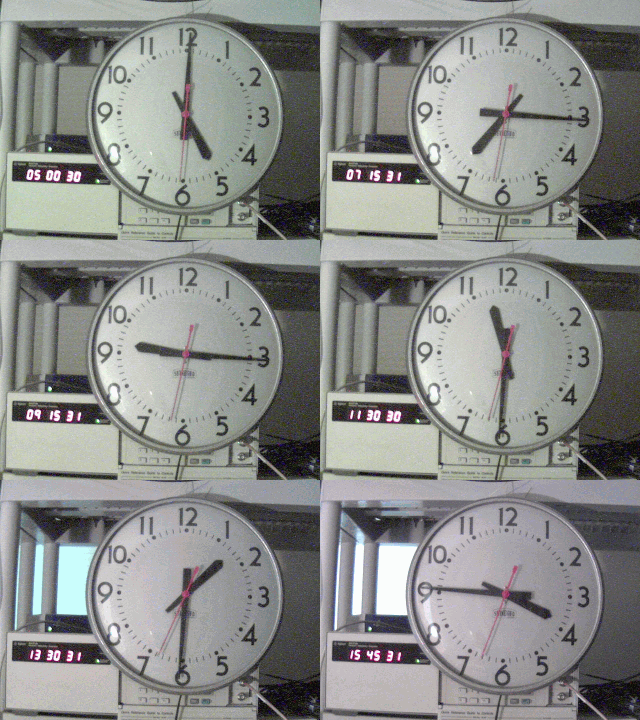
Hi  Jim,

I had a similar challenge a while ago. I ended up capturing a 4-digit,
7-segment display with a USB/LAN webcam, converting the JPG to BMP, analyzing
pixel gradients, matching the image with heuristic masks, and appending an
ascii log file with the 4 decimal digit result once a minute. It worked
amazingly well. I can send you the C source code (contact me off-line). See
also these legacy links:
    http://leapsecond.com/webcam/
    http://tycho.usno.navy.mil/ptti/ptti2003/paper35.pdf
More recently I used the same webcam to capture AC mains wall clock time vs. a
cesium clock:
    http://leapsecond.com/pages/tec/mains-clock-ani.gif

Now, it may seem very old-fashion and crude to use a web cam to capture data.
But the reality is that not all devices expose their internal state via
convenient analog test points, or through digital I2C, RS232, GPIB, USB, or LAN
protocols. So the last resort is simply a web cam on a visual (LED or LCD)
display.

But, if I understand correctly, in your case, you are more interested using the
external LCD display as a *proxy* for the internal crystal oscillator. Thus you
are not concerned with the actual numeric value that the LCD segments are
displaying; you are simply interested in measuring the time at which the LCD
digits and segments change -- because that corresponds to the phase/frequency
of the internal oscillator.

Measuring clock drift and tempco would be very easy and would produce
interesting results. The higher the rate of web cam capture the finer the
resolution of your TIC detection. Note that multiplexed displays are not a
problem; in fact, if you're clever it can actually improve your resolution by
observing the segment transition times. That is, instead of *polling* the
display, you use *changes* in the display as your timing trigger. Edge
detection. You move from a world of periodic/gated frequency counters to a
world of a reciprocal period counters, or even time-stamping counters.

In other words, since you are interested in the underlying clock performance
rather than the RSA algorithm itself, just focus a few photo-transistor(s) on
the LCD segment(s). The transition from light/dark/light/dark will exactly
correspond to some internal crystal clock phase/frequency, from which you can
gather precise long-term phase, frequency, and stability information. Edges are
always better than polling.

The idea is that segment *transition* instants rather than periodic observation
of segment *state* provides much greater accuracy. What you want to do is
measure the time of transition of individual segments. I would use
time-stamping rather than polling or time interval or frequency measurement.
That is, use a CNT-91, or picPET (www.leapsecond.com/pic).

If you look at a 7-segment digit encoding table
(http://en.wikipedia.org/wiki/Seven-segment_display) you can see that focusing
on segment 'e' gives you 8 transitions out of every 10, and using two
opto-detectors on segments 'a' and 'e' will allow you to generate a timing
event for every change in LCD digit. This will be several orders of magnitude
more precise than using a web cam. You don't need photo-transistors on all
segments.

/tvb

----- Original Message -----
From: "Jim Lux" <[email protected]>
To: <[email protected]>
Sent: Saturday, March 02, 2013 12:57 PM
Subject: Re: [time-nuts] webcam app to watch for and time stamp changes


> On 3/2/13 12:30 PM, [email protected] wrote:
>> My fob only outputs a code on demand, that is after I push the button.
>>
>> Any of the motion detection programs that use webcams would detect the
>> change in display, but with a multiplexed  display, I'm not sure how well.
>
> Interesting point.. mine only has the 6 digit (7-segment) display, but
> I'm sure it's multiplexed (digit/segment)..
>
> But, the mux rate is fairly high, compared to the "transition time" for
> the segments.  So maybe I can average over some (short) time...
>
> What I want to do is see what the temperature dependence is.  (prompted
> by leaving the fob in the sun, and having the code rejected, presumably
> because it was "slightly ahead")


_______________________________________________
time-nuts mailing list -- [email protected]
To unsubscribe, go to https://www.febo.com/cgi-bin/mailman/listinfo/time-nuts
and follow the instructions there.