Hi Antonio,

At some level, frequency standards are all affected by every environmental
factor. Typically the manufacturer shields or controls or compensates for each
factor, in order to create a product that meets spec. But it is always fun to
measure this yourself. Here are a couple of ways to make the measurements:
1) One is to create a large artificial change in the environment. We do this
when we measure the tempco of oscillators. Try it at 0 C, 25C, and 50C. It's
also how we measure the effect of voltage or load or humidity or gravity. It
would be very easy to check AC or DC magnetic susceptibility using the same
technique.

2) The other method is to remove the existing shielding or compensation that a
frequency standard has. So turning off the oven is a great way to see how
strongly temperature affects a crystal. Removing the mu-metal shield from a
Rubidium would also make a nice experiment (the military uses unshielded Rb
clocks as magnetometers to track submarines).

3) The final method is to add an additional level of shielding or control. A
good example here is creating an second oven to control the ambient temperature
seen by a frequency standard. Or placing a frequency standard in a soft foam
block to reduce seismic effects. One can learn about environmental sensitivity
by comparing the performance with and without this additional homebrew layer of
environmental shielding.

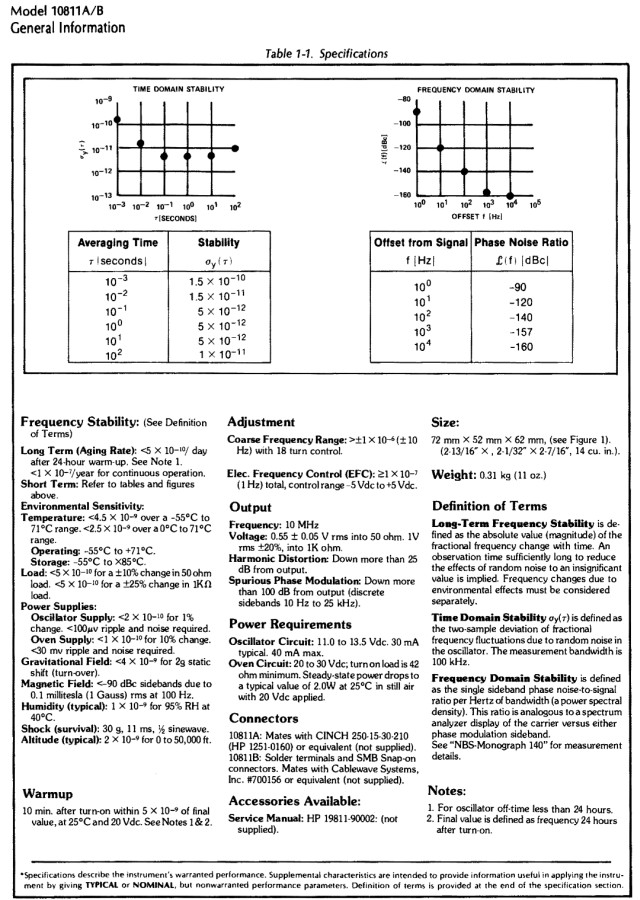
Regardless of which methods are used, what you end up with is a "calibration"
value, or sensitivity coefficient. That is, what level of change in
environmental parameter X causes how much change in oscillator frequency, or
stability. The most common ones are numbers like 1ppm/C (temperature) or
1e-8/volt (voltage) or 1e-9/2g (acceleration). A classic example of these
coefficients is:
http://leapsecond.com/museum/10811a/10811a-spec.jpg

The fun of having frequency standards at home is that you can validate these
specification with little effort and sometimes improve the performance of the
oscillator, either by additional shielding, or by active compensation.

Of course, the big labs do this from time to time. Here are some papers to read:

Environmental Sensitivities of Cavity Tuned Hydrogen Masers
Environmental Factors and Hydrogen Maser Frequency Stability
Influence of Environmental Factors on Hydrogen Maser Frequency Stability
http://tf.boulder.nist.gov/general/pdf/1201.pdf
http://tf.boulder.nist.gov/general/pdf/1252.pdf
http://tf.boulder.nist.gov/general/pdf/2592.pdf

Environmental Effects on the Medium and Long Term Frequency Stability of Quartz
Oscillators
Environmental Sensitivities of Quartz Crystal Oscillators
Environmental Sensitivities of Quartz Oscillators
http://tf.boulder.nist.gov/general/pdf/819.pdf
http://tf.boulder.nist.gov/general/pdf/906.pdf
http://tf.boulder.nist.gov/general/pdf/957.pdf

Not only will you find numbers and graphs, including magnetic effects, but you
will also see how to perform these experiments and how to properly interpret
and report the results.

Remember also that in the timing industry we use quartz for stability and so we
shield from the environment. But there's an entire other industry out there
that uses quartz as extremely sensitive sensors; for temperature, for
acceleration, for pressure, for air quality, etc.

If you have any questions, let me know. Finding external effects is really fun.
Creating the calibration charts takes time but is well worth it. We tend to
focus a lot on temperature, but other factors can be measured as well. My
favorite surprise was when I realized that my Sulzer quartz oscillator was so
stable and yet so sensitive that it could detect when the kids used the
bathroom (in the room next to my lab).

So everything affects everything; the only question is by how much. If it's 10
dB below the ADEV(tau) of the oscillator, then no worries. If it's more than
that, then you get to decide if you want to make your oscillator a better
timekeeper or a better sensor.

/tvb

----- Original Message -----
From: <[email protected]>
To: "Discussion of precise time and frequency measurement" <[email protected]>
Sent: Wednesday, April 30, 2014 3:28 PM
Subject: Re: [time-nuts] Phase noise and geomagnetism


>
> Hi all,thanks for your replies.Geomagnetic storms are known to produce easily
> detectable effects at earth, sometimes dramatic (
> http://en.wikipedia.org/wiki/Solar_storm_of_1859 ,
> http://www.youtube.com/watch?v=7ukQhycKOFw ), sometimes serious (compasses
> get crazy), sometimes minor (only aurorae boreales and other minor effects).
> I think that time-nuts should be aware whether these fenomena might affect
> their measurements or not. Geomagnetic activity data are easily available at
> the NOAA website http://www.swpc.noaa.gov/ , so checks would be easy. I hope
> to see some reports here sooner or later.Antonio I8IOV


_______________________________________________
time-nuts mailing list -- [email protected]
To unsubscribe, go to https://www.febo.com/cgi-bin/mailman/listinfo/time-nuts
and follow the instructions there.