Pete,

I have not measured the Resolution-T clock frequency. Be aware that the 1PPS
timing spec in the data sheet (e.g., N ns from UTC) is not related to the CPU
clock frequency.
The CPU clock is directly related to the range of the sawtooth corrections, by
the very definition of "quantization". Some receivers use both edges of the
clock so you have to be careful about guessing clock rate from sawtooth range
alone.

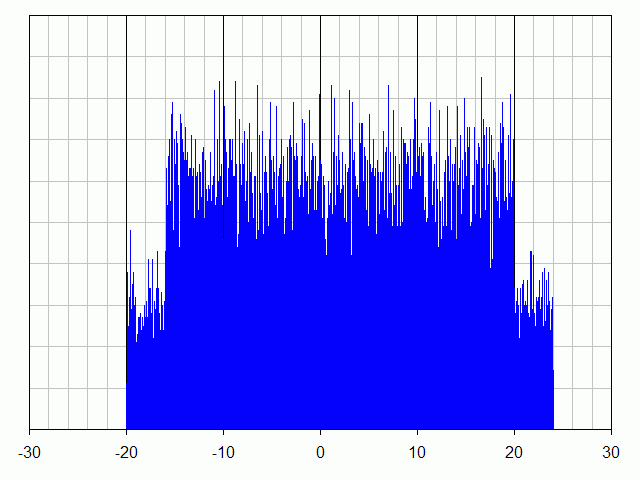
To give you a feel for Resolution-T sawtooth correction here's a histogram:
http://leapsecond.com/pages/res-t/res-t-saw.gif
25,000 sample raw data for the plot:
http://leapsecond.com/pages/res-t/res-t-saw.txt

The standard deviation is 11.7 ns. Depending on how you measure, the range is
36 or 44 ns. Note the mean is about 2 ns (not 0). I'm curious if your Res-T
looks the same as mine.

More sawtooth examples:
http://leapsecond.com/pages/MG1613S/
http://leapsecond.com/pages/vp/sawtooth.htm
http://leapsecond.com/pages/m12/sawtooth.htm

/tvb

----- Original Message -----
From: "Peter Reilley" <[email protected]>
To: "'Discussion of precise time and frequency measurement'"
<[email protected]>
Sent: Saturday, September 13, 2014 5:52 PM
Subject: Re: [time-nuts] Correcting jitter on the 1 PPS signal fromaGPSreceiver.


>I don't see any mention of sawtooth correction in their documentation.
> I take that to imply that sawtooth correction is not necessary to get
> the 15 nS that is spec'ed?
>
> Does the 15 nS imply that the internal clock is 33 MHz?   That is: +-15 nS
> is 30 nS which is 33 MHz.   Is that correct?  Or do they need a higher
> internal
> clock so that all errors sum to less than 15 nS?
>
> Pete.


_______________________________________________
time-nuts mailing list -- [email protected]
To unsubscribe, go to https://www.febo.com/cgi-bin/mailman/listinfo/time-nuts
and follow the instructions there.