Hi Tom:
The Li-Ion 18650 size cells (18mm dia x 650mm long) are used in most laptop computer batteries and Tesla cars because
they are made in such high volumes.
The referenced article shows a single 18650 cell, but with about 3.7 Volts per cell you need to connect them in series
and/or parallel to get the typically needed 12 or 24 Volts (and needed amp hours) for backup power. The big problem is
these cells can easily catch on fire and/or explode if they are mistreated either during discharge or charge. To
prevent that a protection circuit needs to be incorporated for each individual cell. The easiest way to do that is to
buy a battery pack with internal protection circuits and matched charger. Then this can be connected to the external DC
input on an individual piece of equipment. For example:
http://www.batteryspace.com/li-ionpacks37-89v.aspx
My first precision oscillator was a rack mount Gibbs 5 MHz standard that I got for a very low price because the internal
lead acid battery had vented acid fumes which etched away many of the copper PCB traces inside the oven.
http://prc68.com/I/office_equip.html
http://www.prc68.com/I/rack1.html
Mail_Attachment --
Have Fun,
Brooke Clarke
http://www.PRC68.com
http://www.end2partygovernment.com/2012Issues.html
http://www.prc68.com/I/DietNutrition.html
Tom Van Baak wrote:
I found this UPS article fascinating, because it echoed what I eventually found
in my own lab:

http://www.theplatform.net/2015/03/13/how-this-battery-cut-microsoft-datacenter-costs-by-a-quarter/

I used to rely on one massive UPS (along with natural gas generator) for my
entire lab. Eventually I found it more reliable and convenient to have
localized power backup. By local I mean backup for a single shelf, or even a
single instrument.

Consider that many Rb/Cs standards and even some Qz standards have internal
batteries. Even if one chooses not to use their internal batteries, most of
these instruments still feature dual power inputs. In addition to power
redundancy it also makes it easy to move equipment or cables around without
power loss. Most importantly, local backup like this avoids the possibility of
single-point lab-wide power failures.

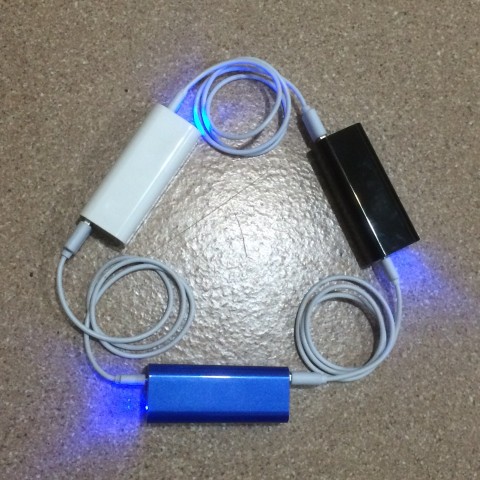
Recently, as some of my gear works from 5 VDC, those ~2600 mAh mobile phone USB
backup power bricks make an excellent mini-UPS. The ideal models are those
without LEDs or on/off buttons so they discharge and charge/float seamlessly
without manual intervention, even if fully drained.

Multiple units can be placed in series for additional, if slightly inefficient,
capacity. A good self-test is:

http://leapsecond.com/images/perpetual-USB-power.jpg

/tvb

----- Original Message -----
From: "Poul-Henning Kamp" <[email protected]>
To: "Discussion of precise time and frequency measurement" <[email protected]>; "Bill
Byrom" <[email protected]>
Sent: Monday, October 12, 2015 11:44 PM
Subject: Re: [time-nuts] UPS for my time rack
--------
In message <[email protected]>,
Bill Byrom writes:
Anything can (and will) fail, [...]
The interesting thing is that several sources in that business have
reported to me that about 30-40% of all power related downtime is
caused by Battery, generator and UPS failure, in that order.

Many sites simply have lower uptime after they install UPS systems.

--
Poul-Henning Kamp       | UNIX since Zilog Zeus 3.20
[email protected]         | TCP/IP since RFC 956
FreeBSD committer       | BSD since 4.3-tahoe
Never attribute to malice what can adequately be explained by incompetence.
_______________________________________________
time-nuts mailing list -- [email protected]
To unsubscribe, go to https://www.febo.com/cgi-bin/mailman/listinfo/time-nuts
and follow the instructions there.
_______________________________________________
time-nuts mailing list -- [email protected]
To unsubscribe, go to https://www.febo.com/cgi-bin/mailman/listinfo/time-nuts
and follow the instructions there.