Hi

RMS:
https://en.wikipedia.org/wiki/Root_mean_square
<https://en.wikipedia.org/wiki/Root_mean_square>

When we talk about things like “6 sigma” in QA, the sigma is the RMS.

Bob

> On May 3, 2017, at 1:44 AM, Bob Stewart <[email protected]> wrote:
>
> Hi Tom,
> Could you clarify the term RMS?  Is there some sort of calculation I need to
> do on the raw data to get the RMS value?
> I'm going to begin by doing a fresh 8 hour test of GPSDO Unit 1 vs GPSDO Unit
> 2, with the same conditions as the tests involving the PRS.  IOW, the 5370 is
> being clocked by GPSDO Unit 2, and the trigger for the EXT input to the 5370
> is from GPSDO Unit 2.  START is from GSPDO Unit 1 and STOP is from GPSDO Unit
> 2.  The ones I have on hand show about 4E-11 at 1s tau.
>
> After that, I'll run an 8 hour test of raw 1PPS from a LEA-6T against the
> PRS.  Since I don't really trust the PRS, I'll use GPSDO Unit 2 to clock the
> 5370.  If you really don't want the GSPDO to clock the 5370, I'll run the
> same test using the internal 10811 as the clock, to compare the difference.
>
> I also ran into an old test of the 5370 where START (10MHz) was fed by a
> GPSDO and STOP (10MHz) was fed by the same GPSDO but with (I think) a 20 ft
> cable from START to STOP.  I'll probably want to rerun that, as well, but it
> was an almost straight line from 2E-11 at 1s tau in that dataset.  Still,
> that test will verify that the 5370 hasn't degraded. Bob
>
>      From: Tom Van Baak <[email protected]>
> To: Discussion of precise time and frequency measurement <[email protected]>
> Sent: Wednesday, May 3, 2017 12:02 AM
> Subject: Re: [time-nuts] Three-cornered hat on timelab?
>
> Hi BobS,
>
>> I've also made the timelab file (compressed by 7z) available here:
>> http://evoria.net/AE6RV/Timelab/GFSvsCS.4.22.17.7z
>
> Thanks for sharing that. To follow-up on recent emails...
>
> When you start to push the limits of your own test equipment it's good to
> employ tricks such as 3-corner hat in order to get a few dB better
> measurement. But there's a limit to that. And you probably don't want me to
> suggest that you run 3 GPSDO, 3 counters and 3 cesiums all simultaneously.
>
> I've attached two plots showing 4+ days of your GPSDO data and 4+ days of a
> TBolt (factory defaults, *untuned*)
>
> bob-gpsdo-3.gif -- Notice how much your GPSDO (blue trace) wanders all over
> the place.
>
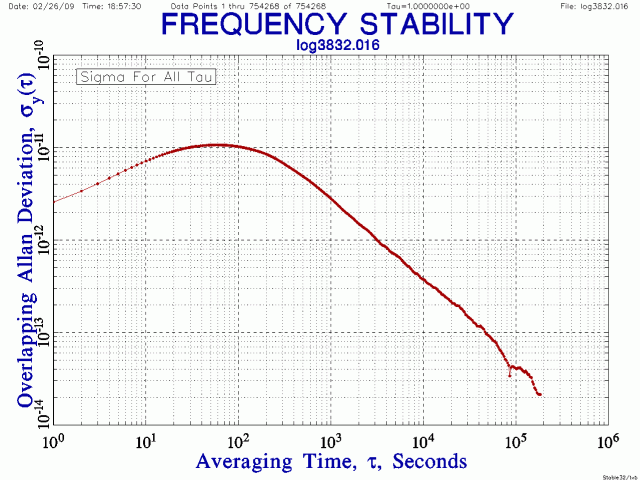
> bob-gpsdo-5.gif -- ADEV comparison. See below for comments.
>
> 1)
> When I look at the ADEV for your data set it's pretty clear that the limiting
> factor on the left (short tau) is the resolution of your 5370A counter.
> That's why the TBolt looks better. Don't worry about that.
>
> 2)
> In the middle of the ADEV plot it would appear that both your 5370A counter
> and your PRS-45A cesium reference are sufficiently good to properly measure
> your GPSDO. That's good. The TBolt looks bad in the middle but that's simply
> because it was using a way-too-short default time constant. With proper
> tuning the red trace would be mostly flat out to 1000 seconds.
>
> 3)
> From the look of the phase plot and the ADEV plot it almost seems to me like
> your PRS-45A is the limiting factor on the right (long tau). If so, it would
> explain the lack of diurnal and sidereal effects in your data. If you look at:
> http://leapsecond.com/pages/tbolt-8d/sigma1.gif from
> http://www.leapsecond.com/pages/tbolt-8d/
> you'll note the sidereal "blip" is below 4e-14. Your ADEV doesn't get near
> that level.
>
>
> I say this because a rule-of-thumb is that a good M12+T timing receiver
> should get you down to 3 ns per day RMS. And a good ublox-6T can get you to 3
> or 2 ns per day RMS. Your data shows something more like 5 ns -- which for a
> GPSDO is worse than no GPSDO at all. So something's wrong. What set of
> experiments can you perform to locate the problem? Or, what experiments can
> you perform that don't require buying expensive gear?
>
> My first suggestion is for you run a standalone GPS timing receiver like a
> M12+T or ublox-6. Put all your GPSDO away. Just use that OEM board, and your
> TIC, and your PRS-45A. Collect sawtooth data too. You should get down to 2 or
> 3 ns RMS.
>
> /tvb
>
> ----- Original Message -----
> From: "Bob Stewart" <[email protected]>
> To: "Discussion of Precise Time and Frequency Measurement"
> <[email protected]>; "Magnus Danielson" <[email protected]>
> Sent: Thursday, April 27, 2017 9:48 AM
> Subject: Re: [time-nuts] Three-cornered hat on timelab?
>
>
> Hi Magnus,
> Try as I might, the weather and the local power company had other ideas about
> my long term capture. I'm running everything but the 5370 from a UPS. I guess
> I'm going to have to get batteries for my other UPS and run the 5370 from
> that. A one second power loss was all it took to stop the test.
>
> Anyway, I did manage to get 376,238 points of data. The data is captured on a
> 5370A. The external clock input and the STOP channel are fed by the 10MHz
> from my PRS-45A. The START channel is fed by the 10MHz from one of my GPSDOs.
> The EXT channel is fed by the 1PPS from another of my GPSDO units. "EXT ARM"
> is enabled. So, essentially, at every 1PPS pulse, the phase difference
> between the two 10MHz feeds is captured.
>
> I've attached a screenshot of the phase plot which can also be found
> here:http://evoria.net/AE6RV/Timelab/Screenshot.png
> I've also made the timelab file (compressed by 7z) available here:
> http://evoria.net/AE6RV/Timelab/GFSvsCS.4.22.17.7z
>
> So, back to my question: Where are the large ionospheric phase moves? This
> question has been causing me doubt since I started on this project. Or don't
> I still have enough data collected for this to happen?
>
> Bob
>
> -----------------------------------------------------------------
> AE6RV.com
>
> GFS GPSDO list:
> groups.yahoo.com/neo/groups/GFS-GPSDOs/info
>
>       From: Magnus Danielson <[email protected]>
> To: Bob Stewart <[email protected]>; Discussion of precise time and frequency
> measurement <[email protected]>
> Cc: [email protected]
> Sent: Tuesday, April 18, 2017 1:09 AM
> Subject: Re: [time-nuts] Three-cornered hat on timelab?
>
> Hi Bob,
>
> That is a good solution indeed. Good luck with that measurement run!
>
> One of the fun stuff with Timelab is that you can walk by and check the
> developments. I've found that very useful for long measurements (as in
> hours and days).
>
> I prepared a cesium for one vendor, and initially they did not care so
> much, but then they saw more deviations between the receivers, so they
> wanted to sort it out, but discovered that they could not cancel out the
> common mode of GPS signals (and its shifts), so then firing up that
> cesium was the right thing. I remember writing support emails while
> waiting for the airplane in Madrid airport, happy that they was doing a
> first run for the right measurement reason. :)
>
> Cheers,
> Magnus
>
> On 04/18/2017 04:25 AM, Bob Stewart wrote:
>> Hi Magnus,
>> Today I started a long run against my PRS-45A. Maybe this time I won't have
>> a power outage. I'll see what it tells me in a few days.
>> Bob_______________________________________________
> time-nuts mailing list -- [email protected]
> To unsubscribe, go to https://www.febo.com/cgi-bin/mailman/listinfo/time-nuts
> and follow the instructions there.
>
>
> _______________________________________________
> time-nuts mailing list -- [email protected]
> To unsubscribe, go to https://www.febo.com/cgi-bin/mailman/listinfo/time-nuts
> and follow the instructions there.

_______________________________________________
time-nuts mailing list -- [email protected]
To unsubscribe, go to https://www.febo.com/cgi-bin/mailman/listinfo/time-nuts
and follow the instructions there.