Hi

The objective of the early work with coolers and OCXO’s was DOD sponsored. Low
cost was
not the goal :) The idea was that aging might be much better at the lower turn
than at the upper turn. Once they
played around a bit they found that activation energy was a real thing in this
case. The improvement in aging
did not justify the significant increase in complexity of the design. The idea
has popped up about every ten
years. Each time the conclusion after building a trial unit is pretty much the
same.
Bob

> On Jun 3, 2017, at 8:18 PM, jimlux <[email protected]> wrote:
>
> On 6/3/17 2:38 PM, Poul-Henning Kamp wrote:
>> --------
>> In message
>> <cabxq0zczlhbjpzwt+jtxtgr+xgprao9x9ewkwxs+jaye2h8...@mail.gmail.com>
>> , "Donald E. Pauly" writes:
>>
>>> Electronic thermal coolers did not exist then
>>
>> http://www.thermoelectrics.caltech.edu/thermoelectrics/history.html
>
> I'm not sure about fancy coolers.. Yeah, people showed that the effect
> worked, but I think they really didn't come into their own until the modern
> ones that are omnipresent in 12V powered beer coolers and the like were
> developed.  That was 70s according to the article.
> Borg Warner (of clutch, brake, and gearbox fame) apparently had one in 1960.
> http://www.thermoelectric.com/2010/archives/library/Ads%20in%20the%2060's.PDF
>
> So they existed, but were pretty exotic. would a crystal oscillator builder
> have wanted to fool with one?  Hey, there have been people tinkering with
> almost everything forever.
>
>
>>
>>> Electronic temperature sensors did not exist either.
>>
>> https://en.wikipedia.org/wiki/Resistance_thermometer#History
>>
>
> Yep... and thermocouples have been used for thermometry for a long time too.
> Thermistors, for that matter, nonlinear as all get-out, but readily available.
>
> In the 50s, a *transistor* oscillator would have been pretty unusual. I'm not
> sure they could work at a high enough frequency.  You'll note that the early
> "transistor radios" were basically TRF designs for the AM band, and the
> transistor basically provided audio gain, not RF gain.
>
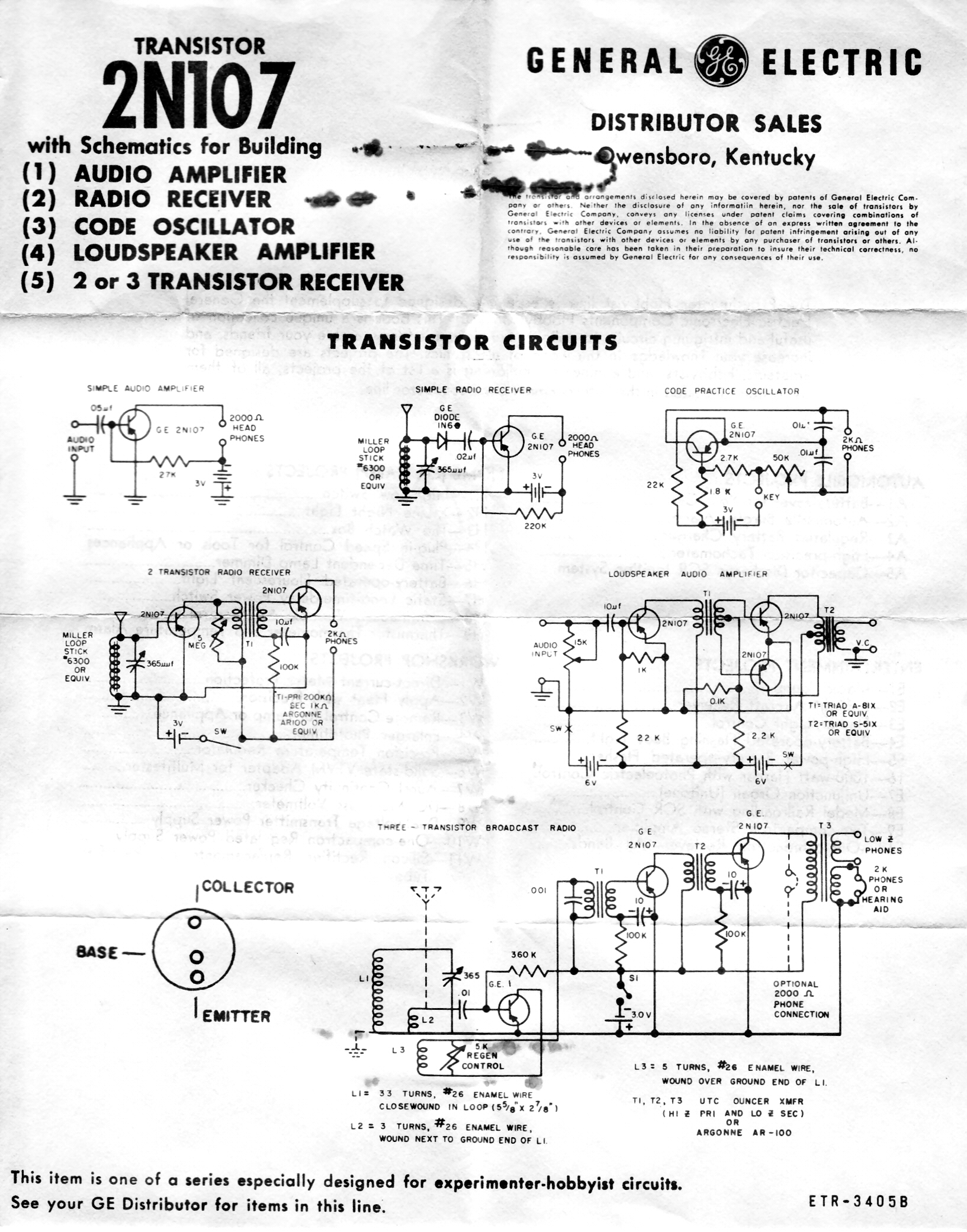
> http://www.junkbox.com/electronics/sheets/GE_2N107_Datasheet.jpg
>
> I guess the regen receiver must have had some gain at 1 MHz. I found an old
> GE datasheet that gives the ft of 0.6 MHz. (and the hfe wasn't bad, 20, at
> DC, probably)
>
> But you sure weren't building a 5MHz or 10 MHz oscillator with a 2N107 or a
> CK722.  Or the 2N170 NPN, which I am surprised to find you can still buy (and
> cheaper, in constant dollars, than originally).
>
>
>
> _______________________________________________
> time-nuts mailing list -- [email protected]
> To unsubscribe, go to https://www.febo.com/cgi-bin/mailman/listinfo/time-nuts
> and follow the instructions there.

_______________________________________________
time-nuts mailing list -- [email protected]
To unsubscribe, go to https://www.febo.com/cgi-bin/mailman/listinfo/time-nuts
and follow the instructions there.