Hi

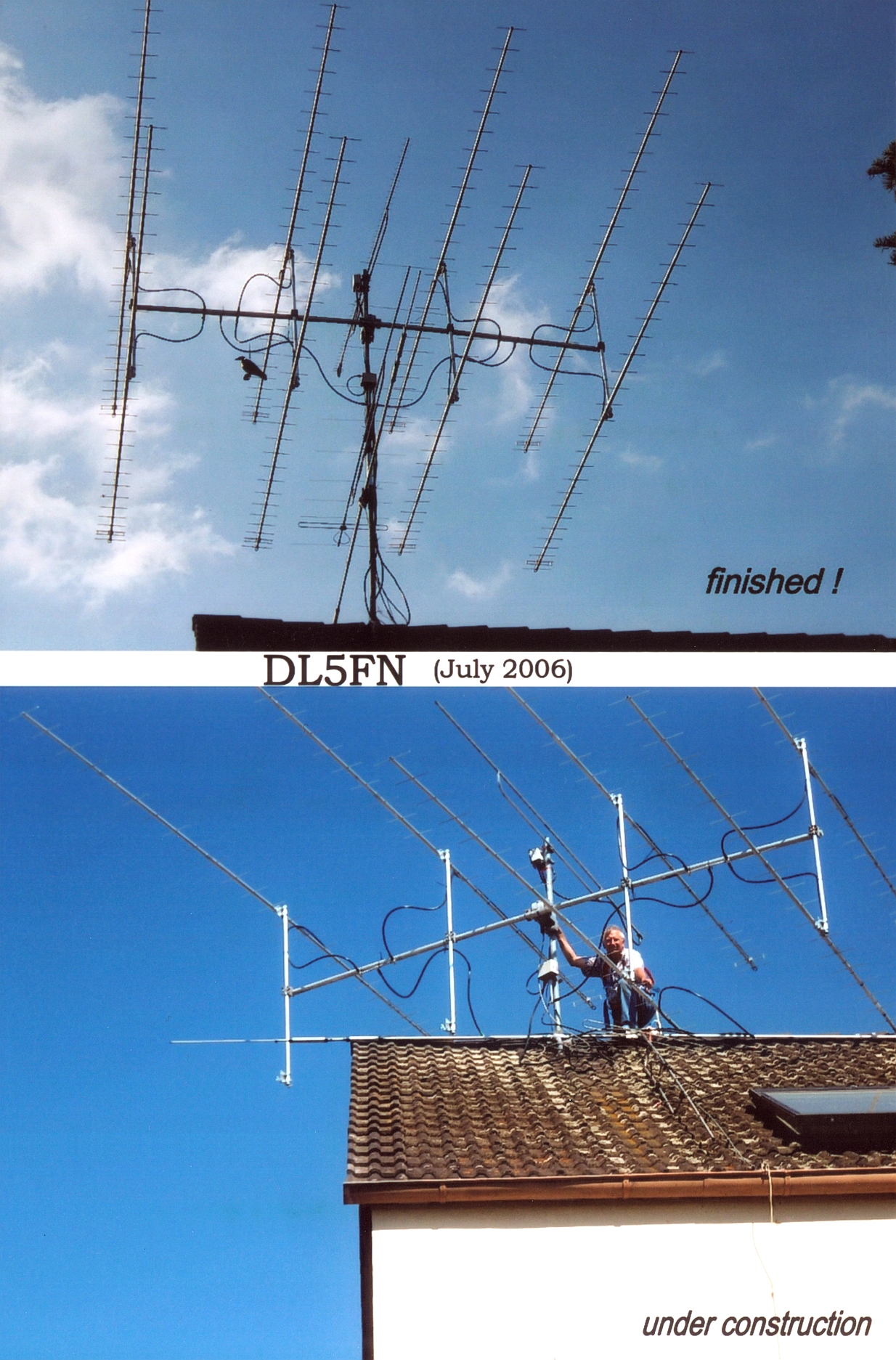
As you get into a bigger array, your antenna pointing / tracking requirements
become more exotic. I doubt that your 8 X array antenna has to do much more
than track the moon, I could be wrong ….
Bob

> On Nov 17, 2017, at 8:14 PM, Azelio Boriani <[email protected]> wrote:
>
> With 197dB of path attenuation and, say, 1W or 2W of transmitter
> power, I think that a modest antenna is insufficient. The usual yagi
> array for this distance is made by 8 27-element antennas like this:
> <http://ok1teh.nagano.cz/dl5fn.jpg>
>
> On Sat, Nov 18, 2017 at 12:54 AM, Bob kb8tq <[email protected]> wrote:
>> Hi
>>
>>
>>> On Nov 17, 2017, at 4:26 PM, Patrick Barthelow <[email protected]> wrote:
>>>
>>> From me, Pat a newbie, second post:
>>>
>>> A new project, STEM opportunity.   A STEM/CitizenScience/Ham Space Science
>>> project. Kids welcome.
>>> In formative stages so this is for internal discussion, not for public
>>> announcements yet.
>>> Will do a frequency measurement of a Cubesat at about 437 mhz that will
>>> orbit the Moon in 2018.
>>> Can be received by modest yagi antennas while orbiting the moon.
>>
>> That sounds like a pretty high ERP … Of course your definition of a modest
>> antenna
>> may not be quite the same as mine :) Consider that there *are* SNR
>> implications
>> when you get into your accuracy requirements below.
>>
>>> Challenge is to get/use/build precision frequency references and counters,
>>> and measure the carrier frequency.    Cesium, Rubidium,  MASER, GPS based,
>>> commercial standards, and their derivations all welcome.
>>> Have found 4 (and More)  more hydrogen line masers in diverse locations
>>> around the world, who wish to participate.
>>> USA, Netherlands, South Africa, Australia, Mexico, and other locations have
>>> expressed interest.
>>>
>>> I am a member of  Team Alpha Cubesat.  We and some other teams are in the
>>> NASA CUBEQUEST challenge.  Launching next year a 6u  cubesat to lunar
>>> orbit.  I am not an expert at the freq measurement aspect of this, so, I am
>>> a Newbie. With tons of questions, but  I was surprised how quickly a check
>>> of the world's Hydrogen line MASERS got many to offer to come on board.
>>> MASER is overkill, but that is OK.
>>
>> The MASER is a cute device. It is not an accurate device by it’s self. It is
>> a
>> very *stable* device. Yes, that is a subtle distinction. In this case I
>> think it is
>> a pretty important one.
>>
>>> The Chief Scientist of the project is
>>> in the USA and wants to make measurements to the HZ level, at 437 mhz so
>>> with MASERS and Cesium, Rubidium we are overkill but it could generate
>>> STEM/Citizen Science participation.  That is what we are doing.  So the
>>> satellite will be on 437.5 mhz  plus  minus doppler.  We have to measure
>>> its received freq to 1 HZ or less.
>>
>> Ok, 1 Hz at 437.5 MHZ is roughly 2 ppb. That is pretty much “slam dunk”
>> accuracy
>> with a GPSDO. Much easier to obtain and set up in a school environment. The
>> key will be orbit estimation for the +/- doppler part of it.  Orbit
>> estimation is not
>> quite a slam dunk sort of thing. The GPSDO would also give accurate location.
>> Even with good orbit data, the solution still requires a good location
>> estimate.
>>
>>>  So I talked to the chief scientist,
>>> and we decided to go with a public STEM related program
>>
>> I’ve been down the road (from scratch to running) on STEM competitions. The
>> KISS principle is one to keep in mind. At the same time you *do* want a topic
>> that presents a challenge.
>>
>>> with it. [PLEASE
>>> DO NOT GO PUBLIC YET
>>
>> This *is* a public list, it’s “out” now.
>>
>>> this is confidential for now.] Announcement of a
>>> competition for anyone to measure the frequency of the sat as it is in moon
>>> orbit.  So I decided to check with  about 5 geographically diverse located
>>> MASERS. ( Australia,  South Africa, UK, Holland, Mexico and USA,  and got
>>> or am getting buy-in from them to make the measurement.  I was surprised
>>> they did not just say go away... a half million dollar MASER is, or should
>>> be busy with similar but necessary measurements from paying customers.
>>> Overkill, I admit, but it is a chance for Citizen Science publicity,
>>> Popular Science, STEM, etc..
>>>
>>>
>>> Anyway I got a bunch of MASERS  to participate and will develop a website
>>> for people to measure the freq and send in their "answer".  We will have
>>> (are looking for) sponsors that will pay prizes or wall paper awards,  for
>>> very close accurate measurements.
>>> This is like a modern day Frequency Measurement Test that ARRL did years
>>> ago.  I will in fact call ARRL to see if they want to play in this.  I will
>>> CC others to see if they want to play.  Other frequency references used may
>>> be commercial variations of
>>> Cesium Beam and Rubidium references.  But the King Kong in accuracy is the
>>> MASER.  I got to learn a bit about the MASER they had at Arecibo when I was
>>> there.   And now know a school in Europe a Technical Instrumentation
>>> school, that offers a project to build a Hydrogen Line Maser using modern
>>> simpler, cheaper methods and hardware.
>>>
>>> Arecibo may play on this event next year.   So, you only need modest yagis
>>> to pick up the Sat at moon distances  on 437.5 mhz  should be fun...
>>> The Goldstone MASER; above:
>>>
>>>>
>>>> https://www.nist.gov/pml/time-and-frequency-division
>>>> https://www.nist.gov/pml/time-and-frequency-division/radio-stations/wwv
>>>> http://tf.nist.gov/stations/wwvtimecode.htm
>>>> https://www.nist.gov/pml/time-and-frequency-division/time-se
>>>> rvices/history-radio-station-wwv
>>>>
>>>> https://www.nist.gov/pml/time-and-frequency-division/time-se
>>>> rvices/wwv-and-wwvh-digital-time-code-and-broadcast-format
>>>>
>>>> http://tf.nist.gov/phase/Properties/main.htm
>>>
>>> See/Search Also:
>>> Precise Time and Time Interval Clocks Time Frames and Frequency, James R.
>>> Clynch  Navy Postgraduate School.
>>> Introduction to Frequency Standards  by Lindon Lewis
>>>
>>>
>>> Interested?   Get back to me to start planning for the 2018 launch, and
>>> cubesat in lunar orbit,  exact date not known.
>>>
>>> Best, 73,   Pat Barthelow AA6EG
>>> apol <[email protected]>[email protected]
>>>
>>
>> Bob
>>
>>>
>>> *"The most exciting phrase to hear in Science, the one that heraldsnew
>>> discoveries,  is not "Eureka, I have found it!"    but:*
>>> "That's funny..."  ----Isaac Asimov
>>> <masergoldstone.jpg>_______________________________________________
>>> time-nuts mailing list -- [email protected]
>>> To unsubscribe, go to
>>> https://www.febo.com/cgi-bin/mailman/listinfo/time-nuts
>>> and follow the instructions there.
>>
>> _______________________________________________
>> time-nuts mailing list -- [email protected]
>> To unsubscribe, go to https://www.febo.com/cgi-bin/mailman/listinfo/time-nuts
>> and follow the instructions there.
> _______________________________________________
> time-nuts mailing list -- [email protected]
> To unsubscribe, go to https://www.febo.com/cgi-bin/mailman/listinfo/time-nuts
> and follow the instructions there.

_______________________________________________
time-nuts mailing list -- [email protected]
To unsubscribe, go to https://www.febo.com/cgi-bin/mailman/listinfo/time-nuts
and follow the instructions there.